
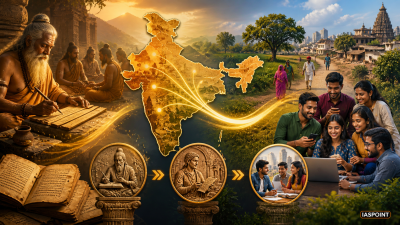
The Indo-Aryan group is a primary branch of the Indo-Iranian subfamily of the Indo-European language family. In the context of Indian heritage, it represents the largest linguistic group, spoken by approximately 74% of the population. Its evolution is traditionally divided into three distinct historical stages, mapping the transition from sacred texts to modern vernaculars.
Old Indo-Aryan Period (1500 BCE – 600 BCE)
This era is characterized by the dominance of Sanskrit, the foundational language of Indian liturgy, philosophy, and science.
- Vedic Sanskrit: The oldest form, preserved in the four Vedas, Brahmanas, and Upanishads. It is linguistically more complex than later forms.
- Classical Sanskrit: Refined from the Vedic dialect, its grammar was standardized by Panini in his seminal work Ashtadhyayi (4th Century BCE).
- Cultural Significance: Sanskrit served as a lingua franca for the elite and intellectuals across the subcontinent, facilitating the spread of Indian thought to Southeast and Central Asia.
Middle Indo-Aryan Period (600 BCE – 1000 CE)
As Sanskrit became restricted to priestly and scholarly circles, the masses developed “Prakrits” (natural or common languages).
- Pali: The earliest transition from Sanskrit, gained prominence as the language of the Buddhist Canon (Tripitakas). It was the medium through which Ashoka’s Dhamma was initially propagated.
- Prakrit: A group of regional dialects used in Jain Agamas and secular literature. Key variants include:
- Magadhi Prakrit: Spoken in Bihar; used extensively in Mauryan administration.
- Shauraseni: Centered around Mathura; used in various Sanskrit dramas for the speech of women and commoners.
- Maharashtri: The ancestor of modern Marathi; used for lyrical poetry like the Gaha Sattasai.
- Apabhramsha: Appearing toward the end of this period (6th–10th Century CE), it represents the final “corrupted” or “deviated” stage of Middle Indo-Aryan, serving as the immediate precursor to modern regional languages.
Modern Indo-Aryan Period (1000 CE – Present)
This stage saw the crystallization of distinct regional identities and the birth of modern vernaculars from various Apabhramsha dialects.
- Western Branch: Evolution of Sindhi, Punjabi, Gujarati, and Rajasthani.
- Central Branch: Development of Hindi and Urdu (collectively Hindustani).
- Eastern Branch: Rise of Assamese, Bengali, Odia, and Maithili.
- Southern/Insular Branch: Development of Marathi and Konkani, and the unique evolution of Sinhala and Dhivehi.
Classification and Geographic Distribution
| Sub-Group | Major Languages | Primary Geographic Regions |
| North-Western | Punjabi, Sindhi, Lahnda | Punjab, Sindh, Jammu & Kashmir |
| Southern | Marathi, Konkani | Maharashtra, Goa, Northern Karnataka |
| Eastern | Bengali, Assamese, Odia, Maithili | West Bengal, Assam, Odisha, Bihar |
| Central | Hindi, Urdu, Awadhi, Braj Bhasha | Uttar Pradesh, Madhya Pradesh, Delhi, Haryana |
| Pahari | Nepali, Dogri, Garhwali, Kumaoni | Himalayan belt (Uttarakhand, Himachal, Nepal) |
Structural and Phonological Features
The Indo-Aryan languages share specific linguistic markers that distinguish them from the Dravidian or Tibeto-Burman families.
- Script Heritage: Almost all Indo-Aryan languages utilize scripts derived from Brahmi, with Devanagari being the most prominent (used for Hindi, Sanskrit, Marathi, and Nepali).
- Phonology: They possess a rich set of retroflex consonants (e.g., [ṭ], [ḍ]), a feature believed to be a result of early contact with Dravidian speakers.
- Vocabulary: They maintain a high degree of Tatsama (direct Sanskrit loans) and Tadbhav (evolved Sanskrit words) vocabulary.
Official and Classical Status
The recognition of these languages under the Indian Constitution ensures their preservation and promotion within the national framework.
- Eighth Schedule Inclusion: Languages such as Hindi, Bengali, Marathi, Gujarati, Punjabi, Sanskrit, Sindhi, Odia, Assamese, Konkani, Kashmiri, Nepali, Dogri, and Maithili are constitutionally recognized.
- Classical Languages: Within this family, Sanskrit was the first to be declared a Classical Language (2005). In 2024, the status was extended to Marathi, Pali, Prakrit, Assamese, and Bengali, recognizing their ancient roots and independent literary traditions.
Fact-File for UPSC Prelims
- First Grammar: Panini’s Ashtadhyayi is the world’s first systematic treatise on linguistics.
- The Sindhi Addition: Sindhi was the first language added to the Eighth Schedule via the 21st Amendment Act, 1967.
- Script Variance: While most use Devanagari or derivative scripts, Urdu and Sindhi utilize versions of the Perso-Arabic script.
- Dardic Languages: A sub-branch of Indo-Aryan (including Kashmiri) found in the North-West, often noted for retaining archaic features.
- Official Language: Under Article 343, Hindi in Devanagari script is the official language of the Union, though it is not the “National Language” as often misidentified.