
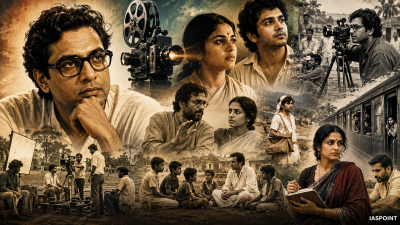
The New Wave Cinema, often synonymous with the Indian New Wave or Art Cinema, represented a formal break from the escapist “Masala” traditions of Bombay. While Parallel Cinema began in the 1950s with Satyajit Ray, the 1970s and 80s saw this movement mature into a nationwide phenomenon, characterized by state-sponsored funding, experimental narratives, and a commitment to socio-political critique.
The Genesis and the Role of State Institutions
The late 1960s and early 1970s witnessed the institutionalization of serious cinema. The government shifted its view of cinema from a source of revenue to a medium of cultural and educational importance.
- Bhuvan Shome (1969): Directed by Mrinal Sen, this film is regarded as the official manifesto of the New Wave. It was funded by the Film Finance Corporation (FFC) and broke all conventions of the hero-heroine dynamic.
- Film Finance Corporation (FFC) / NFDC: By providing low-interest loans for “offbeat” scripts, the FFC (renamed National Film Development Corporation in 1975) enabled filmmakers to bypass commercial distributors.
- The FTII Revolution: The Film and Television Institute of India (Pune) became the epicenter of this wave, producing technically trained directors like Mani Kaul and Kumar Shahani, and powerhouse actors like Naseeruddin Shah, Om Puri, and Shabana Azmi.
Core Characteristics of the 70s-80s New Wave
Unlike the Golden Age which focused on melodrama, the New Wave was marked by:
- Socio-Political Commitment: Direct engagement with rural feudalism, industrial unrest, and the disillusionment of the urban middle class.
- Minimalism: Rejection of playback songs, heavy makeup, and artificial studio sets in favor of location shooting and ambient sound.
- Non-Linear Narratives: Using avant-garde techniques like jump cuts, long takes, and breaking the “fourth wall” to alienate or provoke the audience.
The Rise of “Middle Cinema”
During this period, a bridge was built between pure Art Cinema and Commercial Cinema, often referred to as “Middle Cinema.” Directors like Shyam Benegal and Hrishikesh Mukherjee utilized relatable storylines and realistic settings while maintaining high artistic integrity.
| Director | Notable Works (70s-80s) | Thematic Focus |
| Shyam Benegal | Ankur (1974), Nishant (1975), Manthan (1976) | Feudalism, caste oppression, and rural cooperatives. |
| Mani Kaul | Uski Roti (1969), Ashadh Ka Ek Din (1971) | Visual aesthetics, formal experimentation, and slow cinema. |
| Govind Nihalani | Aakrosh (1980), Ardh Satya (1983) | Police brutality, legal corruption, and existential angst. |
| Sai Paranjpye | Sparsh (1980), Chashme Buddoor (1981) | Human relationships and light-hearted social realism. |
| M.S. Sathyu | Garm Hava (1973) | The socio-economic impact of the Partition on Indian Muslims. |
Regional Manifestations of the New Wave
The New Wave was not restricted to Hindi cinema; it flourished in regional pockets, often with even greater radicalism.
The Kerala New Wave (Malayalam)
Adoor Gopalakrishnan and G. Aravindan led a movement that won numerous National Awards. Adoor’s Swayamvaram (1972) is a landmark that explored the fragility of romantic dreams against harsh economic realities.
The Kannada New Wave
Known as the Navya movement, it was led by Girish Karnad, B.V. Karanth, and P. Lankesh. Samskara (1970) remains a foundational text for its critique of Brahminical orthodoxy.
The Bengali Intellectualism
Mrinal Sen continued his political “Calcutta Trilogy” (Interviews, Calcutta 71, Padatik), while Satyajit Ray explored the urban crisis in films like Pratidwandi (1970).
Key Facts and Technical Trivia for UPSC
- First Crowdfunded Film: Manthan (1976) was financed by 500,000 farmers of the Gujarat Co-operative Milk Marketing Federation (Amul), who contributed ₹2 each.
- First National Award for Best Feature Film (70s): Samskara (1970) was the first Kannada film to win the President’s Gold Medal.
- Parallel Cinema Infrastructure: The 1970s saw the creation of the Directorate of Film Festivals (1973) to oversee the National Film Awards and IFFI.
- The Concept of “Angry Young Man”: While New Wave explored social angst through realism, the commercial counterpart (Amitabh Bachchan in Zanjeer, 1973) addressed the same societal frustration through the “Masala” lens.
- Academy Recognition: Salaam Bombay! (1988), directed by Mira Nair, emerged at the tail end of this wave and became the second Indian film to be nominated for the Academy Award for Best Foreign Language Film.
Impact on Indian Art and Heritage
The New Wave redefined the “Indian Identity” on the global stage. It moved away from the “Exotic East” stereotype, presenting India as a complex, modern nation grappling with internal contradictions. This era ensured that cinema was preserved as a cultural document, reflecting the socio-economic changes of the Indira Gandhi era and the subsequent post-Emergency period.
Last Modified: May 7, 2026