

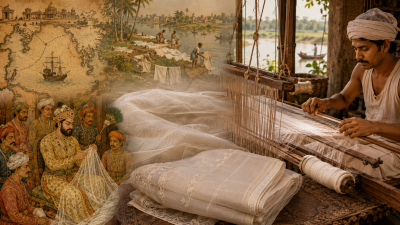
Muslin, a fine and lightweight cotton fabric of plain weave, represents the zenith of Indian textile craftsmanship. Historically known as Malmal, its origins are deeply rooted in the Bengal region (modern-day West Bengal and Bangladesh). Ancient Greek and Roman records frequently mention Gangitiki, a thin fabric from the Ganges delta, as a luxury item traded for gold. During the Mughal era, Muslin received royal patronage, leading to the creation of ultra-fine varieties like Ab-e-Rawan (running water) and Shabnam (evening dew), which were said to be so delicate they became invisible when wet.
The Raw Material: Photi Cotton
The legendary quality of Muslin was attributed to a unique variety of cotton, Gossypium arboreum var. neglecta, locally known as Photi.
- Geographic Specificity: This cotton grew exclusively along the banks of the Meghna River. The high humidity and unique soil composition allowed the fibers to retain a specific degree of elasticity and fineness.
- Spinning Complexity: Unlike modern industrial cotton, Photi was too delicate for machines. It required manual spinning by artisans, usually young women whose sense of touch was sensitive enough to handle the microscopic filaments.
- Thread Count: Traditional Dacca Muslin could reach thread counts of over 1000, whereas modern commercial cotton rarely exceeds 150 to 200.
Major Varieties and Categorization
Muslins were historically classified based on their fineness, weight, and the complexity of the weave.
| Variety Name | Literal Meaning | Characteristic Feature |
| Ab-e-Rawan | Running Water | So transparent it resembled flowing water; favored by Mughal royalty. |
| Shabnam | Evening Dew | Designed to be spread on grass; it became invisible under morning dew. |
| Baft-Hawa | Woven Air | Extremely lightweight; it was said a full sari could pass through a finger ring. |
| Khas | Special | A high-quality muslin reserved specifically for the Emperor’s use. |
| Jhuna | Net-like | A coarser, gauze-like muslin used primarily by dancers and for summer wear. |
The Jamdani Technique: Figured Muslin
Jamdani is the most sophisticated form of Muslin weaving, characterized by the “discontinuous supplementary weft” technique.
- The Weaving Process: Artisans use a small bamboo or bone needle (Kandul) to manually interweave decorative motifs into the fabric as it is being woven on the loom.
- Visual Effect: The motifs appear to float on the translucent surface of the muslin.
- UNESCO Recognition: The traditional art of Jamdani weaving was inscribed on the UNESCO Representative List of the Intangible Cultural Heritage of Humanity in 2013.
Key Production Centers and Clusters
While Bengal remains the spiritual home of Muslin, several regional clusters developed unique variations.
- Dhaka (Bangladesh): The historical epicenter of the finest Dacca Muslin.
- West Bengal (India): Clusters in Kalna, Shantipur, and Phulia continue the legacy of fine cotton weaving and Jamdani.
- Chanderi (Madhya Pradesh): Known for “Chanderi Muslin,” which often blends silk with fine cotton to create a glossy, sheer fabric.
- Kota (Rajasthan): Produces Kota Masuria, a square-checkered muslin created using a mix of silk and cotton threads.
- Uppada (Andhra Pradesh): Famous for Uppada Jamdani, which utilizes the Jamdani technique on fine local cotton.
Technical Terminology in Muslin Craft
- Tana (Warp): The longitudinal threads held in tension on the loom.
- Bana (Weft): The transverse threads woven through the warp.
- Sizing: Applying a starch paste (often made from rice) to the delicate threads to prevent breakage during weaving.
- Reed: A comb-like tool used to separate and space the warp threads; in Muslin, reeds were often made of extremely fine bamboo splints.
Fact Sheet for UPSC Prelims
- The British Impact: The British East India Company’s industrial policies and the import of mill-made yarn from Lancashire led to the systemic decline of the Muslin industry in the 19th century.
- The “Ring Test”: A traditional benchmark for Muslin quality where a 6-yard sari could be pulled through a small lady’s ring.
- Revival Initiatives: The “Muslin Revival Project” in West Bengal and Bangladesh seeks to re-cultivate the Photi cotton plant and train new weavers in ancient spinning techniques.
- GI Tags: Handloom weavers in West Bengal have secured Geographical Indication (GI) tags for various cotton and muslin-based weaves like Shantipur and Dhaniakhali.
- Puni: The small roll of cotton from which the thread is spun; in Muslin making, this required specific humidity levels to ensure the thread didn’t snap.
Cultural and Global Significance
Muslin was more than a fabric; it was a global currency of prestige. It was exported to the Roman Empire for the togas of senators and later to the French court, where Queen Marie Antoinette popularized “Muslin gowns,” sparking a European fashion revolution. In Indian culture, it remains a symbol of purity and is frequently used in religious ceremonies and as offerings to deities in temples across Bengal and Odisha.
Last Modified: May 6, 2026