
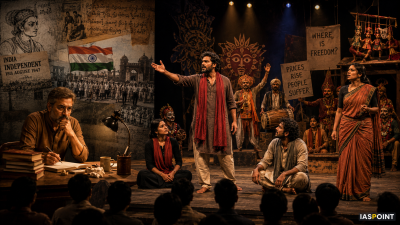
Modern Indian playwriting represents a shift from classical Sanskrit dictates and Parsi commercialism toward a “theatre of engagement.” It emerged as a synthesis of Western realistic structures and the “Theatre of Roots” movement, which sought to rediscover indigenous folk identities. The post-independence era, in particular, saw playwrights using history and myth as allegories to critique contemporary socio-political disillusionment.
The Big Four: Pillars of Modern Indian Drama
The following four playwrights are considered the architects of the modern Indian dramatic canon, each representing a distinct linguistic and stylistic tradition.
Girish Karnad (Kannada)
A Rhodes Scholar and Jnanpith Awardee, Karnad is celebrated for using ancient myths and historical figures to explore modern existential crises and psychological complexities.
- Key Works: Yayati (his debut), Tughlaq, Hayavadana, and Nagamandala.
- Contribution: He popularized the use of Yakshagana motifs and the “mask” technique to explore the theme of human incompleteness. Tughlaq is famously regarded as an allegory for the Nehruvian era’s idealism and eventual decline.
Vijay Tendulkar (Marathi)
The pioneer of “New Drama” in Maharashtra, Tendulkar’s work is characterized by raw social realism, exploration of violence, and the hypocrisy of middle-class morality.
- Key Works: Ghashiram Kotwal, Shantata! Court Chalu Aahe (Silence! The Court is in Session), and Sakharam Binder.
- Contribution: Ghashiram Kotwal is a landmark for its use of the Dashavatar folk form and traditional musical structures to critique political corruption.
Badal Sircar (Bengali)
Sircar moved away from traditional proscenium theatre to establish the “Third Theatre”—a minimalist, flexible, and rural-centric form that rejected expensive sets for direct audience interaction.
- Key Works: Ebong Indrajit (And Indrajit), Basi Khabar, and Sagina Mahato.
- Contribution: Ebong Indrajit is considered a definitive play of the “absurdist” tradition in India, capturing the existential boredom and angst of the urban youth.
Mohan Rakesh (Hindi)
Rakesh was a leading figure of the Nai Kahani movement and is credited with bringing a sophisticated, introspective realism to Hindi drama.
- Key Works: Ashadh Ka Ek Din, Adhe Adheere, and Lehron Ke Rajhans.
- Contribution: Ashadh Ka Ek Din (1958) is often cited as the first modern Hindi play, centered on the life of the classical poet Kalidasa and the conflict between creative freedom and state patronage.
Comparative Table of Influential Playwrights
| Playwright | Primary Language | Signature Style | Notable Play |
| Habib Tanvir | Chhattisgarhi/Urdu | Folk-Proletarian (Naya Theatre) | Charandas Chor |
| Dharmvir Bharati | Hindi | Verse Drama/Epic Allegory | Andha Yug |
| K.N. Panikkar | Malayalam | Classical-Folk Synthesis | Madhyamavyayoga |
| Utpal Dutt | Bengali | Revolutionary/Political Satire | Kallol |
| Bhasa (Modern Revival) | Sanskrit | Classical reconstruction | Urubhanga (directed by Panikkar) |
| Mahesh Dattani | English | Contemporary Social Issues | Final Solutions |
Significant Modern Dramatic Movements
The Verse Drama Revival
Playwrights like Dharmvir Bharati revived the tradition of writing plays in verse. His masterpiece, Andha Yug, set in the immediate aftermath of the Mahabharata war, serves as a powerful commentary on the ethics of war and the trauma of the Partition of India.
The Dalit and Protest Theatre
Emerging largely from Maharashtra and South India, this movement uses playwriting as a tool for social emancipation. Playwrights like G.P. Deshpande and Datta Bhagat used the stage to challenge Brahminical hegemony and discuss the “Ambedkarite” consciousness.
Indian English Drama
Long considered a niche, Indian English playwriting gained international stature through Mahesh Dattani. He was the first playwright in English to win the Sahitya Akademi Award, focusing on previously “taboo” subjects such as gender identity, communalism, and child abuse.
Technical Innovations in Modern Scripts
- Non-Linear Narratives: Departure from the chronological storytelling of the Parsi and Sanskrit traditions.
- Breaking the Fourth Wall: Directly addressing the audience, a technique borrowed from both Western “Epic Theatre” (Brecht) and Indian folk traditions like Nautanki.
- Physicality over Dialogue: Playwrights like K.N. Panikkar and Ratan Thiyam (Manipur) emphasized the actor’s body, breath, and ritualistic movement, reducing the reliance on heavy linguistic delivery.
Fact File for UPSC Prelims
- Andha Yug’s Significance: It was famously staged by Ebrahim Alkazi at the Feroz Shah Kotla ruins, marking a watershed moment in Indian scenography.
- The Sangeet Natak Akademi: Most modern playwrights mentioned above are recipients of the Akademi’s highest honors, which are essential for tracking the evolution of state-recognized art.
- The “Theatre of Roots”: A term coined by critics to describe the 1960s-70s trend where directors like B.V. Karanth and Kavalam Narayana Panikkar directed scripts that utilized indigenous aesthetics.
- Jnanpith Winners: Girish Karnad remains one of the few playwrights to receive the Jnanpith Award (1998), India’s highest literary honor, primarily for his contributions to Kannada literature and drama.
- The “Absurdist” Influence: Badal Sircar’s Ebong Indrajit is often compared to Samuel Beckett’s Waiting for Godot for its treatment of time and purpose.