
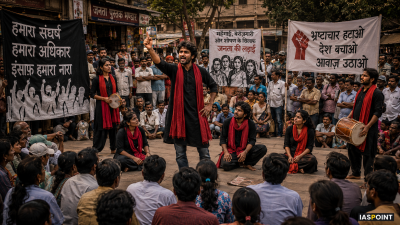
Street Theatre, often referred to as Nukkad Natak, is a form of theatrical performance characterized by the absence of a formal stage, ticket sales, or elaborate lighting. It emerged as a powerful tool for social and political awakening during the Indian independence movement and gained significant momentum in the post-independence era. Unlike proscenium theatre, it aims to “take the play to the people” by performing in public spaces such as marketplaces, street corners, and factory gates.
Historical Roots and the IPTA Legacy
The origins of organized street theatre for activism are rooted in the Indian People’s Theatre Association (IPTA), established in 1943.
- Anti-Fascist and Anti-Imperialist Focus: IPTA was formed to mobilize public opinion against British colonial rule and the threat of fascism.
- The Bengal Famine (1943): Plays like Nabanna (New Harvest) by Bijon Bhattacharya revolutionized the medium by depicting the grim reality of the famine, moving theatre away from mythological escapism to grassroots realism.
- Decentralization: IPTA workers traveled to villages and industrial belts, using local dialects and folk tunes to ensure the message reached the subaltern classes.
Safdar Hashmi and Janam: The Modern Turning Point
The most defining movement in Indian Street Theatre history is associated with Safdar Hashmi and the Jana Natya Manch (JANAM), founded in 1973.
- Political Activism: JANAM focused on the rights of industrial workers, peasants, and women. Their landmark play, Machine, critiqued the dehumanization of labor in a capitalist setup.
- The Martyrdom of Safdar Hashmi: In 1989, while performing the play Halla Bol in Sahibabad, Hashmi was fatally attacked by political goons. This incident turned street theatre into a symbol of democratic resistance and led to the observance of April 12th (Hashmi’s birthday) as National Street Theatre Day.
- Democratic Space: JANAM’s philosophy emphasized that the “circle” formed by the audience is a democratic space where everyone is equal, regardless of caste or class.
Key Characteristics of Street Theatre for Activism
Street theatre relies on specific aesthetic and logistical elements to remain effective as a tool for protest.
- Minimalism: Lack of sets and costumes necessitates a high degree of physical acting, vocal projection, and the use of the body to create imagery.
- The “Circle” Formation: Performers usually act in a circle (360° audience), which demands constant movement and multiple frontages.
- Improvisation: Scripts are often fluid to incorporate local news, names of local oppressors, or immediate grievances.
- Call to Action: Every performance typically ends with a direct address to the audience, urging them to organize or protest.
Major Street Theatre Groups and Their Contributions
| Group / Movement | Key Figure | Primary Region | Core Themes |
| Jana Natya Manch (JANAM) | Safdar Hashmi | Delhi | Labor rights, secularism, and democracy. |
| Budhan Theatre | Ganesh Devy / Chhara Community | Ahmedabad | Rights of Denotified Tribes (DNTs) and police brutality. |
| Theatre of the Oppressed | Augusto Boal (Global influence) | Pan-India | Spect-actor participation to solve social conflicts. |
| Praja Natya Mandali | Various | Andhra Pradesh/Telangana | Agrarian reforms and anti-feudal struggles. |
| Samudaya | Prasanna | Karnataka | Dalit rights and literacy campaigns. |
Street Theatre as a Tool for Social Reform
Beyond political protest, street theatre has been utilized by the state and NGOs for developmental communication.
- Health Awareness: Plays on HIV/AIDS, immunization, and maternal health are frequently organized in rural pockets.
- Environmental Activism: During the Chipko Movement and the Narmada Bachao Andolan, street plays were used to explain the ecological impact of large-scale industrialization.
- Gender Justice: Groups like Asmita Theatre Group (Delhi) have used street plays like Dastak to address domestic violence, dowry, and street harassment.
- Consumer Rights: Educational plays funded by the Ministry of Consumer Affairs under the “Jago Grahak Jago” campaign.
Contemporary Relevance and Challenges
In the 21st century, street theatre has adapted to new forms of activism.
- Flash Mobs and Performance Art: Modern activism often blends traditional Nukkad Natak with flash mobs to capture social media attention.
- Legislative Theatre: Based on Boal’s techniques, this involves using theatre to suggest changes in local laws or community guidelines.
- Digital Integration: Performances are now live-streamed, extending the “street” to a global digital audience.
- Challenges: Rising intolerance, the need for police permissions in urban centers, and the “NGO-ization” of the medium (which some argue dilutes its revolutionary edge) are current hurdles.
UPSC Prelims Fact File: Trivia and Quick Facts
- First Street Play of India: While many existed, Charge Sheet (1944) by IPTA is often cited as a definitive early example of an organized protest play in a non-theatre space.
- April 12: Celebrated as National Street Theatre Day in memory of Safdar Hashmi.
- Augusto Boal’s Influence: The “Forum Theatre” technique, where the audience can stop the play and suggest a different action for the protagonist, is a staple of Indian activist theatre.
- The Role of the Dholak: The rhythmic beat of the Dholak or Duff is the traditional “siren” used to gather a crowd before a street performance begins.
- Budhan Theatre: Named after Budhan Sabar, a member of a denotified tribe who died in police custody; this group uses theatre to fight the stigma of the “Criminal Tribes Act.”