
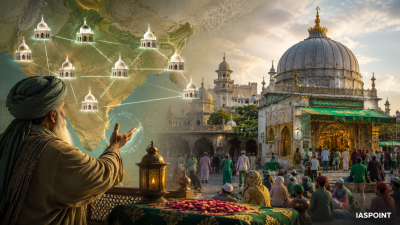
Sufism, or Tasawwuf, introduced a unique dimension to India’s sacred geography by establishing a network of spiritual territories known as Wilayat. Unlike the static boundaries of kingdoms, the Sufi landscape was defined by the spiritual jurisdiction of a Pir (Saint). This led to the creation of Dargahs (shrines) and Khanqahs (hospices) that acted as nodes of cultural synthesis, bridging the gap between orthodox Islam and local Indic traditions.
The Khanqah and Dargah: Architectural and Social Hubs
The physical manifestation of Sufism in the Indian landscape evolved from humble living quarters to grand funerary complexes.
- Khanqah: A building designed specifically for gatherings of a Sufi brotherhood. It served as a community center, a hospice for travelers, and a place for spiritual instruction.
- Dargah: Built over the grave (Mazar) of a deceased Sufi saint. In the cultural landscape, the Dargah is viewed as a “court” where the saint, though physically dead, is spiritually alive (Zinda Pir) and acts as an intermediary between the devotee and God.
- Ziarat: The practice of pilgrimage to these shrines, which became a localized alternative to the Hajj for many rural and impoverished devotees.
Spatial Distribution of Major Sufi Silsilas (Orders)
The sacred geography of Sufism is organized around various Silsilas, each dominating specific geographical corridors of the Indian subcontinent.
| Silsila (Order) | Key Regions | Major Dargah / Center | Founder/Key Figure in India |
| Chishti | Delhi, Ajmer, Punjab, Deccan | Dargah Sharif (Ajmer), Nizamuddin Auliya (Delhi) | Moinuddin Chishti |
| Suhrawardi | Punjab, Sindh, Bengal | Multan, Uch | Baha-ud-din Zakariya |
| Naqshbandi | Delhi, Sirhind | Roza Sharif (Sirhind) | Khwaja Baqi Billah / Ahmad Sirhindi |
| Qadri | Punjab, Deccan, Sindh | Uch, Bidar | Shah Ni’matullah |
| Rishi Order | Kashmir Valley | Charar-e-Sharief | Sheikh Nooruddin Wali (Nund Rishi) |
Architectural Features of Indian Dargahs
Dargahs represent a profound blend of Indo-Islamic architecture, incorporating local materials and motifs into Islamic structural forms.
- The Dome and Minarets: Symbolizing the celestial vault and the call to the divine.
- Jali Work: Intricate stone lattice screens, most famously seen at the Dargah of Salim Chishti (Fatehpur Sikri), used for tying “Mannat” threads.
- Courtyards and Buland Darwaza: Large open spaces to accommodate pilgrims and grand gateways signifying the entrance to a spiritual realm.
- Local Influences: The use of lotus motifs, kalash-like finials on domes, and local stone (like the red sandstone of Delhi or the white marble of Rajasthan).
The Dargah as a Cultural Landscape
Sufi shrines transformed the “profane” landscape into “sacred” space through rituals that integrated diverse communities.
- Urs (Death Anniversary): Literally meaning “wedding” (union with the Divine), it is the most significant event in the Sufi calendar, attracting millions across religions.
- Sama and Qawwali: The use of music as a vehicle for spiritual ecstasy (Wajd). The Qawwali tradition, pioneered by Amir Khusrau, synthesized Persian lyrics with Hindavi scales and rhythms.
- Langar: The practice of providing free communal meals, emphasizing social equality and the rejection of caste hierarchies.
The “Wilayat” and Urban Development
Sufi saints often settled in the periphery of political capitals, creating a dual power structure.
- Delhi (Hazrat-e-Dehli): Delhi is often called “Bais Khwaja ki Chaukhat” (the threshold of 22 saints). Shrines like those of Qutbuddin Bakhtiyar Kaki and Nizamuddin Auliya provided spiritual legitimacy to the Sultans.
- The Deccan Gateway: The migration of Sufis to Gulbarga (Gesu Daraz) and Bijapur created a distinct “Dakhni” Sufi culture, which influenced the local Marathi and Kannada languages.
Fact File for UPSC Prelims
- Moinuddin Chishti: Known as Gharib Nawaz (Benefactor of the Poor); his Dargah in Ajmer is the most visited Sufi shrine in South Asia.
- Nizamuddin Auliya: His shrine in Delhi became the focal point of the “Chishti-Nizami” branch; he famously served seven successive Sultans without visiting their courts.
- Salim Chishti: His white marble Dargah within the red sandstone complex of Fatehpur Sikri was built by Akbar in gratitude for the birth of his son, Jahangir.
- Charar-e-Sharief: A 600-year-old shrine in Kashmir dedicated to the patron saint of Kashmir, Nund Rishi, representing the “Rishi” tradition which combined Sufism with Shaivite Bhakti.
- Baba Budan Giri: A mountain in Karnataka where a Sufi saint is credited with introducing coffee to India; it remains a site of syncretic worship for both Hindus and Muslims.
Trivia: The Spiritual Boundary
In the sacred geography of Sufism, it was believed that as long as a great saint was “patrolling” a city’s spiritual borders (Wilayat), the city would remain safe from invasions. For instance, the safety of Delhi was historically attributed to the spiritual presence of the Chishti saints. This belief system turned the physical landscape into a protected “Sanctuary of the Divine.”
Last Modified: May 7, 2026