
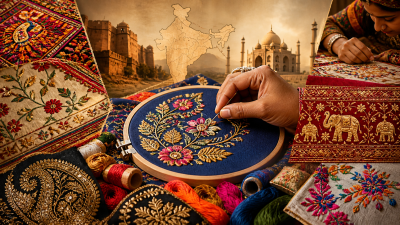
Indian embroidery is a sophisticated craft of surface ornamentation that has evolved over millennia, influenced by trade, religion, and royal patronage. Under the Indian Handicrafts unit of Art and Culture, embroidery is classified by the type of stitch, thread material, and the regional context of its origin. It serves as a vital record of India’s socio-cultural history, ranging from the nomadic stitches of the Northwest to the courtly refinements of the Deccan and the Indo-Gangetic plains.
Major Regional Embroidery Styles
The diversity of Indian embroidery is mapped across distinct geographical clusters, each utilizing unique motifs and thread types.
- Chikankari (Uttar Pradesh): Originating in Lucknow, this is a delicate shadow-work embroidery traditionally done on white muslin with white cotton thread. It involves 36 types of stitches, including Bakhiya (shadow work), Phanda (millet-shaped stitches), and Jali (thread-tension lattice).
- Phulkari (Punjab): Meaning “flower work,” this craft involves the use of the damask stitch on the wrong side of coarse cotton cloth (Khaddar). Traditionally, the Bagh (garden) style covers the entire fabric with floral patterns so that the base cloth is invisible.
- Kantha (West Bengal & Odisha): A sustainable craft where old sarees and dhotis are layered and joined using a simple running stitch. The motifs often depict rural life, folk stories, and religious symbols.
- Zardozi (Pan-India): An elaborate metal embroidery that reached its zenith under the Mughals. It uses Zari (metallic threads), pearls, and precious stones. Historically, it was categorized into Zardouzi (heavy work) and Kamdani (lighter work).
- Kasuti (Karnataka): A traditional form involving four specific stitches—Gavanti, Murgi, Negi, and Menthi. It is unique because the patterns are created by counting the threads of the fabric, ensuring the design looks identical on both sides.
Tribal and Nomadic Embroidery
Tribal embroideries are characterized by bold colors, geometric patterns, and the inclusion of mirrors or shells to ward off “evil eyes.”
- Lambani/Banjara Embroidery (Karnataka/Andhra Pradesh): Practiced by the nomadic Lambani community, it features a vibrant mix of appliqué, mirror work (Abhla), and cross-stitches on hand-loomed cloth.
- Toda Embroidery (Tamil Nadu): Locally known as Pukhoor, this is done by the Toda tribe of the Nilgiris. It uses red and black woolly threads on a white background, creating a weave-like appearance that represents the local flora and fauna.
- Kutch Embroidery (Gujarat): A collective term for styles like Ahir, Mutwa, and Soof. Soof is particularly notable as it is done from the back of the fabric without any pre-drawn sketches, relying on mental geometry.
Comparative Analysis of Prominent Styles
| Style | State of Origin | Key Material | Primary Motifs |
| Kashida | Jammu & Kashmir | Wool and Silk | Chinar leaves, grapes, butterflies |
| Chamba Rumal | Himachal Pradesh | Silk thread on Unbleached Muslin | Scenes from Mahabharata and Ramayana |
| Pipli Work | Odisha | Fabric patches (Appliqué) | Peacocks, elephants, and lanterns |
| Sujini | Bihar | Layered cloth | Social messages and contemporary themes |
| Shamilami | Manipur | Silk and Cotton | Combined weaving and embroidery |
| Gara | Gujarat (Parsi) | Silk | Chinese-inspired flora and fauna |
Intellectual Property: Geographical Indication (GI) Tags
The protection of traditional embroidery through GI tags is crucial for the economic survival of artisan clusters.
- Lucknow Chikankari: Protected for its unique 36-stitch technique.
- Kashmir Sozani Craft: A fine needlework style often found on Pashmina shawls.
- Sandur Lambani Embroidery: Recognized for its distinctive use of coins, shells, and mirrors.
- Nakshi Kantha: The artistic version of the Kantha stitch from West Bengal.
- Kutch Embroidery: Covers the various sub-styles practiced in the Rann of Kutch.
Key Embroidery Stitches and Techniques
Understanding the technical terminology is essential for the UPSC Prelims, as questions often focus on the “how” and “what” of the craft.
- Aari Work: Performed using a hooked needle (resembling a crochet needle) to create concentric loops. It is faster than needle embroidery and is often used for bridal wear.
- Mirror Work (Sheesha): The process of attaching small pieces of mirrors using a casing of buttonhole stitches. It is most prevalent in the arid regions of Rajasthan and Gujarat.
- Appliqué: A technique where smaller pieces of fabric are sewn onto a larger base fabric to create a design. The Katwa work of Bihar and Pipli of Odisha are prime examples.
- Bead Work: Known as Moti Bharat in Gujarat, where opaque or transparent beads are stitched onto fabric to create 3D patterns.
Cultural Trivia and Historical Facts
- The Mughal Influence: It was during the reign of Akbar that Karkhanas (royal workshops) were established specifically for embroidery, integrating Persian aesthetics with Indian craftsmanship.
- Chamba Rumal as Diplomacy: These embroidered handkerchiefs were historically used as gifts during weddings and diplomatic visits, often called “needle-painted” stories.
- Parsi Gara: This style represents a unique fusion of Persian, Indian, and Chinese cultures, resulting from the Parsi community’s trade links with China in the 19th century.
- Social Medium: Sujini embroidery in Bihar has transitioned from a domestic craft to a medium of social activism, with quilts depicting themes of domestic violence, female education, and environmental protection.
Institutional Support for Embroidery
The Government of India supports the embroidery sector through several schemes:
- USTTAD Scheme: Aims at upgrading the skills and training in traditional arts/crafts for development.
- Shilp Guru Awards: The highest honor bestowed upon master craftsmen for their contribution to the preservation of Indian heritage.
- Handicrafts Mega Cluster Mission: Focuses on infrastructure and production bottlenecks in major hubs like Lucknow and Kutch.