
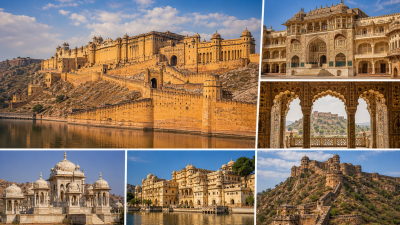
Rajput architecture is a prominent school of Indian architecture characterized by its defensive nature, grandeur, and integration with the rugged landscape of North and Western India. Primarily concentrated in Rajasthan and parts of Central India, this style represents a fusion of indigenous Hindu traditions with later Islamic influences. It is renowned for its formidable hill forts, ornate palaces (Mahals), and commemorative cenotaphs (Chhatris).
Core Architectural Features and Elements
Rajput structures were designed for both aesthetic appeal and strategic military defense. The following elements define the style:
- Hanging Balconies (Jharokhas): Enclosed or semi-enclosed overhanging balconies supported by brackets, used for ventilation and as viewing platforms.
- Stepwells (Baoris): Unique subterranean structures for water storage, often featuring intricate carvings and multi-story designs.
- Chhatris: Elevated, dome-shaped pavilions used as cenotaphs or decorative elements on roofs.
- Ornate Brackets: Heavily carved stone brackets used to support balconies and cornices.
- Corbelled Arches: Unlike the true arches of the Mughals, early Rajput architecture utilized the corbelling technique where stones are laid horizontally to bridge gaps.
- Strategic Fortification: Use of concentric walls, “Pol” (massive gateways), and spiked doors to repel elephant charges.
The Rajput Forts: Defensive Marvels
The Rajput forts were often “Giri Durgs” (Hill Forts), built on natural elevations for tactical advantages. Six of these are collectively recognized as UNESCO World Heritage Sites.
- Chittorgarh Fort: Known as the “Water Fort” due to its 84 water bodies; it features the Vijay Stambha (Tower of Victory) built by Rana Kumbha.
- Kumbhalgarh Fort: Features a 36-kilometer-long wall, the second longest in the world after the Great Wall of China.
- Mehrangarh Fort (Jodhpur): Noted for its massive burnished red sandstone walls and the Moti Mahal and Phool Mahal within.
- Amer Fort (Jaipur): A blend of Rajput and Mughal styles, famous for its Sheesh Mahal (Mirror Palace) and Maota Lake setting.
- Jaisalmer Fort: Known as the “Sonar Quila” (Golden Fort) because it is built with yellow sandstone that glows in the sunlight.
- Ranthambore Fort: Strategically located at the junction of the Vindhyas and the Aravallis.
Palaces and Secular Architecture
Rajput palaces were built as retreats and administrative centers, emphasizing luxury and cooling mechanisms.
- City Palace, Udaipur: Situated on the banks of Lake Pichola, it is a complex of several palaces built over 400 years.
- Hawa Mahal (Jaipur): Built by Maharaja Sawai Pratap Singh, it features 953 small windows (Jharokhas) designed to allow royal women to observe street festivities without being seen.
- Umaid Bhawan Palace: One of the world’s largest private residences, built using “Chitar” sandstone in the Beaux-Arts style.
- Jantar Mantar (Jaipur): An astronomical observatory built by Maharaja Sawai Jai Singh II, featuring the world’s largest stone sundial.
Comparison: Rajput vs. Mughal Architecture
| Feature | Rajput Architecture | Mughal Architecture |
| Philosophy | Defensive, rugged, and landscape-integrated. | Symmetry, balance, and formal grandeur. |
| Main Material | Local stones (Red/Yellow sandstone, Quartzite). | Red sandstone and White marble. |
| Domes | Fluted or ribbed domes, often smaller. | Smooth bulbous or onion-shaped domes. |
| Arches | Corbelled or pointed arches with brackets. | True arches, often foliated or cusped. |
| Water Use | Functional stepwells and natural lakes. | Ornamental fountains and Charbagh canals. |
| Religious Influence | Temples and Chhatris are central. | Mosques and Mausoleums are central. |
Regional Sub-Styles of Rajput Architecture
- Mewar Style: Focused on massive fortifications (Chittorgarh, Udaipur).
- Marwar Style: Characterized by ruggedness and high elevation (Jodhpur, Bikaner).
- Dhundhar Style: Noted for extensive Mughal influence and intricate frescos (Amer, Jaipur).
- Hadoti Style: Known for detailed stone carvings and mural paintings (Bundi, Kota).
Facts and Trivia for Competitive Exams
- The Vijay Stambha in Chittorgarh is dedicated to Lord Vishnu and was built to commemorate victory over the armies of Malwa and Gujarat.
- Rana Kumbha of Mewar is credited with building 32 of the 84 forts in the Mewar region.
- The City of Jaipur was the first planned city of India, designed by Vidyadhar Bhattacharya based on the principles of Vastu Shastra and Shilpa Shastra.
- Stepwells (Baoris) like the Chand Baori in Abhaneri demonstrate the mastery of geometry and hydraulic engineering in Rajput culture.
- The “Pol” refers to the massive fortified gates of a fort; for example, the Amer Fort has the Ganesh Pol, famous for its intricate paintings.
- Man Singh I and Sawai Jai Singh II were the most influential patrons who facilitated the synthesis of Rajput and Mughal architectural aesthetics.