
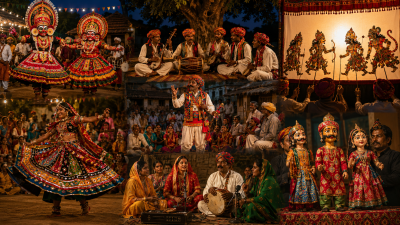
Traditional folk entertainment serves as a vital repository of India’s intangible cultural heritage. Unlike classical forms, folk entertainment is rooted in rural landscapes, characterized by spontaneous regional dialects, community participation, and a blend of the sacred and the profane. These forms are categorized based on their functional role into theatrical, musical, and puppetry traditions.
Folk Theatre: The Mirror of Society
Folk theatre in India, often referred to as Lok Natya, is distinguished by its non-proscenium, open-air stages and its ability to communicate complex social and religious messages to the masses.
- Jatra (West Bengal, Odisha, Bihar): Originally a musical procession dedicated to Krishna, it evolved into a secular narrative form. It is characterized by high-pitched singing and loud acting to reach large rural crowds.
- Tamasha (Maharashtra): Evolved from the influences of Sufi saints and the Maratha military, it features the Lavani dance and the Vag (theatrical narrative). It traditionally involves the Kolhati and Mahar communities.
- Bhavai (Gujarat): Associated with the worship of Goddess Amba, this form uses the Bhungal (a long copper pipe) to create a distinct soundscape. It focuses on social satire and the struggles of the common man.
- Nautanki (Uttar Pradesh): Known for its operatic style and use of the Nagara (kettledrum), it draws stories from Persian romances and local folklore like Laila-Majnu and Amar Singh Rathore.
- Yakshagana (Karnataka): A temple-based theatre form that combines dance, music, dialogue, and costume. It is performed in the Bayalata (open field) and primarily narrates episodes from the Ramayana and Mahabharata.
Traditional Puppetry: The Inanimate Storytellers
Puppetry is one of the oldest forms of entertainment in India, mentioned in the Silappadikaram and the Mahabharata. It is classified into four distinct types based on the mechanism of manipulation.
| Category | Form | State | Key Features |
| String Puppets | Kathputli | Rajasthan | Carved from a single piece of wood; uses a “squeaker” for the voice of the puppet. |
| Gombeyatta | Karnataka | Styled like Yakshagana; highly complex string movements. | |
| Shadow Puppets | Tholu Bommalata | Andhra Pradesh | Large, translucent leather puppets; involves intricate colored shadows. |
| Ravana Chhaya | Odisha | Opaque puppets made of deer skin; no joints, creating a unique silhouette. | |
| Rod Puppets | Putul Nautch | West Bengal | Large puppets manipulated by a rod attached to the waist of the puppeteer. |
| Yampuri | Bihar | Traditionally depicts the court of Yama (God of Death); made of wood. | |
| Glove Puppets | Pavakoothu | Kerala | Heavily influenced by Kathakali costumes and music. |
Folk Music and Balladry Traditions
Folk music provides the rhythmic backbone to traditional entertainment, often serving as a tool for historical preservation through oral epics.
- Baul (West Bengal): A mystical musical tradition influenced by Hindu Bhakti and Islamic Sufi movements. Bauls are wandering minstrels who seek the “Man of the Heart” (Moner Manush).
- Pandavani (Chhattisgarh): A narrative form of the Mahabharata. It has two styles: Vedamati (sitting) and Kapalik (standing and dancing). Teejan Bai is its most famous exponent.
- Burrakatha (Andhra Pradesh/Telangana): A storytelling technique using a stringed instrument called the Tambura and two small drums (Dakki). The main storyteller is accompanied by two others who provide comic relief and social commentary.
- Villu Paatu (Tamil Nadu): Literally “Bow Song,” where a large bow decorated with bells is used as a musical instrument to narrate stories of local heroes and deities.
Ritualistic and Martial Arts Entertainment
Certain forms of entertainment are inseparable from religious rituals or the display of physical prowess.
- Theyyam (Kerala): A ritualistic dance-theatre where the performer is believed to be possessed by the deity. It involves elaborate facial makeup and massive headgears (Mudi).
- Kalaripayattu (Kerala): While a martial art, its public demonstrations function as a form of traditional entertainment, influencing the physical vocabulary of the Indian circus and classical dances like Kathakali.
- Chhau (Jharkhand, Odisha, West Bengal): A semi-classical folk dance with martial origins. It is famous for its masks (in Seraikella and Purulia styles) and was inscribed in the UNESCO Representative List of Intangible Cultural Heritage in 2010.
Important Facts and Trivia for Aspirants
- The Vidushaka: Almost all Indian folk theatre forms feature a comic character (the Jester or Vidushaka) who bridges the gap between the performers and the audience, often providing contemporary political satire.
- The Sutradhara: In forms like Ankiya Naat (Assam), the Sutradhara acts as the conductor of the play, a tradition dating back to Sanskrit theatre.
- UNESCO Recognition: Besides Chhau, the Mudiyettu (ritual theatre of Kerala) and Kalbelia (folk songs and dances of Rajasthan) are significant entries in the UNESCO Intangible Cultural Heritage list.
- Kutiyattam: It is the only surviving specimen of Sanskrit theatre in India, preserved in Kerala, and was the first Indian art form to be recognized by UNESCO.
Socio-Economic Impact and Conservation
Traditional folk entertainment has historically acted as a “Social Leveller,” providing a platform for marginalized communities to voice dissent through allegory. Today, these forms face challenges from urbanization and digital media. However, government initiatives through the Zonal Cultural Centres (ZCCs) and the Sangeet Natak Akademi aim to preserve these “living traditions” by providing stipends, organizing festivals, and documenting oral histories.
Last Modified: May 7, 2026