
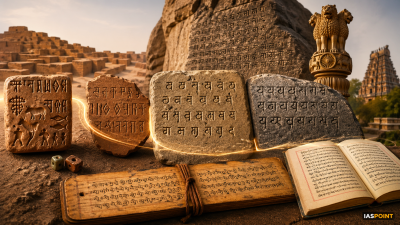
The evolution of scripts in India is a journey from pictographic representation to phonetically sophisticated writing systems. The transition from oral traditions to written records played a pivotal role in the preservation of Indian art, culture, and administrative edicts. While the Indus Valley script remains undeciphered, the historical era of Indian epigraphy begins with the Brahmi and Kharosthi scripts.
The Genesis: Indus Valley Script
The earliest evidence of writing in the Indian subcontinent is found in the seals of the Indus Valley Civilization (c. 2500 BCE).
- Nature: It is a logo-syllabic script, containing approximately 400 to 600 distinct signs.
- Direction: The script is generally written in Boustrophedon style (right to left in the first line, left to right in the second).
- Status: It remains undeciphered, creating a “linguistic gap” between the Harappan era and the appearance of Brahmi.
The Pillars of Ancient Indian Epigraphy
The 3rd Century BCE marks the definitive emergence of two major scripts used extensively by Emperor Ashoka for his Dhamma edicts.
Brahmi Script
Brahmi is considered the “Mother of all Indian Scripts” and most scripts in Southeast Asia.
- Characteristics: Written from left to right, it is an alphasyllabary (Abugida) where each character carries an inherent vowel.
- Decipherment: It was successfully deciphered by James Prinsep in 1837, who identified the script on Ashokan inscriptions.
- Evolution: Brahmi branched into Northern and Southern variants during the Gupta period, eventually giving rise to Devanagari, Bengali, Tamil, and Malayalam scripts.
Kharosthi Script
Primarily used in the North-Western part of ancient India (Gandhara region).
- Characteristics: Written from right to left, it was heavily influenced by the Aramaic script due to Persian contact.
- Usage: Commonly found on Indo-Greek coins and Gandhara Buddhist texts. Unlike Brahmi, it did not leave long-term descendants in modern Indian languages and became extinct by the 3rd Century CE.
The Evolution of Northern Scripts
The Northern branch of Brahmi underwent several stylistic modifications influenced by the materials used (stone, birch bark, paper).
Gupta Script
Emerging in the 4th Century CE, it is a refined version of Brahmi used during the Gupta Empire. It is characterized by more cursive strokes and is the immediate ancestor of the Siddham and Nagari scripts.
Devanagari Script
Developed from the 7th Century CE onwards, it is the most widely used script in India today.
- Features: Notable for the Shirorekha (horizontal line) connecting the tops of letters.
- Languages: Used for Sanskrit, Hindi, Marathi, Nepali, Konkani, and Maithili.
Other Northern Derivatives
- Gurmukhi: Developed by Guru Angad Dev in the 16th century for the Punjabi language.
- Bengali-Assamese Script: Evolved from the Siddham script; used for Bengali, Assamese, and Manipuri.
- Sarada Script: An ancient script of Kashmir (8th Century CE), used primarily for Sanskrit manuscripts.
The Evolution of Southern Scripts
Southern scripts evolved with a distinct rounded appearance, largely because they were traditionally written on palm leaves (Olas). Straight lines would have torn the delicate leaf fibers.
Grantha Script
One of the most important scripts of South India, used specifically by Tamil speakers to write Sanskrit. It was instrumental in the development of the Malayalam and Tulu scripts.
Kadamba and Chalukya Scripts
These scripts served as the bridge between Brahmi and the modern Telugu-Kannada scripts. The Halmidi Inscription (450 CE) provides the earliest evidence of the transition toward a distinct Kannada script.
Vatteluttu Script
A “round script” used in the southern parts of Tamil Nadu and Kerala. It was eventually replaced by the modern Tamil script under the influence of the Pallavas and Cholas.
Comparison of Major Ancient Scripts
| Feature | Brahmi Script | Kharosthi Script | Devanagari Script |
| Direction | Left to Right | Right to Left | Left to Right |
| Period | 3rd Century BCE onwards | 3rd Century BCE – 3rd Century CE | 7th Century CE onwards |
| Region | Pan-India | North-West India (Gandhara) | North and Central India |
| Descendants | Almost all modern Indian scripts | None (Extinct) | Hindi, Marathi, Nepali |
| Key Patron | Ashoka the Great | Indo-Greeks, Kushanas | Pratiharas, Paramaras |
Influence of Foreign Scripts in India
The medieval and colonial periods introduced scripts that integrated with Indian linguistic culture.
- Perso-Arabic Script: Introduced during the Sultanate and Mughal periods. It was adapted to write Urdu (a variant of the Perso-Arabic script known as Nastaliq) and Sindhi.
- Roman Script: Introduced by European missionaries and colonial administration. It is currently used for English and several North-Eastern languages like Mizo and Khasi.
- Modi Script: A cursive script used primarily for maintaining Marathi administrative records from the 12th century until the mid-20th century.
Script-Related Trivia for Competitive Exams
- First Deciphered Inscription: The Edicts of Ashoka, deciphered by James Prinsep.
- Oldest Surviving Manuscript: The Bower Manuscript (Birch bark), written in the Gupta script.
- The Concept of Matras: The vowel notation system found in Brahmi-derived scripts is a unique feature of the Indian Abugida system.
- UNESCO Memory of the World: Several ancient Indian manuscripts written in various scripts (like the Rigveda in Sharada script) are part of this register.
- Language vs. Script: An important distinction for UPSC—Konkani is a language that can be written in five scripts (Devanagari, Roman, Kannada, Malayalam, and Perso-Arabic).