
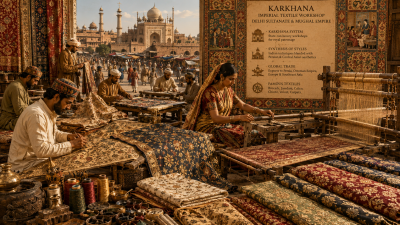
The Medieval period (c. 12th – 18th Century CE) marked a transformative era for Indian textiles, characterized by the synthesis of indigenous techniques with Persian, Central Asian, and Islamic aesthetics. The establishment of the Delhi Sultanate and later the Mughal Empire introduced the “Karkhana” system—state-run luxury workshops—which elevated textile production to a global standard of excellence.
Technological Advancements and Innovations
The arrival of Islamic dynasties brought significant mechanical improvements that revolutionized the speed and complexity of weaving.
- The Spinning Wheel (Charkha): Introduced to India around the 12th–14th century, the Charkha replaced the hand spindle (Takli) for mass-scale yarn production, significantly increasing efficiency.
- Draw-loom (Jala): This sophisticated loom allowed weavers to create complex “figured” patterns (animal and floral motifs) which were previously difficult to execute.
- Treadle Loom: The introduction of foot-operated pedals freed the weaver’s hands to manage the shuttle more rapidly, leading to the production of wider and more consistent fabric lengths.
The Mughal “Karkhana” System
Under Emperors Akbar, Jahangir, and Shah Jahan, textiles were treated as a strategic state industry.
- Royal Workshops: Known as Karkhanas, these facilities employed thousands of artisans, including designers, dyers, weavers, and embroiderers.
- Persian Synthesis: Akbar invited Persian master weavers to settle in Agra, Fatehpur Sikri, and Ahmedabad, blending Persian floral motifs (like the Buta) with Indian colors.
- Imperial Robes (Khilat): The practice of the Emperor gifting “Robes of Honor” made of the finest silks and gold brocades fueled the demand for luxury textiles.
Iconic Medieval Textile Varieties
The Medieval era established specific regional centers that remain the cornerstone of Indian heritage today.
| Fabric/Technique | Origin/Hub | Description | Key Feature |
| Kinkhwab | Varanasi/Ahmedabad | Heavy silk brocade woven with gold and silver threads (Zari). | Known as “The Fabric of Dreams.” |
| Mushru | Gujarat/Hyderabad | A mixed fabric with a silk face and cotton backing. | Created for Muslim men to comply with the prohibition of pure silk against the skin. |
| Himroo | Aurangabad | A simplified version of Kinkhwab, using wool or cotton with silk. | Introduced during Muhammad bin Tughlaq’s capital shift to Daulatabad. |
| Jamdani | Bengal (Dhaka) | Discontinuous weft technique on fine muslin. | Often called “Parsi Gara” or “figured muslin.” |
| Patola | Patan (Gujarat) | Double-Ikat silk where both warp and weft are tie-dyed before weaving. | Achieves perfect symmetry on both sides of the fabric. |
Decorative Techniques and Surface Ornamentation
Medieval textiles were defined by their opulent surface decorations, often using precious metals.
Zardosi and Embroidery
- Zardosi: The art of heavy metal embroidery using gold (Zari) and silver threads. Under the Mughals, it incorporated pearls and precious stones for royal canopies and shoes.
- Chikan Kari: Traditionally believed to have been popularized by Empress Nur Jahan, this shadow-work embroidery on white muslin originated in Lucknow.
- Phulkari: A folk embroidery of Punjab that gained prominence during the medieval era, using silk threads on coarse cotton (Khaddar).
Dyeing and Printing
- Kalamkari: The “Pen-work” art flourished under the Golconda Sultanate. It used natural dyes and a bamboo pen (Kalam) to depict scenes from Persian poetry and Hindu epics.
- Ajrakh: A complex block-printing technique from Sindh and Gujarat, utilizing geometric patterns and indigo/madder dyes, heavily patronized by the Khatri community.
- Bandhani: The art of tie-and-dye reached its zenith in Rajasthan and Gujarat, with intricate patterns like Leheriya (waves).
Motifs and Design Language
The Mughal aesthetic shifted Indian textile motifs from the representational (human figures) to the botanical and geometric.
- The Buta/Paisley: A stylized floral spray that evolved from Persian influences into the iconic “Mango” or Paisley motif.
- Floral Naturalism: Jahangir’s love for nature led to highly realistic depictions of lilies, poppies, and tulips on shawls and waistbands (Patkas).
- Shikargah: A pattern depicting hunting scenes, often seen in Banaras brocades.
Trade and Economic Impact
India functioned as the “Industrial Laboratory” of the medieval world’s textile needs.
- Global Demand: Indian cottons (Calico and Chintz) were exported to Europe, while fine silks were sent to Japan and Indonesia.
- Textile Currency: In parts of Southeast Asia, Indian textiles were so highly valued that they were used as a form of currency and stored in royal treasuries.
- European Interaction: The 17th century saw the arrival of the East India Companies, which initially acted as middlemen, carrying Indian textiles to global markets before the eventual shift to colonial exploitation.
Key Facts for UPSC Prelims
- Zari/Jari: The metallic thread made by wrapping flattened gold or silver wire around a silk core.
- Pashmina: The development of the fine goat-wool shawl industry in Kashmir was significantly boosted by Mughal patronage, especially Zain-ul-Abidin.
- Calico: Derived from the city of Calicut, this refers to plain-woven unbleached cotton that became a global sensation.
- Kalamkari GI Tag: While practiced in many areas, Srikalahasti and Machilipatnam are the two primary GI-tagged styles today.
- Ain-i-Akbari: Abul Fazl’s text provides a detailed list of contemporary textiles, prices, and the specific interest Akbar took in the “Karkhanas.”