
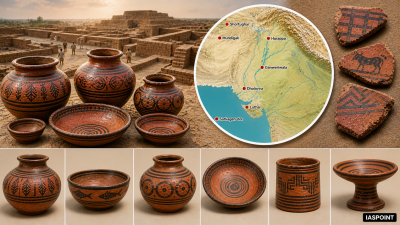
The pottery of the Indus Valley Civilization (IVC), spanning approximately 2600 BCE to 1900 BCE, represents the first instance of large-scale, standardized industrial production in the Indian subcontinent. Primarily a “Red and Black Ware” tradition, it serves as a “diagnostic artifact” for archaeologists, meaning its presence helps identify and date Harappan strata across diverse geographical locations from Afghanistan to Gujarat.
Classification and Manufacturing Techniques
Harappan ceramics were predominantly utilitarian but exhibited high technical sophistication. The use of the fast-spinning potter’s wheel was universal, ensuring symmetry and uniform thickness.
- Plain Pottery: The most common variety, usually made of red clay with or without a fine slip. It was used for daily household functions.
- Painted Pottery (Red and Black Ware): High-quality ware treated with a bright red slip (ochre) upon which designs were painted with black pigment (manganese).
- Polychrome Pottery: Rare and localized; features multiple colors (red, black, white, and occasionally green/yellow) to create geometric or floral patterns.
- Incised Ware: Rare pottery where decorations were carved into the wet clay, often found in the lower Indus region and Mohenjo-daro.
- Perforated Pottery: Features a large hole at the bottom and small holes across the body; scholars suggest these were used for straining liquor or as incense burners.
Technical Features and Composition
The Harappan potters possessed advanced knowledge of mineralogy and thermal dynamics.
- Raw Materials: Fine alluvial silt was tempered with sand, lime, or mica to prevent cracking during the shrinkage process.
- Firing Technology: Potters utilized specialized up-draught kilns. These circular structures featured a fire-pit at the bottom and a perforated floor above to allow heat to circulate, ensuring an oxidizing atmosphere that turned the iron-rich clay a deep terracotta red.
- Glazing (Faience): While not true glass-glazed pottery, the Harappans were pioneers in producing Faience—a vitrified silica material used for beads, amulets, and miniature vessels.
Typology of Harappan Vessels
The variety of shapes recovered indicates a highly specialized culinary and ritual culture.
| Vessel Type | Physical Description | Probable Function |
| Dish-on-Stand | A shallow dish supported by a tall, flared pillar. | Ritual offerings, display of fruit, or high-status dining. |
| S-Shaped Jar | Gracefully curved jars with a wide mouth and narrow base. | Storage of liquids or precious grains. |
| Indus Goblet | Small, pointed-base (button base) cups. | Mass-produced, disposable “use-and-throw” drinking vessels. |
| Storage Jars | Massive, thick-walled jars, often coated with black slip. | Bulk storage; black slip prevented liquid seepage (percolation). |
| Beakers | Small, straight-sided cylindrical cups. | Daily consumption of water or beverages. |
Decorative Motifs and Iconography
Harappan pottery acts as a canvas for the religious and environmental consciousness of the civilization.
Geometric Patterns
The most iconic motif is the Intersecting Circles, which appear on vessels from nearly every Harappan site. Other patterns include checkerboards, triangles, and horizontal bands.
Naturalistic and Floral Motifs
- Pipal Leaf: The most frequently depicted botanical motif, indicating the sacred status of the Ficus religiosa.
- Faunal Imagery: Realistic depictions of humped bulls (Zebu), goats, deer, fish, and birds like peacocks.
- The “Sun” Motif: Represented as a circle with radiating lines or rays.
Narrative and Mythological Scenes
- Lothal “Crafty Crow”: A jar depicting a bird holding a fish and a fox-like animal, interpreted as an early version of a Panchatantra folk tale.
- Horned Deities: Some pots feature figures with buffalo-horned headgear, linking ceramic art to the “Pashupati” seal iconography.
Regional Variations in Harappan Pottery
While standardized, regional “sub-cultures” integrated local styles into the Harappan fold.
- Gujarat Region (Lothal/Rangpur): Known for Micaceous Red Ware, which has a shiny, glittery surface due to high mica content.
- Rajasthan (Kalibangan): Exhibits a transition from the “Six Fabrics” of the Pre-Harappan period to the Mature Harappan Red and Black style.
- Late Harappan (Cemetery H): Found at Harappa; characterized by more elaborate and surrealistic paintings, such as human forms inside stars or birds, signifying a shift in burial beliefs.
UPSC Prelims Facts and Trivia
- First Mass Production: The Harappan civilization is the world’s first culture to implement standardized mass production of ceramics.
- Graffiti Marks: Many pots bear post-firing “Graffiti” or signs that resemble the Indus Script, possibly serving as owner marks or trade tallies.
- Absence of Human Figures: Unlike contemporaneous civilizations in Mesopotamia, human figures are extremely rare on Harappan pottery; the focus remained on nature and geometry.
- Vitrified Segments: The presence of vitrified (glass-like) pottery fragments in kilns suggests that Harappans were on the verge of discovering glass-making technology.
- Porosity Control: The application of a “Black Slip” on large storage jars was a sophisticated waterproofing technique to store water and wine without evaporation loss.