
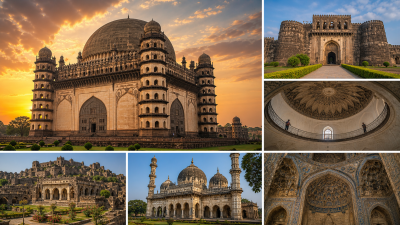
The Deccan Sultanate architecture (14th–17th Century CE) emerged following the disintegration of the Bahmani Kingdom into five independent principalities: the Adil Shahi (Bijapur), Qutb Shahi (Golconda), Nizam Shahi (Ahmadnagar), Barid Shahi (Bidar), and Imad Shahi (Berar). This style is a sophisticated evolution of the Indo-Islamic tradition, blending the austere Tughlaq influences of the North with local Deccani traditions and strong Persian (Safavid) cultural aesthetics. It is particularly noted for its structural daring, bulbous domes, and the integration of the “whispering gallery” phenomenon.
Key Architectural Features and Innovations
Deccan architecture is distinguished by its departure from the heavy, sloping walls of the Delhi Sultanate toward more vertical, airy, and ornate structures.
The Bulbous Dome and Lotus Finials
A hallmark of this style is the “onion” or bulbous dome, which often sits upon a drum decorated with a ring of vertical petals. This gives the appearance of the dome emerging from a blossoming lotus, a clear synthesis of Islamic geometry and Indian floral motifs.
Minarets and Turrets
Unlike the massive, functional minarets of the North, Deccani minarets are often slender, decorative, and topped with small domes. They frequently appear at the corners of mosques and tombs, acting as vertical extensions of the structure rather than detached towers.
Surface Decoration and Stucco Art
The Sultanates made extensive use of stucco (plaster) carving rather than stone relief. Intricate patterns of medallions, arabesques, and “chain-and-pendants” motifs were used to decorate façades. They also utilized glazed tiles, particularly in Bidar, reflecting direct Persian influence.
The Five Provincial Schools of the Deccan
| Sultanate | Capital | Key Architectural Characteristics | Notable Monument |
| Adil Shahi | Bijapur | Massive scale, grand domes, and the use of the “Three-Arched” façade. | Gol Gumbaz, Ibrahim Rauza |
| Qutb Shahi | Golconda / Hyderabad | Fusion of Hindu and Persian styles; use of granite and stucco. | Charminar, Golconda Fort |
| Barid Shahi | Bidar | Extensive use of colored glazed tiles and wooden carvings. | Tomb of Ali Barid Shah |
| Nizam Shahi | Ahmadnagar | Simpler structures, often focused on garden palace complexes. | Farah Bagh, Damri Masjid |
| Imad Shahi | Gawilgarh / Ellichpur | Most understated; known for massive fortifications. | Hauz Katora |
Detailed Analysis of Iconic Masterpieces
Gol Gumbaz (Bijapur)
Built by Muhammad Adil Shah in 1656, it is the most technically advanced structure of the era.
- The Dome: It features the second-largest dome in the pre-modern world, supported not by pillars but by a system of intersecting arches (interlacing squinches).
- Whispering Gallery: Located inside the drum of the dome, where a sound is echoed eleven times and even the faintest whisper can be heard across the 38-meter diameter.
- The Four Minars: Seven-storied octagonal turrets at each corner house winding staircases leading to the gallery.
Charminar (Hyderabad)
Commissioned by Muhammad Quli Qutb Shah in 1591 to mark the end of a plague, it served as the center of the new city.
- Structure: A square plan with four grand arches facing the cardinal directions.
- The Minarets: Four fluted minarets rising to 56 meters, each containing four stories and a small mosque on the top floor.
- Ornamentation: Exquisite stucco work and granite masonry reflecting a “Cairene” (Cairo) influence in its proportions.
Ibrahim Rauza (Bijapur)
Often called the “Taj Mahal of the South,” this palatial tomb of Ibrahim Adil Shah II is praised for its rhythmic symmetry and delicate stone carvings.
- Features: It consists of two main buildings (a tomb and a mosque) on a single raised platform. It is famous for its stone “chains” carved from single blocks and its Persian inscriptions.
Comparison: Deccan Sultanate vs. Mughal Architecture
| Feature | Deccan Sultanate Style | Mughal Architecture |
| Dome Shape | Deeply bulbous, constrained at the base. | Hemispherical or slightly bulbous. |
| Materials | Local basalt, granite, and stucco. | Red sandstone and white marble. |
| Garden Style | Occasional; less emphasis on Charbagh. | Centralized Charbagh (four-fold garden). |
| Arches | Frequent use of the “Tudor” or “Petal” arch. | Pointed, multifoil, or scalloped arches. |
Military and Secular Engineering
The Deccan Sultanates were masters of defensive architecture due to constant warfare with the Vijayanagara Empire and the Mughals.
- Golconda Fort: Renowned for its acoustic signaling system; a clap at the entrance “Bala Hissar” gate can be heard at the hilltop pavilion one kilometer away. It also featured a highly advanced clay-pipe water supply system.
- Bidar Fort: Notable for its Persian-style “Madrasa of Mahmud Gawan,” which was a three-story university decorated with green and yellow tiles, once housing a library of 3,000 manuscripts.
Facts and Trivia for UPSC Prelims
- UNESCO Heritage: The “Monuments and Forts of the Deccan Sultanate” are currently on the UNESCO tentative list, including sites at Gulbarga, Bidar, Bijapur, and Golconda.
- The Chand Minar: Located at Daulatabad Fort, it is one of the tallest victory towers in India, built in the 15th century by the Bahmanis.
- Dark Basalt: Unlike the vibrant red and white of Mughal Delhi, Deccani monuments often have a somber, greyish-black appearance due to the extensive use of local volcanic basalt.
- Persian Architects: Many Deccani structures were designed by Persian emigrants, leading to the “Isfahan” style influence seen in the arches and tilework of Bidar.
- Haft Gumbaz: A collection of seven tombs in Kalaburagi (Gulbarga) that showcases the transition from the heavy Tughlaq style to the refined Deccani aesthetic.