
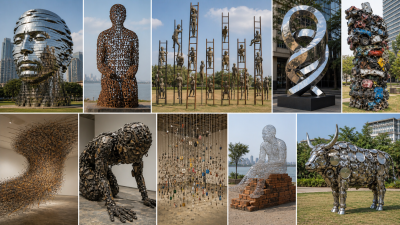
The contemporary phase of Indian sculpture, beginning roughly in the late 1980s and intensifying post-liberalization (1991), represents a departure from the “Modernist” preoccupation with form and material. While modern sculptors like Ramkinkar Baij focused on the “essential human form,” contemporary artists engage with globalization, consumerism, urban displacement, and environmental crises. This era is characterized by the use of “New Media,” site-specific installations, and the subversion of everyday objects into high art.
Defining Characteristics of Contemporary Sculptural Art
Contemporary Indian sculpture is not defined by a single style but by its conceptual diversity and “Material Pluralism.”
- Material Subversion: Use of unconventional materials like stainless steel utensils, cow dung, fiberglass, scrap metal, found objects, and digital components.
- Scale and Monumentality: Moving away from pedestal-based sculptures to massive, room-filling installations or outdoor site-specific works.
- Socio-Political Commentary: Deep engagement with themes of migration, gender identity, the “Digital Divide,” and the friction between rural tradition and urban modernity.
- Interdisciplinary Approach: Blending sculpture with video art, performance, and sound to create an immersive experience.
Leading Figures and their Sculptural Contributions
Contemporary Indian sculptors have gained significant international acclaim, often representing India at the Venice Biennale and Documenta.
| Artist | Primary Medium | Key Themes | Notable Work |
| Subodh Gupta | Stainless Steel Utensils | Consumerism, Migration, Food Culture | Very Hungry God (Skull made of tiffins) |
| Anish Kapoor | Reflective Steel, PVC, Wax | Space, Void, Self-perception | Cloud Gate and Leviathan |
| Bharti Kher | Bindi, Fiberglass | Identity, Mythology, Domesticity | The Skin Speaks a Language Not Its Own |
| Vivan Sundaram | Recycled Trash, Terra-cotta | Ecology, Memory, History | Trash series and Memorial |
| Shilpa Gupta | Electronics, Audio, Found Objects | Borders, Surveillance, Identity | 100 Hand-drawn Maps of India |
| Ravinder Reddy | Painted Fiberglass | Femininity, Pop Culture, Rural Icons | The Head (Colossal gilded heads) |
Iconic Contemporary Masterpieces and Installations
The “Stainless Steel” Aesthetic: Subodh Gupta
Subodh Gupta is often called the “Damien Hirst of Delhi.” He utilizes the iconography of the Indian middle class—the dabba (tiffin), the milk pail, and the bicycle. By magnifying these objects into colossal installations, he comments on the “globalization of the local.” His work Line of Control (2008), a mushroom cloud made of steel utensils, is a poignant commentary on nuclear warfare and hunger.
Bindi and the Hybrid Form: Bharti Kher
Kher uses the bindi as a sculptural skin. Her masterpiece, a life-sized fiberglass elephant titled The Skin Speaks a Language Not Its Own, is covered in thousands of sperm-shaped bindis. It represents the dying spirit of a tradition trapped in a contemporary shell.
Conceptualism and Borders: Shilpa Gupta
Moving beyond physical carving, Shilpa Gupta uses sculpture to question political geography. Her use of barbed wire, tape, and light installations challenges the permanence of national borders. Her work is a prime example of “New Media Sculpture” in the Indian context.
The Rise of Public and Site-Specific Art
Contemporary sculpture has moved out of the gallery into the public consciousness through massive projects that redefine urban spaces.
- The Rock Garden of Chandigarh: Though started earlier, Nek Chand’s work remains a contemporary marvel of “Outsider Art,” utilizing industrial and domestic waste to create a sprawling sculptural kingdom.
- Jindal Art Foundation Initiatives: Contemporary installations in Vidyanagar and other industrial townships utilize scrap metal from factories to create public monuments.
- Kochi-Muziris Biennale: This platform has become the epicenter for contemporary Indian installations, where sculpture often interacts with the sea, heritage buildings, and local history.
Technological Integration in Sculpture
Contemporary Indian artists are increasingly using 3D printing, laser cutting, and kinetic engineering.
- Kinetic Sculpture: Artists like Sudharshan Shetty create mechanical installations that move, exploring the transience of life and the repetition of daily rituals.
- Environmental Sculpture: Vivan Sundaram’s use of “found trash” to build sculptural landscapes serves as a critique of urban waste management and the environmental footprint of the 21st century.
Important Facts and Trivia for UPSC Prelims
- The Kochi-Muziris Biennale: Founded by Bose Krishnamachari and Riyas Komu in 2012, it is the largest contemporary art festival in Asia and a major showcase for Indian installation sculpture.
- The Devi Art Foundation: India’s first contemporary art museum (private) located in Gurugram, which houses a vast collection of contemporary sculptural works.
- Kiran Nadar Museum of Art (KNMA): A significant institution that has played a vital role in documenting the shift from Modern to Contemporary sculpture in India.
- Santhal Family Re-interpretation: Many contemporary artists have re-interpreted Ramkinkar Baij’s Santhal Family to comment on the current status of displaced tribal communities in modern India.
- The “VantaBlack” Controversy: Indian-born sculptor Anish Kapoor famously secured exclusive rights to use VantaBlack (the world’s darkest pigment), sparking a global debate on the ownership of materials in art.
Comparison: Modern vs. Contemporary Sculptural Intent
- Modern Sculpture: Sought a “National Identity” through Indigenous themes; focused on the artist’s touch on the material (clay, bronze, stone).
- Contemporary Sculpture: Seeks a “Global Dialogue” through universal themes (environment, migration); often involves “Fabrication” where the artist designs and a factory or specialized team executes the work.