
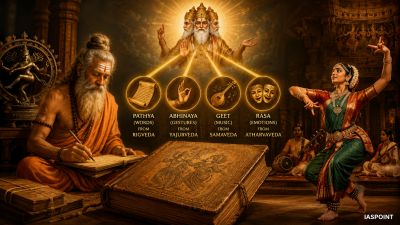
The Natya Shastra is the most exhaustive ancient Indian treatise on the performing arts, encompassing dance, drama, and music. Attributed to Bharata Muni, it is often referred to as the Fifth Veda (Panchama Veda). It was compiled between 200 BCE and 200 CE and serves as the foundational “grammar” for all Indian classical dance forms. The text asserts that Lord Brahma created Natya by taking pathya (words) from the Rigveda, abhinaya (gestures) from the Yajurveda, geet (music) from the Samaveda, and rasa (emotions) from the Atharvaveda.
The Concept of Rasa and Bhava
The Natya Shastra introduces the Rasa-Sutra, which posits that the ultimate goal of any performance is to evoke a specific aesthetic flavor or “Rasa” in the audience.
The Eight Primary Rasas
Bharata Muni originally defined eight Rasas, each associated with a specific presiding deity and a color. (The ninth, Shanta Rasa, was added later by Abhinavagupta).
| Rasa (Sentiment) | Bhava (Stable Emotion) | Color | Deity |
| Shringara (Love/Erotic) | Rati (Delight) | Light Green | Vishnu |
| Hasya (Humor/Comic) | Hasa (Laughter) | White | Pramata |
| Karuna (Compassion/Pathetic) | Shoka (Sorrow) | Grey | Yama |
| Raudra (Anger/Fury) | Krodha (Anger) | Red | Rudra |
| Veera (Heroism) | Utsaha (Energy) | Pale Yellow | Mahendra |
| Bhayanaka (Fear/Terrible) | Bhaya (Fear) | Black | Kala |
| Bibhatsa (Disgust/Odious) | Jugupsa (Disgust) | Blue | Mahakala |
| Adbhuta (Wonder/Marvel) | Vismaya (Astonishment) | Yellow | Brahma |
Classification of Dance Movements
The treatise divides dance into three distinct categories, a classification still followed by the Sangeet Natak Akademi.
- Nritta: Refers to pure dance where the movements of the body do not express any mood or meaning. It focuses on rhythm, tempo, and technical virtuosity.
- Nritya: Expressive dance that conveys a story or theme through the use of Abhinaya (gestures) and facial expressions.
- Natya: The dramatic element which incorporates a narrative, usually involving multiple characters and a plot.
The Four Pillars of Abhinaya (Expression)
According to the Natya Shastra, a dancer communicates with the audience through four types of Abhinaya:
- Angika Abhinaya: Use of body parts to convey meaning, including Hastas (hand gestures), Mukhaja (facial expressions), and Cari (leg movements).
- Vachika Abhinaya: Use of speech, song, and modulation of voice. In classical dance, this is represented by the accompanying vocal music.
- Aharya Abhinaya: Use of external elements such as costumes, jewelry, make-up, and stage props.
- Sattvika Abhinaya: Expression of psychic states or deep internal emotions, such as trembling, tears, or horripilation.
Technical Terminology and Structural Units
The Natya Shastra provides a meticulous breakdown of the physical grammar of dance.
- Karanas: The 108 basic units of dance. A Karana is a synchronized movement of hands and feet. The Brihadisvara Temple and Chidambaram Temple feature stone carvings of these 108 Karanas.
- Angaharas: Combinations of six or more Karanas. The text mentions 32 Angaharas.
- Rechakas: Minor movements involving the neck, waist, hands, and feet.
- Pindi-bandhas: Group sequences or formations in a dance performance.
- Dharani: The static postures from which movements originate.
Two Main Styles: Tandava and Lasya
The text distinguishes between two stylistic approaches to performance, reflecting the cosmic duality of Hindu philosophy.
- Tandava: Attributed to Lord Shiva, this is the masculine, vigorous, and powerful aspect of dance. It emphasizes rhythm and strength.
- Lasya: Attributed to Goddess Parvati, this is the feminine, graceful, and lyrical aspect of dance. It focuses on soft movements and erotic or devotional sentiments.
Musical and Stage Dimensions
Beyond movement, the Natya Shastra codifies the environment of the performance.
- Prekshagriha (Playhouse): It describes three types of theater shapes: Vikrishta (rectangular), Chaturasra (square), and Tryasra (triangular).
- Musical Instruments: Instruments are classified into four groups: Tata (stringed), Avanaddha (percussion/covered), Sushira (hollow/wind), and Ghana (solid/ideophones).
- Kutapa: The term used for the orchestra or the group of musicians seated on the stage.
Significance for UPSC Prelims
- The Fifth Veda: The Natya Shastra claims to be accessible to all castes, unlike the four primary Vedas, making it a “Universal Veda.”
- Muni Bharata: While traditionally attributed to one sage, modern scholars believe it may be a compilation of works by several authors over centuries.
- Abhinavagupta’s Commentary: The “Abhinavabharati” is the most famous commentary on the Natya Shastra, written in the 10th-11th century, which introduced the ninth rasa, Shanta (Peace).
- The Goal of Art: The text emphasizes that the purpose of Natya is to provide Kritanukarana (re-creation) of the universe and to offer three things: Hita (instruction), Sukh (pleasure), and Vishranti (solace).