
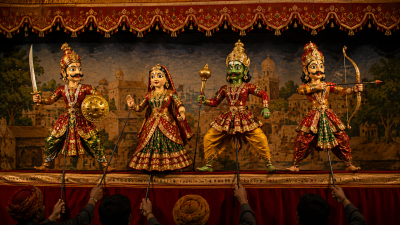
Rod puppetry is a traditional performance art characterized by the use of large puppets supported and manipulated by rods from below. Unlike string puppets (controlled from above) or glove puppets (controlled by the hand inside), rod puppets rely on the principles of leverage and verticality. These puppets are typically heavier and larger, requiring significant physical strength and coordination from the puppeteer, who is usually concealed behind a high curtain.
Technical Characteristics and Materials
- Support Structure: The central support is a main rod (often bamboo or wood) that runs through the body to the head.
- Manipulation: Smaller rods are attached to the hands of the puppets to facilitate gestures. In some regional variations, these rods are tucked into the puppeteer’s waist to allow for hands-free torso movement.
- Materiality: Most rod puppets are carved from light wood (Gular or Teak) or constructed from paper-mache and hay to manage the weight during long performances.
Regional Variations of Rod Puppetry in India
Rod puppetry is geographically concentrated in the eastern and northern belts of India, with West Bengal, Odisha, and Bihar hosting the most prominent traditions.
| Style | State | Key Material | Primary Theme |
| Putul Nautch | West Bengal | Wood & Paper-mache | Jatra-style mythological plays |
| Kandhei Nach | Odisha | Wood & Cloth | Krishna Leela & Ramayana |
| Yampuri | Bihar | Wood | Morality plays (Court of Yama) |
| Danger Putul | Tripura | Wood & Bamboo | Social and contemporary issues |
Putul Nautch: The Giant Puppets of West Bengal
Putul Nautch (literally “Puppet Dance”) is the most physically demanding form of rod puppetry in India. It is primarily found in the Nadia and 24 Parganas districts.
- Scale: These puppets are nearly human-sized, standing 3 to 4 feet tall and weighing between 5 to 10 kg.
- Manipulation: The puppeteer supports the main rod in a hub tied to their waist. By moving their own body, the puppeteer provides the puppet with a walking or dancing gait, while their hands manipulate the rods connected to the puppet’s arms.
- Theatrical Style: The performance is heavily influenced by Jatra, the traditional folk theater of Bengal. It features high-pitched melodrama, loud percussion, and elaborate costumes.
Yampuri: The Didactic Tradition of Bihar
Yampuri is a unique form of rod puppetry that serves as a visual medium for moral and ethical instruction.
- The Court of Yama: The performances specifically depict the Yampuri or the “House of Yama” (the God of Death). Characters include Yama, Chitragupta (the record-keeper), and various messengers.
- Moral Narratives: Unlike other forms that focus on the Ramayana, Yampuri focuses on the consequences of human actions (Karma). It depicts the trials of the dead and the punishments for various sins.
- Simplified Design: These puppets are usually made of wood and are non-jointed, making the movement less fluid but the narrative delivery more direct.
Kandhei Nach (Rod variation) of Odisha
While Odisha is famous for string puppets (Kundhei), certain regions practice a rod-based variation.
- Stylistic Blend: These puppets often incorporate elements of the Odissi dance style in their gestures.
- Socio-Religious Context: The performances are integral to village fairs (Melas) and are often staged during religious festivals like Dol Purnima.
Comparative Analysis with Other Styles
Rod puppetry occupies a middle ground between the delicacy of string puppets and the starkness of shadow puppets.
- Size and Visibility: Rod puppets are significantly larger than string or glove puppets, making them suitable for large outdoor gatherings.
- Rigidity vs. Fluidity: While they lack the complex joint movements of Bommalattam (Tamil Nadu), their vertical stability allows for grand, sweeping gestures that convey authority and power, fitting for epic characters like Ravana or Duryodhana.
Socio-Cultural and Modern Significance
- Educational Tool: Due to their visual impact, rod puppets are frequently used by the Indian Puppetry Unit for social awareness campaigns regarding pulse polio, sanitation, and voting rights.
- Craftsmanship: The making of rod puppets supports specialized artisan communities in West Bengal who also create idols for the Durga Puja festival.
- Institutional Preservation: The Sangeet Natak Akademi organizes the Putul Amrut festival and provides “Guru-Shishya Parampara” scholarships to ensure the transmission of rod manipulation techniques to the younger generation.
Facts and Trivia for UPSC Aspirants
- The Fifth Veda: Like other traditional Indian performing arts, rod puppetry is theoretically linked to the Natya Shastra, aiming to provide Rasa (aesthetic flavor) to the audience.
- Jatra Influence: The musical structure of Bengal’s rod puppetry is identical to Jatra, utilizing the Pakhawaj, Cymbals, and Harmonium.
- Aparigraha Rituals: In many traditions, old or broken rod puppets are not thrown away but are ritually immersed in a river, acknowledging their “consecrated” status during their performance life.
- Hub Manipulation: The technical term for the wooden socket used by Bengali puppeteers to hold the rod is the “Hub,” which acts as a pivot for the puppet’s weight.