
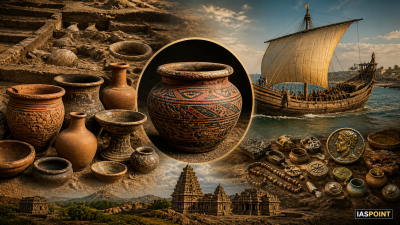
Ancient South Indian pottery is a cornerstone of Dravidian archaeology, providing a continuous timeline from the Neolithic period through the Iron Age to the early historical era. Unlike Northern traditions often influenced by Persian or Central Asian aesthetics, South Indian pottery evolved through indigenous experimentation with local red and black soils. Key archaeological sites such as Adichanallur (Tamil Nadu), Arikamedu (Puducherry), and Brahmagiri (Karnataka) have yielded artifacts that prove South India’s extensive maritime trade links with the Roman Empire and Southeast Asia.
The Megalithic Black and Red Ware (BRW) Culture
The most defining pottery tradition of South India is the Black and Red Ware, which dominated the Iron Age (Megalithic period). This style is not just a color preference but a result of sophisticated firing techniques.
- Inverted Firing Technique: The pots were placed upside down in the kiln. The interior and the rim, deprived of oxygen, turned black (reduction), while the exterior body, exposed to oxygen, turned red (oxidation).
- The Burial Connection: This pottery is almost exclusively found in Megalithic burial sites (Urn burials, Dolmens, and Cists). It served as funerary offerings, often containing grains or beads for the afterlife.
- Surface Finish: The vessels are noted for their high luster and polished surface, achieved by rubbing the leather-hard clay with smooth stones before firing.
Key Ancient Pottery Varieties of South India
| Pottery Type | Primary Region | Period/Context | Distinctive Features |
| Black and Red Ware (BRW) | Entire South India | Megalithic/Iron Age | Bi-chrome appearance; polished slip; used in burials. |
| Rouletted Ware | Arikamedu, Kaveripattinam | 1st Century BC – 2nd Century AD | Fine-grained; grey or black; features “rouletted” (dotted) circular patterns. |
| Russet Coated Painted Ware | Karnataka, Andhra, Tamil Nadu | Satavahana Era | Kaolin (white clay) painting under a russet-colored coating. |
| Aretine Ware | Arikamedu (Puducherry) | Roman Trade Era | Red-glazed, stamped pottery imported from Italy/Europe. |
| Perforated Pottery | Harappan Influence/Deccan | Neolithic-Chalcolithic | Vessels with numerous small holes, possibly used as strainers or incense burners. |
Regional Specializations and Traditions
Arikamedu and Indo-Roman Trade
Arikamedu, near Puducherry, remains the most significant site for “Trade Pottery.” The discovery of Amphorae (large, two-handled jars used for wine or oil) and Arretine Ware confirmed that South Indian ports were vital nodes in the Roman maritime network. Local potters adapted these foreign styles, leading to a “hybrid” Greco-Roman-Dravidian aesthetic in functional ware.
The Urn Burials of Adichanallur
In the Thamirabarani valley of Tamil Nadu, the Urn Burial tradition involved placing the deceased in massive terracotta jars known as Mudhumakkal Thazhi. These urns were thick-walled, hand-built (rather than wheel-turned), and fired at low temperatures to ensure the preservation of the skeletal remains inside.
Satavahana Russet Coated Ware
During the Satavahana rule in the Deccan, a unique decorative style emerged. Artisans used Kaolin (white clay) to paint wavy lines or geometric dots on the pottery. A translucent russet (reddish-brown) slip was then applied over it, creating a sophisticated visual depth that remains a hallmark of the 1st and 2nd century AD.
Technical Characteristics of Dravidian Ceramics
- Hand-modeling vs. Wheel-turning: While the potter’s wheel was common, large storage jars and funerary urns were often hand-modeled using the coil or slab method due to their immense size.
- Slip and Glaze: South Indian pottery rarely used “glaze” in the modern sense. Instead, they used “slips” (liquid clay) and “burnishing” to achieve a shiny, water-resistant surface.
- Graffiti Marks: A fascinating feature of Megalithic pottery is the presence of “Post-firing Graffiti.” These etched symbols (resembling ladders, suns, or stars) are considered by some scholars to be a precursor to the Brahmi script or specific clan identifiers.
Comparative Analysis: South Indian vs. Northern Traditions
| Parameter | South Indian Ancient Pottery | Northern (Gangetic) Traditions |
| Dominant Style | Black and Red Ware (BRW) | Northern Black Polished Ware (NBPW) |
| Firing Type | Open pit and Inverted firing | Advanced high-temperature kilns |
| External Influence | Roman and Maritime | Persian and Hellenistic |
| Functional Context | Funerary and Trade focus | Urban/Administrative focus |
| Aesthetic | Rustic, Earthy, Incised | Metallic, Glossy, Painted |
Key Factoids for UPSC Prelims
- Keezhadi Excavations: Recent findings in Keezhadi (Tamil Nadu) have pushed back the dates of the Sangam Era pottery, suggesting a highly literate and urbanized society around the 6th century BCE.
- Amphorae Fragments: These are the primary archaeological evidence used to map the “Silk Road of the Sea” connecting South India to the Mediterranean.
- Technological Continuity: Unlike the North, where pottery styles changed drastically with every invasion (Mughal, British), South Indian rural pottery still retains the “Black and Red” firing technique in many village clusters.
- Dholavira vs. South Indian BRW: While BRW is found in the Indus Valley, the South Indian variant is distinct for its association with iron tools and megalithic structures.
- The “Machi” Leaf: Even in ancient times, natural resins were used for post-firing treatments to make the vessels impermeable, a practice that survives in tribal pockets of the Eastern Ghats.
Socio-Cultural Significance
Pottery in ancient South India was deeply intertwined with the Sangam Literature. References in the Purananuru and Akananuru describe the potter (Kuyavar) as an essential member of the village, responsible for creating the lamps used in temples and the urns used for heroes. This reflects the 360-degree integration of the craft into the life, death, and spiritual cycles of the Dravidian people.
Last Modified: May 5, 2026