
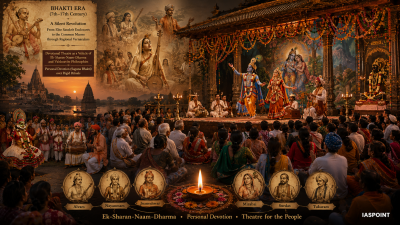
The Bhakti era (7th–17th century) marked a “silent revolution” in Indian cultural history, transitioning theatre from elite Sanskrit enclosures to the common masses through regional vernaculars. Devotional theatre served as a potent vehicle for the Ek-Sharan-Naam-Dharma and Vaishnavite philosophies, emphasizing personal devotion (Saguna Bhakti) over rigid rituals.
Core Philosophical Underpinnings
- Democratization of Art: Theatre moved to village squares (Maach, Tamasha) and courtyards, breaking the monopoly of priestly classes.
- Vernacular Proliferation: Plays were composed in local dialects like Brajavali, Maithili, Awadhi, and Kannada to ensure accessibility for the illiterate populace.
- Social Reform: Most forms rejected caste hierarchies, allowing performers from diverse backgrounds to enact divine roles.
Prominent Forms of Devotional Theatre
1. Ankia Naat and Bhaona (Assam)
Created by the 15th-century saint-reformer Srimanta Sankardeva, this form was instrumental in spreading Neo-Vaishnavism in the Northeast.
- Language: Written in Brajavali, an artificial poetic language mixing Maithili, Assamese, and Braj Bhasha.
- Key Feature: The Sutradhara (narrator) is the central figure who remains on stage throughout, managing production, direction, and spiritual commentary.
- Bhaona: The actual presentation of the Ankia Naat. It uses masks (Mukha) to represent characters like Garuda or Narasimha.
- Venue: Traditionally performed in the Namghar (prayer halls) or Sattras (monasteries).
2. Rasleela and Ramlila (North India)
These are the most widespread forms of devotional theatre, revolving around the lives of Krishna and Rama respectively.
- Ramlila: Based primarily on Tulsidas’s Ramcharitmanas (16th century). In 2008, it was inscribed on the UNESCO Representative List of Intangible Cultural Heritage of Humanity.
- Rasleela: Centered in the Braj region (Vrindavan/Mathura), focusing on the adolescent life of Krishna. It combines folk songs, dance, and dialogue.
- Svarupas: Young boys (pre-pubescent) are traditionally chosen to play the roles of Rama or Krishna, as they are believed to embody the actual deity during the performance.
3. Yakshagana (Karnataka)
A semi-classical dance-drama that evolved during the Bhakti movement, drawing heavily from the Vaishnavite influence.
- Performance Structure: Traditionally staged from dusk to dawn in open-air theatres (Bayalata).
- Himmela: The musical ensemble led by the Bhagawatha (singer/director) who plays the cymbals.
- Thematic Content: Stories are drawn from the Bhagavata Purana, Ramayana, and Mahabharata. It uses elaborate headgears (Kirita) and heavy makeup.
4. Maach (Madhya Pradesh)
Originating in the Malwa region, it is believed to have evolved from the Khyal theatre of Rajasthan.
- Etymology: The term is derived from the Hindi word Manch (stage).
- Characteristics: It incorporates satirical humor to make social commentaries alongside religious narratives.
- Music: Heavy reliance on Hindustani classical ragas and folk melodies using instruments like the Sarangi and Dhol.
Comparative Summary of Regional Devotional Theatre
| Theatre Form | Primary Region | Key Personalities | Distinctive Element |
| Ankia Naat | Assam | Sankaradeva | Use of Brajavali language and Sutradhara. |
| Kirtaniya | Bihar/Mithila | Vidyapati | Focus on the love of Radha and Krishna. |
| Bhagavata Mela | Tamil Nadu | Venkatarama Sastri | Performed in temples (Varadaraja Perumal) by male Brahmins. |
| Dashavatar | Konkan/Goa | – | Depicts the ten incarnations of Lord Vishnu. |
| Krishnanattam | Kerala | King Manavada | Eight-day cycle of plays depicting Krishna’s life. |
Key UPSC Facts & Trivia
- First Use of Masks: Sankaradeva is credited with using masks in the play Chihna Yatra, which is considered one of the earliest instances of organized devotional theatre in Assam.
- UNESCO Recognition: Koodiyattam (Sanskrit theatre from Kerala) and Ramlila are the prominent theatrical entries in the UNESCO Intangible Heritage list.
- The Sutradhar Evolution: In classical Sanskrit theatre, the Sutradhar appeared only in the Purvaranga (prologue). In Bhakti theatre (like Ankia Naat), he became a permanent fixture on stage to bridge the gap between the divine story and the lay audience.
- Gender Roles: Historically, Bhakti theatre was male-dominated, with men playing female roles (e.g., in Maach and Ankia Naat). However, female Bhakti saints like Mirabai and Andal influenced the content and poetry performed in these plays.
Structure of a Typical Performance
- Purvaranga: The preliminary ritual and musical invocation (e.g., Gayan-Bayan in Assam).
- Nandi Sloka: A benediction prayer to the deity (usually Vishnu/Krishna).
- Prastavana: The introduction where the narrator sets the theme.
- Katha: The main body of the play involving dialogue, song, and dance.
- Bharatavakya: The concluding prayer for the welfare of the world.