

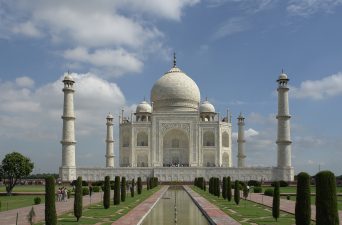
Mughal architecture represents the zenith of Indo-Islamic structural design, blending Persian, Turkic, and Central Asian styles with indigenous Indian craftsmanship. It is characterized by the extensive use of red sandstone and white marble, bulbous domes, slender minarets at the corners, and the “Charbagh” layout. Unlike the preceding Sultanate style, Mughal structures emphasize symmetry and intricate ornamentation.
Architectural Innovations and Features
Mughal buildings introduced specific elements that became hallmarks of the era:
- Pietra Dura: A decorative technique involving the inlay of colored semi-precious stones (like lapis lazuli, jade, and jasper) into white marble.
- Charbagh Style: A Persian-style garden layout divided into four parts by walkways or flowing water, symbolizing the Islamic concept of paradise.
- Double Dome: A technique where an inner dome provides the ceiling for the interior while an outer layer provides height and proportion to the exterior.
- Jali Work: Intricate stone lattice screens that allowed for ventilation and filtered light.
- Arabesque: Use of rhythmic linear patterns of scrolling and interlacing foliage or plain lines.
Evolution Across Reigns
Babur and Humayun: The Formative Phase
The early Mughal period focused more on landscape architecture and foundational mosques rather than grand monuments.
- Babur: Introduced the Charbagh system to India. Notable structures include the Ram Bagh in Agra and the Kabuli Bagh Mosque in Panipat.
- Humayun: His reign was politically unstable, but his tomb (commissioned by Hamida Banu Begum) became the prototype for the Taj Mahal.
- Humayun’s Tomb: Designed by Persian architect Mirak Mirza Ghiyas, it featured the first proper double dome in India and the first grand-scale use of the Charbagh layout.
Akbar: The Synthesis of Styles
Akbar’s reign saw a shift toward red sandstone and a synthesis of Rajput and Persian styles, reflecting his religious tolerance.
- Agra Fort: Constructed primarily in red sandstone; contains the Bengali Mahal and Jahangiri Mahal.
- Fatehpur Sikri: A planned city serving as Akbar’s capital for 15 years.
- Buland Darwaza: Built to commemorate the victory over Gujarat; it is the highest gateway in the world.
- Panch Mahal: A five-story columnar structure inspired by Buddhist viharas.
- Ibadat Khana: The hall of prayer where Akbar conducted inter-religious discussions.
- Salim Chishti’s Tomb: Notable for being one of the first Mughal structures to use white marble extensively within a red sandstone complex.
Jahangir: The Transition to Elegance
Jahangir focused more on paintings and gardens than massive stone structures. However, his reign marked the transition from sandstone to marble.
- Itimad-ud-Daulah’s Tomb: Built by Nur Jahan for her father, it is often called the “Baby Taj.” It is the first Mughal structure made entirely of white marble and features the first extensive use of Pietra Dura.
- Shalimar Bagh (Srinagar): A prime example of Jahangir’s obsession with horticulture and terraced gardens.
Shah Jahan: The Golden Age
The peak of Mughal architectural refinement, characterized by the replacement of red sandstone with fine white marble and the perfection of the Pietra Dura technique.
- The Taj Mahal: A funerary complex for Mumtaz Mahal. It utilizes the “tapering” minaret technique to ensure that if they fall, they fall away from the main tomb.
- Red Fort (Shahjahanabad): Includes the Diwan-i-Aam, Diwan-i-Khas, and the Rang Mahal. The Diwan-i-Khas once housed the legendary Peacock Throne.
- Jama Masjid (Delhi): One of the largest mosques in India, built on a high platform with three large white marble domes and two tall minarets.
Aurangzeb: The Decline of Grandeur
Architecture under Aurangzeb saw a decline in lavishness due to his austere nature and focus on military expansions.
- Bibi ka Maqbara: Built in Aurangabad for his wife, Rabia-ud-Daurani. It is often described as a “poor man’s Taj” due to the use of inferior materials and lack of proportion.
- Moti Masjid: A small, delicate white marble mosque built inside the Red Fort complex for the Emperor’s personal use.
- Badshahi Mosque (Lahore): One of the last great Mughal mosques, maintaining the traditional imperial scale.
Comparison of Architectural Phases
| Feature | Akbar’s Style | Shah Jahan’s Style |
| Primary Material | Red Sandstone | White Marble |
| Influence | Strong Rajput and Indian influence | Persian and Central Asian refinement |
| Decoration | Carvings and tiles | Pietra Dura and precious stones |
| Arches | Tudor arches and Beam-and-Lintel | Foliated/Cusped arches |
| Vibe | Robust and Fortified | Elegant and Delicate |
Trivia for Prelims
- The Pietra Dura technique is also known as Parchin Kari in South Asia.
- Akbar’s Tomb at Sikandra is unique because it lacks a conventional dome, featuring a flat roof with kiosks (chhatris) instead.
- The Moti Masjid at Agra was built by Shah Jahan, whereas the Moti Masjid at Delhi was built by Aurangzeb.
- Hawa Mahal influence can be seen in the Panch Mahal of Fatehpur Sikri regarding the tiered, open-pillared structure.
- Shah Jahan founded the city of Shahjahanabad, which today is known as Old Delhi.