
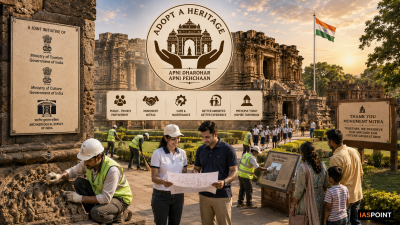
The Adopt a Heritage: Apni Dharohar, Apni Pehchaan scheme is a collaborative initiative launched on World Tourism Day (September 27, 2017). It is a joint effort by the Ministry of Tourism, Ministry of Culture, and the Archaeological Survey of India (ASI). The scheme invites private sector companies, public sector units, and individuals to become “Monument Mitras” by adopting specific heritage sites to provide and maintain basic and advanced amenities.
Core Objectives and Strategic Mandate
The scheme follows a Public-Private Partnership (PPP) model to enhance the tourism potential and cultural importance of Indian monuments.
- Amenity Development: Providing basic civic amenities such as cleanliness, public conveniences, drinking water, and ease of access for tourists.
- Visitor Experience: Enhancing the aesthetic and functional value of sites through advanced amenities like illumination, surveillance, and multi-lingual guides.
- Sustainable Tourism: Promoting sustainable operations and maintenance of heritage sites through corporate resources.
- Community Participation: Encouraging a sense of ownership among citizens and corporate entities toward India’s “Composite Culture.”
The Concept of “Monument Mitra”
Under this scheme, the entities that adopt a monument are known as Monument Mitras.
- Eligibility: Private sector firms, Public Sector Undertakings (PSUs), NGOs, and individuals are eligible to participate.
- Selection Process: Selection is based on the entity’s vision for the site, financial capability, and the feasibility of the proposed “Vision Bidding.”
- Non-Commercial Nature: Monument Mitras do not earn revenue from the site. They are allowed to place limited, non-intrusive signage acknowledging their contribution under Corporate Social Responsibility (CSR) guidelines.
- No Ownership Transfer: The scheme involves only the provision and maintenance of amenities; the ownership and core conservation of the monument remains strictly with the ASI.
Operational Hierarchy and Tiers of Monuments
The scheme covers a wide range of monuments, classified by the Ministry of Tourism based on footfall and significance.
| Tier Category | Significance | Examples |
| Green Monuments | High visibility/footfall; iconic status. | Taj Mahal, Red Fort, Qutub Minar. |
| Blue Monuments | Medium visibility; regional significance. | Purana Qila, Kaziranga National Park. |
| Orange Monuments | Lower footfall; local historical value. | Lesser-known tombs and temples. |
Scope of Work: Basic vs. Advanced Amenities
The “Monument Mitra” is responsible for specific types of interventions as agreed upon in the Memorandum of Understanding (MoU).
Basic Amenities (Priority 1)
- Cleanliness and sanitation.
- Safe drinking water facilities.
- Standardized signage and wayfinding.
- Ease of access for Divyangjan (differently-abled) and senior citizens.
Advanced Amenities (Priority 2)
- Night illumination and light-and-sound shows.
- Surveillance systems (CCTV) and security.
- Wi-Fi and digital kiosks.
- Interpretation centers and museums.
The Adopt a Heritage 2.0 (2023 Revision)
In September 2023, the Ministry of Culture and ASI launched an updated version of the scheme to streamline the process and focus on the AMASR Act, 1958 compliance.
- User-Friendly Portal: A dedicated web portal allows entities to view “Amenity Gaps” at various monuments and apply for adoption digitally.
- Standardized MoUs: Fixed timelines and standardized templates for agreements were introduced to reduce administrative delays.
- Archaeological Integrity: Reinforced that all works must be strictly “reversible” and must not alter the original fabric of the ancient structure.
- Indian Heritage App: Launched alongside the 2.0 version to provide a digital interface for tourists to provide feedback on the amenities maintained by Monument Mitras.
Facts and Trivia for UPSC Prelims
- First Monument Mitra: The Dalmia Bharat Group was the first major entity to sign an MoU for the Red Fort (Delhi) and Gandikota Fort (Andhra Pradesh).
- CSR Linkage: The funds spent by companies under this scheme qualify as Corporate Social Responsibility (CSR) expenditure under the Companies Act, 2013.
- Inter-Ministerial Oversight: An Oversight Committee, co-chaired by the Secretary (Tourism) and Secretary (Culture), monitors the implementation.
- Natural Heritage: The scheme is not limited to man-made monuments; it also includes natural heritage sites like National Parks (e.g., Kaziranga).
- Relationship with AMASR Act: Any construction in the “Prohibited” or “Regulated” zones under this scheme must still obtain clearance from the National Monuments Authority (NMA).
Strategic Importance in Heritage Conservation Unit
The Adopt a Heritage scheme addresses the financial and logistical gaps in the Archaeological Survey of India’s vast mandate. By offloading the “service-oriented” aspects (cleanliness, toilets, lighting) to the private sector, the ASI can focus its specialized expertise on core scientific conservation, excavation, and structural restoration. It represents a shift from purely state-controlled preservation to a participatory model that aligns with global best practices in heritage management.
Last Modified: May 8, 2026