
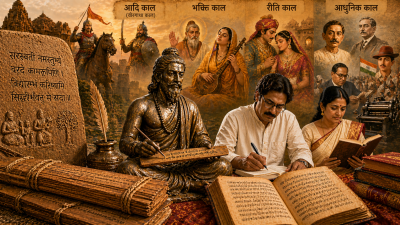
Hindi literature is a cornerstone of Indian Art, Culture, and Heritage, tracing its roots from the Sanskrit and Apabhramsha traditions. It is broadly categorized into four chronological stages: Adi Kal (Heroic), Bhakti Kal (Devotional), Riti Kal (Erotic/Rhetorical), and Adhunik Kal (Modern).
I. Adi Kal: The Age of Bardic Poetry (1050–1375 CE)
This period is characterized by Charan and Bhat poets who composed heroic ballads known as Raso Sahitya. These works primarily focused on the valor and romances of local kings.
- Prithviraj Raso: Authored by Chand Bardai, it is considered the first epic of Hindi literature, detailing the life of Prithviraj Chauhan.
- Visaldev Raso: Written by Narpati Nalh, focusing on the Queen of Malwa.
- Amir Khusrau: Known as the “Parrot of India” (Tuti-e-Hind), he pioneered the use of Khari Boli (the basis of modern Hindi) in his pahelis (riddles) and mukris.
- Vidyapati: Famously known as the Maithil Kokil, his works like Padavali influenced the Bhakti tradition in Bihar and Bengal.
II. Bhakti Kal: The Golden Age (1375–1700 CE)
This era represents the peak of Hindi literature, where spiritualism and social reform took center stage. It is divided into two major schools of thought.
1. Nirguna School (Formless God)
- Gyanashrayi (Saint Poetry): Led by Kabir Das, who used the Sadhukkari language to challenge rituals. His verses are compiled in the Bijak.
- Premashrayi (Sufi Poetry): Primarily written in Awadhi. The most significant work is Padmavat by Malik Muhammad Jayasi, an allegorical tale of Queen Padmini.
2. Saguna School (God with Attributes)
- Rama Bhakti: Led by Goswami Tulsidas, who wrote Ramcharitmanas in Awadhi, making the Ramayana accessible to the masses.
- Krishna Bhakti:
- Surdas: Wrote Sur Sagar in Brij Bhasha, focusing on the childhood of Krishna.
- Mirabai: Her Bhajans expressed intense personal devotion (Madhurya Bhava).
- Raskhan: A Muslim poet whose devotion to Krishna showcased the syncretic nature of Indian culture.
III. Riti Kal: The Scholastic Period (1700–1900 CE)
During this phase, poets turned toward courtly patronage. Focus shifted from devotion to Shringara (eroticism) and the technicalities of poetic theory (Riti).
- Keshav Das: Known for Ramchandrika; he is often called the “Poet of the Difficult Heart” due to his complex style.
- Bihari: Famous for the Bihari Satsai, a collection of 700 couplets (Dohas) that are celebrated for their brevity and depth.
- Bhushan: An exception in this era, he wrote heroic poetry (Veer Rasa) praising Chhatrapati Shivaji Maharaj and Chhatrasal.
IV. Adhunik Kal: The Modern Age (1900 CE – Present)
Modern Hindi literature began with the influence of Western education and the Indian National Movement. It is subdivided into distinct movements.
1. Bharatendu Era (1850–1900)
Bharatendu Harishchandra, the “Father of Modern Hindi Literature,” shifted the language from Brij Bhasha to Khari Boli for prose. His play Bharat Durdasha highlighted the plight of India under colonial rule.
2. Dwivedi Era (1900–1920)
Mahavir Prasad Dwivedi standardized Hindi grammar and encouraged nationalist themes. Key figures included Maithili Sharan Gupt, who wrote the patriotic epic Bharat-Bharati.
3. Chhayavad (Neo-Romanticism: 1920–1936)
This was a period of subjective, mystical, and nature-oriented poetry. The “Four Pillars” of Chhayavad are:
- Jaishankar Prasad: Author of the epic Kamayani.
- Suryakant Tripathi ‘Nirala’: Known for Ram Ki Shakti Puja.
- Sumitranandan Pant: Celebrated as the poet of nature.
- Mahadevi Varma: Known as the “Modern Meera.”
4. Progressivism and Beyond
- Pragativad: Focused on social realism and Marxist ideologies (e.g., Ramdhari Singh ‘Dinkar’).
- Prayogvad (Experimentalism): Led by Agyeya, who introduced the Nayi Kavita (New Poetry) movement.
Major Genres and Key Figures
| Genre | Pioneer / Notable Author | Landmark Work |
| Novel (Upanyas) | Munshi Premchand | Godaan, Gaban (He is called Upanyas Samrat) |
| Drama (Natak) | Jaishankar Prasad | Chandragupta, Skandagupta |
| Short Story | Premchand | Kafan, Idgah |
| Criticism | Ramachandra Shukla | Hindi Sahitya Ka Itihas |
Hindi Literature and the Jnanpith Award
Hindi literature has been consistently recognized with the Jnanpith Award, reflecting its depth and national significance.
- First Hindi Recipient: Sumitranandan Pant (1968) for Chidambara.
- First Woman (Hindi): Mahadevi Varma (1982) for Yama.
- Other Laureates: Ramdhari Singh ‘Dinkar’ (Urvashi), Agyeya (Kitni Navon Mein Kitni Baar), Naresh Mehta, Nirmal Verma, Kunwar Narayan, and Krishna Sobti.
UPSC Prelims Fact-Sheet
- Classical Language Status: Unlike Kannada or Malayalam, Hindi is not designated as a “Classical Language,” though its dialects have ancient roots.
- Constitutional Provision: Article 343 declares Hindi in Devanagari script as the official language of the Union. Article 351 provides a directive for the development of the Hindi language.
- Amir Khusrau’s Contribution: He was the first to use the word “Hindavi” to refer to the language.
- Nand Das: A member of the Ashtachhap (eight disciples of Vallabhacharya), crucial to the Krishna Bhakti movement.
- Phanishwar Nath ‘Renu’: Pioneer of the “Regional Novel” (Anchalik Upanyas) with his work Maila Anchal.