
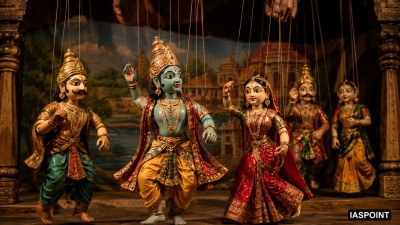
String puppetry, traditionally known as Sutragraha Vidya, is one of the most sophisticated forms of traditional Indian theater. It involves puppets carved from wood and manipulated using strings attached to various body parts, such as the head, back, and limbs. The technical complexity of these puppets allows for a high degree of flexibility and fluid movement, making them a primary tool for narrating Indian epics and folklore.
Technical and Theoretical Foundations
The manipulation of string puppets is based on the principle of tension and gravity. The puppeteer, known as the Sutradhara, controls the puppet from above, often hidden by a backdrop.
- The Sutradhara Concept: In Sanskrit, Sutra means string and Dhara means holder. This term is central to Indian dramaturgy, suggesting that classical theater may have evolved from puppetry techniques.
- Anatomy of the Puppet: Most Indian string puppets are jointed at the shoulders, elbows, hips, and knees. However, regional variations like the Rajasthani Kathputli purposefully omit legs to emphasize rhythmic torso movements.
- The Boli: A unique feature of North Indian string puppetry is the use of a small bamboo whistle called a Boli, which produces a high-pitched, stylized voice for the puppets.
Regional Variations of String Puppetry in India
| Form | Region | Material | Distinctive Characteristics |
| Kathputli | Rajasthan | Wood & Cotton | No legs; controlled by a single string; large oval eyes. |
| Kundhei | Odisha | Light Wood | Multiple joints; dressed in Jatra style costumes. |
| Gombeyatta | Karnataka | Wood | Modeled after Yakshagana; complex stringing with a head-ring. |
| Bommalattam | Tamil Nadu | Wood & Cloth | Largest and heaviest; combines string and rod techniques. |
Detailed Analysis of Regional Styles
Kathputli of Rajasthan
The most famous string puppetry form, maintained by the Bhat community.
- Stylization: Puppets are carved from a single block of wood. Instead of legs, they have long, trailing skirts (ghagras) that swirl during dance sequences.
- Performance: Shows are usually held on a portable stage called a Taj Bari. The themes center on the legendary hero Amar Singh Rathore.
- Acoustics: The puppeteer uses a Boli to “speak,” and the Dholak provides the rhythmic accompaniment.
Kundhei of Odisha
Influenced by the Vaishnava movement and the Giti Natya tradition.
- Design: These puppets have more joints than the Rajasthani counterparts, allowing for delicate hand gestures and seated postures.
- Narrative: The plays predominantly focus on the Raslila (the life of Krishna) and stories from the Ramayana.
- Music: Accompanied by traditional Odissi music, using instruments like the Mardala and Pakhawaj.
Gombeyatta of Karnataka
This form is a miniature version of the Yakshagana folk theater.
- Costume and Makeup: The puppets wear the same elaborate headgears (Kirita) and facial paint as Yakshagana actors.
- Complexity: A single puppet may have 5 to 7 strings attached to a circular wooden prop held by the puppeteer.
- Repertoire: Performances are based on the Prasangas (episodes) of the Ramayana and Mahabharata.
Bommalattam of Tamil Nadu
Regarded as the most technically advanced puppetry form in India.
- Hybrid Nature: It is a unique mix of string and rod puppetry. Strings are attached to a cloth-covered iron ring which the puppeteer wears on their head like a crown, while rods move the hands.
- Size: These are the largest and heaviest string puppets in India, some reaching nearly 4 feet in height and weighing up to 10 kg.
- Ritual: Shows traditionally begin with an invocation to Vinayaka (Ganesha) followed by a ritualistic dance of a puppet called Komali.
Socio-Cultural Significance and Preservation
String puppetry serves as a repository of oral history and regional aesthetics.
- Social Reform: Modern troupes under the Sangeet Natak Akademi use string puppets to address contemporary issues like family planning, immunization, and environmental conservation.
- Economic Structure: Historically, string puppeteers were nomadic, traveling from village to village during the post-harvest season.
- Institutional Support: The Indian Puppetry Unit of the Sangeet Natak Akademi provides grants, organizes the Putul Amrut festival, and runs training workshops to prevent the extinction of rare forms like Kundhei.
Trivia for UPSC Prelims
- Silappadikaram: The ancient Tamil epic (2nd Century CE) contains the earliest literary evidence of string puppets in India.
- The Bhats: The traditional community in Rajasthan responsible for the survival of Kathputli.
- Wood Choice: Traditionally, puppets are made from the wood of the Adusa (Malabar Nut) or Gular (Cluster Fig) tree due to their lightness and durability.
- Putul Nach: While generally referring to rod puppets in Bengal, the term is a generic Bengali phrase for “puppet dance” and is sometimes applied to regional string variations.