
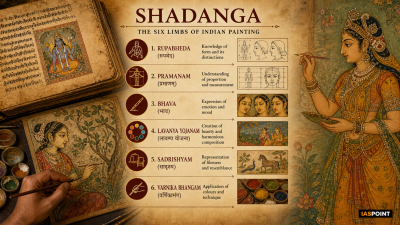
The Shadanga, or the “Six Limbs of Indian Painting,” constitutes the classical canon of Indian art. These principles were first codified in the Vishnudharmottara Purana (specifically the Chitra Sutra section) and later popularized in the 11th-century commentary by Yashodhara Pandit on Vatsyayana’s Kamasutra.
Historical Context and Origin
- Ancient Roots: While painting existed since prehistoric times, formal theory was consolidated during the Gupta period (the “Golden Age”).
- The Verse: The six limbs are summarized in a famous Sanskrit shloka:
“Rupabhedah pramanani bhava-lavanya-yojanam | Sadrishyam varnikabhangam iti chitram shadangakam ||”
- Significance: These rules transformed painting from a mere craft into a sophisticated “Shastra” (science), ensuring that art conveyed spiritual and emotional depth rather than just physical likeness.
The Six Limbs (Shadanga) in Detail
1. Rupabheda (Knowledge of Appearances)
- Definition: The ability to distinguish between different forms and shapes.
- Application: An artist must perceive the subtle differences between various characters (e.g., a king vs. a monk) through their physical attributes and postures.
- Objective: To achieve clarity of form so the viewer can immediately identify the subject’s status and nature.
2. Pramanam (Proportion and Measurement)
- Definition: The science of scale, perspective, and the structural integrity of the figure.
- Standardization: It uses units like Tala (the palm of a hand) and Angula (width of a finger) to maintain anatomical harmony.
- Aesthetic Logic: For instance, a deity is often depicted in the Navatala (9-part) or Dashatala (10-part) measure to signify divine proportions compared to ordinary humans.
3. Bhava (Expression and Emotion)
- Definition: The infusion of feelings, moods, and sentiments into the art.
- Connection to Rasa: Bhava is the vehicle through which the Nava Rasas (nine emotions like Love, Valor, Compassion, etc.) are evoked in the audience.
- Method: Expressed through “Drishti” (glance), mudras (hand gestures), and body flexions (e.g., Tribhanga or the triple-bend pose).
4. Lavanya Yojanam (Infusion of Grace)
- Definition: The artistic “salt” or “charm” that provides luster and beauty to the painting.
- Function: While Bhava deals with internal emotion, Lavanya deals with external elegance and aesthetic appeal. It ensures the figure does not look stiff or mechanical despite following strict proportions.
5. Sadrishyam (Similitude and Realism)
- Definition: The likeness or correspondence between the painted object and the real world.
- Nature-based Analogies: Indian artists rarely used literal realism; instead, they used metaphors from nature. For example:
- Eyes shaped like a lotus petal (Padmapatra) or a fish (Minakshi).
- A nose like a parrot’s beak.
- Arms like a trunk of an elephant.
6. Varnikabhanga (Color Scheme and Brushwork)
- Definition: The artistic use of color, pigments, and the mastery of the brush.
- Technicality: This limb covers the preparation of paints from minerals and vegetables, the mixing of shades, and the final execution of strokes to create texture and depth.
- Symbolism: Colors often held specific symbolic meanings (e.g., Blue for Krishna/Infinite, Yellow for Asceticism).
Summary Table: The Six Limbs at a Glance
| Limb (Sanskrit) | English Equivalent | Primary Focus |
| Rupabheda | Diversity of Form | Visual differentiation and characterization. |
| Pramanam | Proportion | Measurement, anatomy, and structural scale. |
| Bhava | Expression | Conveying internal emotion and Rasa. |
| Lavanya Yojanam | Grace/Charm | External beauty and aesthetic polish. |
| Sadrishyam | Likeness | Use of natural metaphors to achieve realism. |
| Varnikabhanga | Color/Brushwork | Technical mastery of tools and pigments. |
Critical Facts and Trivia for UPSC Prelims
- V.S. Agrawala and Abanindranath Tagore: In the modern era, Abanindranath Tagore (nephew of Rabindranath Tagore) played a pivotal role in reviving the Shadanga theory to counter Western “Academic Realism” during the Bengal School of Art movement.
- The Chitra Sutra: This is part of the Vishnudharmottara Purana (Third Khanda) and is considered the most exhaustive ancient treatise on Indian painting, detailing everything from surface preparation to the depiction of different types of men and women.
- Ajanta Caves: The murals at Ajanta are regarded as the most perfect practical application of the Shadanga principles in ancient India.
- Terminology: In UPSC questions, “Pramanam” is frequently tested in the context of both painting and temple architecture (Shilpa Shastra).
- Relationship with Rasa Theory: While Bharata Muni’s Natya Shastra focused on drama and dance, Shadanga successfully adapted the concept of Rasa (Aesthetic Flavour) specifically for the two-dimensional medium of painting.
Integration in Indian Art Traditions
The Shadanga was not a restrictive set of rules but a flexible framework. It allowed regional variations to flourish:
- Mughal Tradition: Emphasized Pramanam and Varnikabhanga for portraiture and courtly realism.
- Rajput/Pahari Tradition: Focused heavily on Bhava and Sadrishyam to depict the devotional intimacy of the Radha-Krishna theme.
- Folk Art: While less formal, folk traditions like Madhubani or Pattachitra still unconsciously adhere to Rupabheda and Varnikabhanga through their bold outlines and distinct color palettes.