
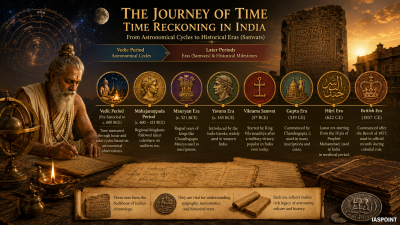
The history of time reckoning in India is characterized by a transition from the astronomical cycles of the Vedic period to the establishment of specific eras (Samvats) to commemorate dynastic achievements, military victories, or celestial alignments. For a UPSC aspirant, understanding these eras is crucial as they provide the chronological framework for Indian epigraphy, numismatics, and literature.
Major Historical Eras and Samvats
Indian history has utilized various eras, often overlapping in geography and time. The following are the most significant for administrative and cultural history.
| Name of the Era | Commencement | Founder / Origin | Context / Significance |
| Kali Era | 3102 BCE | Astronomical | Traditionally marks the end of the Mahabharata War and the departure of Lord Krishna. |
| Vikrama Samvat | 57-58 BCE | King Vikramaditya | Commemorates the defeat of the Shakas (Scythians) in Ujjain. |
| Saka Samvat | 78 CE | King Kanishka (Kushana) | Adopted as the basis for the Indian National Calendar in 1957. |
| Kalachuri Era | 248-249 CE | Ishwarsena (Abhira King) | Also known as the Traikutaka Era; used in Western and Central India. |
| Gupta Era | 319-320 CE | Chandragupta I | Marks the coronation of the first great Gupta emperor. |
| Harsha Era | 606 CE | Harshavardhana | Established by the ruler of Kannauj to mark his accession. |
| Kollam Era | 825 CE | Chera Kings | Predominantly used in the Kerala region (Malayalam Calendar). |
| Chalukya-Vikrama | 1076 CE | Vikramaditya VI | Established by the Western Chalukya king to replace the Saka Era. |
| Ilahi Era | 1584 CE | Akbar | A solar calendar introduced by the Mughal emperor to replace the Hijri era. |
Detailed Analysis of Primary Eras
Vikrama Samvat (57 BCE)
- Nature: It is a Luni-Solar calendar where the new year traditionally starts on the day after the new moon in the month of Chaitra (Chaitra Sukladi).
- Regional Use: Widely used in Northern, Western, and Central India.
- Calculation: To convert a Gregorian year to Vikrama Samvat, add 57 years (e.g., 2026 + 57 = 2083 VS).
- Variations: In Gujarat, the new year begins on the day after Diwali (Kartika Shukla Pratipada).
Saka Samvat (78 CE)
- Historical Basis: Most historians attribute it to the Kushana King Kanishka. It was later extensively used by the Western Kshatrapas and the Satavahanas.
- Official Status: It is the official civil calendar of India.
- Calculation: To convert a Gregorian year to Saka Samvat, subtract 78 years (e.g., 2026 – 78 = 1948 Saka).
- Structure: It follows a solar cycle for official purposes, starting on March 22 (March 21 in leap years).
Gupta Era (319-320 CE)
- Epigraphic Evidence: Found in the Junagadh Rock Inscription of Skandagupta and various copper plate grants.
- Continuity: It remained in use even after the decline of the Guptas by the Valabhi kings of Gujarat (hence sometimes called the Valabhi Era).
- Chronological Importance: This era allowed historians to fix the dates of the “Golden Age” of Indian history with precision.
The Indian National Calendar
Following the recommendations of the Calendar Reform Committee (1952) chaired by Meghnad Saha, India adopted a standardized version of the Saka Era for official purposes on March 22, 1957 (Chaitra 1, 1879 Saka).
- Standardized Months: The months have fixed lengths to align with the tropical year.
- First Month: Chaitra (30 days in a normal year; 31 in a leap year).
- Usage: It is used alongside the Gregorian calendar for the Gazette of India, All India Radio broadcasts, and government communications.
Religious and Regional Time Scales
The Hijri Era (622 CE)
- While primarily an Islamic lunar calendar, it is significant in Indian history for dating the Sultanate and Mughal periods.
- It marks the Hijra (migration) of Prophet Muhammad from Mecca to Medina.
Lakshmana Era (1119 CE)
- Associated with King Lakshmana Sena of the Sena Dynasty in Bengal.
- It was used in Bihar and Bengal for several centuries before being superseded.
Rajyabhishek Era (1674 CE)
- Introduced by Chhatrapati Shivaji Maharaj at the time of his coronation in Raigad.
- It was intended to signify Maratha sovereignty and independence from Islamic and other external eras.
Quick Fact File for UPSC Prelims
- Conversion Formula: VS = Saka + 135. This relationship is often used by historians to verify dates in inscriptions that mention multiple eras.
- The Zero Year: In Indian eras, the year is often counted as “expired” (Gata) rather than “current” (Vartamana). For example, if a record says “Year 100 has passed,” the event occurred in year 101.
- Azadi Ka Amrit Mahotsav: During the 75th year of independence, the Indian government frequently utilized the Saka Samvat dates in official commemorative documents.
- The Nepal Sambat: Established in 879 CE, this era is still celebrated by the Newar community and was recently recognized as a national era in Nepal.
- Fasli Era: A harvest calendar introduced by Akbar to simplify land revenue collection, as the lunar Hijri calendar was impractical for agricultural cycles.