
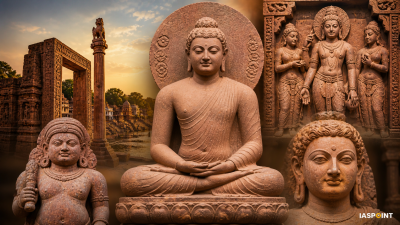
The Mathura School of Art (1st Century BCE – 3rd Century CE) emerged as a powerhouse of indigenous artistic expression centered around Mathura, Uttar Pradesh. Unlike the Gandhara school, which was heavily influenced by Greco-Roman styles, the Mathura school was a purely organic development rooted in the earlier Yaksha traditions of the Mauryan period. It flourished primarily under the patronage of the Kushana Emperors, notably Kanishka, Huvishka, and Vasudeva.
Material and Technique
The most defining physical characteristic of Mathura sculpture is the use of Spotted Red Sandstone, quarried from Sikri and Kankali Tila. The artisans utilized bold, deep carving techniques to create robust, voluminous figures that emphasized physical strength and vitality rather than the lean, muscular realism of the Northwest.
A Triple-Religious Synthesis
Mathura was a unique crucible where three major Indian religions—Buddhism, Jainism, and Brahmanism (Hinduism)—found simultaneous expression.
- Buddhism: Mathura was responsible for creating the earliest indigenous anthropomorphic images of the Buddha. The style was inspired by the massive, fleshy “Yaksha” figures of the Mauryan and Shunga eras.
- Jainism: Mathura was a major center for Jain art, specifically at Kankali Tila. It produced the earliest Tirthankara images and unique votive tablets known as Ayagapattas, which were used for worship and depicted the Ashtamangala (eight auspicious symbols).
- Brahmanism: This school saw the earliest proto-types of several Hindu deities. Notable early depictions include Shiva (often in the form of a Linga or Mukhalinga), Vishnu (with four arms or Chaturvyuha), Surya, and Balarama.
Iconic Characteristics of the Mathura Buddha
The Mathura Buddha is distinct for its focus on a “delightful” and “approachable” appearance rather than a somber, spiritual one.
- Facial Features: The face is round and smiling with fleshy cheeks. The eyes are wide open, and the ears are elongated.
- Hair: Early figures often feature a shaven head or a single spiral shell-like knot known as the Kapardin style. Later figures adopted the “snail-shell” curls.
- Physique: The body is robust and fleshy with a slightly protruding belly (Prana), symbolizing the breath of life.
- Drapery: The Buddha wears a thin, transparent muslin-like robe that clings to the body, usually covering only the left shoulder (Ekansika).
- Aura: The halo (Prabhamandala) in the Mathura school is often very large and elaborately decorated with geometric or floral patterns.
- Mudras: The Abhaya Mudra (gesture of fearlessness) is the most common pose found in Mathura statues.
Notable Sculptures and Royal Portraits
Beyond religious iconography, the Mathura school is famous for its secular and royal portraiture, which provides insight into the costumes and culture of the Kushana period.
- The Headless Statue of Kanishka: Found at Mat, this life-sized statue depicts the King in Central Asian attire—a heavy long coat, trousers, and massive padded boots. It emphasizes the “King of Kings” (Shaonanoshao) status.
- The Yakshis/Vrikshikas: The railings at Bhutesar feature sensuous female figures (Yakshis) in various poses—looking into a mirror, bathing, or playing with birds. These represent the pinnacle of feminine grace in indigenous sculpture.
- Seated Buddha at Katra Mound: A definitive example showing the Buddha seated on a lion throne under a Bodhi tree, flanked by attendants holding fly-whisks.
Comparative Analysis: Mathura vs. Gandhara
| Feature | Mathura School | Gandhara School |
| Material | Spotted Red Sandstone | Blue-Grey Schist / Stucco |
| Influence | Purely Indigenous (Yaksha tradition) | Greco-Roman / Hellenistic |
| Religious Scope | Buddhist, Jain, and Hindu | Almost exclusively Buddhist |
| Hair Style | Shaven or Snail-shell curls | Wavy, Hellenistic hair |
| Body Type | Fleshy, robust, smiling | Lean, muscular, somber |
| Halo | Large and heavily decorated | Plain and simple |
| Garments | Transparent, thin, single shoulder | Thick, heavy folds (Toga-like) |
Chronological and Geographical Reach
The influence of the Mathura school was not localized. Its products were highly sought after and have been excavated at sites as far as Sravasti, Sarnath, and even Bodh Gaya. During the later Gupta Period, the Mathura style evolved further, achieving a perfect balance between the sensuality of the Mathura tradition and the spiritualism of the emerging Sarnath school.
Fact Sheet for UPSC Prelims
- Kankali Tila: The primary archaeological site in Mathura associated with Jain sculptures and Ayagapattas.
- Ushnisha: The cranial protuberance on the Buddha’s head, which in Mathura style often looks like a snail-shell.
- Simhasana: The “Lion Throne” on which the Buddha is frequently seated in Mathura art.
- Continuity: The Mathura school bridged the gap between the archaic relief art of Bharhut and the classical perfection of the Gupta era.
- Secular Art: The “Dampati” (couple) and “Shalabhanjika” (woman and tree) motifs were refined and popularized by Mathura artisans.