
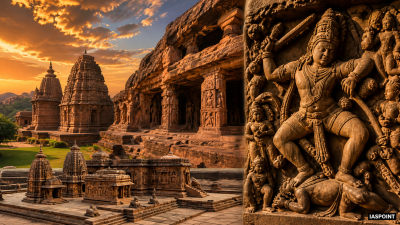
The Early Chalukyas of Badami (6th–8th Century CE) were pioneers in the transition from rock-cut architecture to structural temples in the Deccan. Their sculptural style, concentrated in Badami, Aihole, and Pattadakal, represents a vigorous synthesis of the Nagara (Northern) and Dravida (Southern) traditions. Unlike the serene, meditative quality of Gupta art, Chalukyan reliefs are characterized by dynamism, explosive energy, and heavy anatomical proportions.
Primary Centers of Chalukyan Rock-cut Art
The Chalukyan sculptural movement flourished across three major sites in modern-day Karnataka, often referred to as the “Cradle of Indian Temple Architecture.”
- Badami (Vatapi): Famous for four rock-cut cave temples carved into red sandstone cliffs. These caves contain some of the most iconic Brahmanical, Buddhist, and Jain reliefs.
- Aihole: Known for the Ravana Phadi cave and early structural experiments. The sculptures here are noted for their slender grace compared to the robust figures of Badami.
- Pattadakal: While primarily a site for structural temples, the relief work on the walls of the Virupaksha and Mallikarjuna temples represents the peak of Chalukyan narrative art.
Stylistic Characteristics of Chalukyan Sculpture
Early Chalukyan art is distinguished by its “Deccanese” robustness and a penchant for depicting deities in active, heroic postures.
- Physiognomy: Figures are generally tall with broad shoulders and powerful limbs. The faces are expressive, often showing a “half-smile” similar to Gupta influence but with more localized ethnic features.
- Movement and Energy: Sculptures are seldom static. They utilize the Tribhanga (triple-bend) and Atibhanga (extreme-bend) postures to convey a sense of divine action or dance.
- Elaborate Headdresses: Deities are often depicted with tall, cylindrical crowns known as Kiritamukutas, decorated with intricate pearl strings and jewels.
- Narrative Friezes: The use of small-scale friezes depicting scenes from the Ramayana, Mahabharata, and Puranas became a standard feature, particularly on temple basements and pillars.
Iconic Masterpieces and Iconography
The Chalukyan period saw the standardization of various Hindu iconographic forms that became blueprints for later Southern dynasties.
The Tandava Shiva (Badami Cave 1)
- A 5-foot high relief of an eighteen-armed Shiva performing the Tandava dance.
- The placement of the arms is mathematically precise; if any two arms are chosen, they form a specific dance mudra (gesture).
- He is accompanied by Nandi and Ganapati, showcasing the early integration of the Shiva family.
Vishnu as Trivikrama and Varaha (Badami Caves 2 & 3)
- Trivikrama: Depicts the “three strides” of Vishnu. The figure is shown with one leg flung high, touching the celestial sphere, capturing the moment of cosmic expansion.
- Varaha: Vishnu in his boar incarnation rescuing Bhudevi (Earth). The power and protective nature of the deity are emphasized through the muscular treatment of the torso.
Harihara (Badami Cave 3)
- A composite image of Shiva (left) and Vishnu (right). This reflects the religious syncretism of the Chalukyan court, which patronized various sects simultaneously.
Ravana Phadi Cave (Aihole)
- Features a monumental relief of Saptamatrikas (Seven Mothers) accompanied by Shiva and Ganesha.
- The figures are exceptionally tall and elegant, showing a transition toward the more refined medieval styles.
Comparative Features: Chalukyan vs. Gupta-Vakataka Sculpture
| Feature | Gupta-Vakataka Style | Early Chalukyan Style |
| Aesthetic Tone | Serene, meditative, spiritual. | Dynamic, heroic, energetic. |
| Physical Build | Slender, ethereal, soft limbs. | Robust, powerful, broad-shouldered. |
| Material | Sandstone/Basalt (smooth finish). | Red Sandstone (coarse but bold). |
| Drapery | Diaphanous, “wet” look. | Heavier, with distinct waistbands (Katisutra). |
| Focus | Inner spiritual realization. | Narrative drama and divine prowess. |
Jain and Buddhist Reliefs
Despite being primarily Vedic Hindus, the Chalukyas provided space for other faiths.
- Badami Cave 4 (Jain): Contains magnificent reliefs of Lord Bahubali (standing in Kayotsarga pose with creepers entwined around his legs) and Parshvanatha with a multi-hooded cobra.
- Aihole Buddhist Reliefs: Depicting the Buddha in various mudras, though these are fewer in number compared to the Brahmanical works.
Technical Facts and Trivia for Aspirants
- Patronage: Much of the rock-cut work was commissioned under Mangalesha (brother of Kirttivarman I).
- The Badami Inscription: An inscription in Cave 3 dated 578 CE provides a precise timeline for the completion of the Vaishnava cave, making it a “benchmark” for dating other Indian monuments.
- Nandi Mandapa: The Chalukyas popularized the concept of a separate pavilion for the sacred bull (Nandi) facing the main shrine.
- Influence of Geography: The soft texture of the Malaprabha river valley sandstone allowed Chalukyan artists to experiment with deep undercutting, creating a high-relief effect that appears almost like free-standing sculpture.
- Vesara Style: The sculptural motifs often reflect the hybrid nature of the Vesara style, blending the decorative exuberance of the South with the iconographic clarity of the North.
Summary of Iconographic Standards Established
- Nataraja: Early standardization of the multi-armed dancing Shiva.
- Mahishasuramardini: The depiction of Durga slaying the buffalo demon became more sophisticated, emphasizing the battle’s movement.
- Ganga-Yamuna: Continued the Gupta tradition of placing river goddesses at the entrance, but with more elaborate attendants and floral backdrops.