
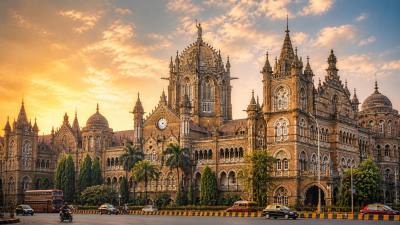
Indo-Saracenic architecture, also known as Indo-Gothic or Hindu-Gothic, was a revivalist architectural style used by British architects in India during the late 19th century. It was a conscious attempt by the British Raj to legitimate its rule by adopting the aesthetic vocabulary of previous Indian empires, specifically the Mughals and Rajputs, and merging them with Victorian Gothic and Neo-Classical frameworks. The term “Saracenic” was a label used by Europeans to describe Muslim-influenced architecture from the Middle East and India.
Key Architectural Characteristics and Elements
This style is characterized by a “hybrid” appearance, where the internal structural engineering was modern (using iron, steel, and concrete), but the exterior was clad in traditional Indian motifs.
- Onion Domes: Large, bulbous domes inspired by Mughal monuments like the Taj Mahal.
- Vaulted Roofs and Overhanging Eaves: Adaptation of the Rajput Chhajja to provide shade from the tropical sun.
- Pointed Arches and Muqarnas: Use of Gothic pointed arches often decorated with Islamic honeycomb vaulting (Muqarnas).
- Minarets and Chhatris: Slender towers and small pillared pavilions used as decorative roof elements.
- Jali Work: Intricate stone lattice screens for ventilation, borrowed from Indo-Islamic traditions.
- Polychromy: The use of contrasting colors and materials, such as red sandstone, yellow basalt, and white marble, to create visual depth.
Major Proponents and Architects
The movement was led by British architects who studied Indian monuments extensively to replicate their grandeur for colonial administrative buildings.
- Robert Fellowes Chisholm: Known for his work in Madras (Chennai), he is often considered the pioneer of this style.
- Charles Mant: He integrated Indian aesthetics with high-tech structural innovations of the time, working primarily for Princely States.
- Henry Irwin: Famous for the Viceregal Lodge in Shimla and the Mysore Palace.
- Sir Samuel Swinton Jacob: An engineer-architect who published the “Jeypore Portfolio of Architectural Details,” which became a guidebook for Indo-Saracenic motifs.
- Edwin Lutyens and Herbert Baker: While they moved toward Neo-Classicism for New Delhi, they incorporated significant Indo-Saracenic elements like the Chhatri and Chhajja in the Rashtrapati Bhavan and Secretariat.
360° Comparison: Indo-Saracenic vs. Neo-Gothic
| Feature | Indo-Saracenic Style | Neo-Gothic Style |
| Origin | Synthesis of Indian (Mughal/Rajput) and European | Medieval European Revival |
| Domes | Prominent onion-shaped or ribbed domes | Absent; replaced by spires and steeples |
| Arches | Foliated, horse-shoe, or pointed | High-pointed (Lancet) arches |
| Ornamentation | Jharokhas, Chhatris, and Jali work | Gargoyles, Flying Buttresses, and Stained Glass |
| Typical Buildings | Palaces, Museums, High Courts, Railway Stations | Churches, Educational Institutions, Secretariats |
Landmark Examples of Indo-Saracenic Architecture
- Senate House, University of Madras (Chennai): Designed by Robert Chisholm; it is one of the earliest and finest examples of this style in South India.
- Victoria Memorial Hall (Kolkata): Designed by William Emerson; it blends Mughal domes with British Classical features, often called the “Taj of the Raj.”
- Gateway of India (Mumbai): Designed by George Wittet to commemorate the visit of King George V. It heavily utilizes 16th-century Gujarati architectural motifs.
- Chhatrapati Shivaji Maharaj Terminus (Mumbai): Originally Victoria Terminus, designed by F.W. Stevens. While predominantly Gothic, it incorporates Indian animal motifs and dome structures.
- Mysore Palace (Amba Vilas): Designed by Henry Irwin for the Wodeyar dynasty; it features pink marble domes and elaborate arches, representing the pinnacle of the style in princely India.
- Mubarak Mahal (Jaipur): Built by Sir Samuel Swinton Jacob, showing how the style was adopted back by Indian royalty to modernize their own palaces.
Regional Variations
- Madras Style: Characterized by red brickwork and the use of “Madras Terrace” roofing, spearheaded by Chisholm and Irwin.
- Bombay Style: Heavy use of local yellow basalt stone (Kurla stone) and a stronger integration with Victorian Gothic.
- Indo-Deco: A later transition phase where Indo-Saracenic motifs were simplified and merged with Art Deco principles in the 1930s.
Facts and Trivia for UPSC Prelims
- The First Building: The Chepauk Palace in Chennai (designed by Paul Benfield in 1768) is often cited as the first building in India to incorporate “Saracenic” elements, though the movement peaked much later.
- Materials: While Mughals used solid stone, Indo-Saracenic buildings often used brick and concrete with a stone veneer or lime-plaster finish to save costs.
- The Jeypore Portfolio: Sir Samuel Swinton Jacob’s six-volume work was so influential that it was used as a template for Indo-Saracenic buildings as far away as Malaysia and Hong Kong.
- Hybridity: This style is frequently called “Imperial Architecture,” as it was specifically designed to make the British appear as the “natural successors” to the Mughal Emperors.
- Mayo College (Ajmer): Often called the “Eton of India,” its main building is a quintessential white marble Indo-Saracenic masterpiece designed by Charles Mant.