
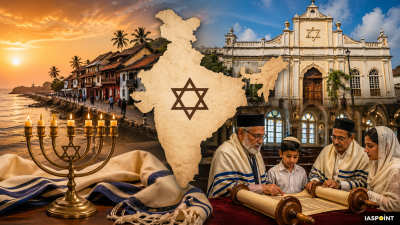
Judaism is one of the oldest non-indigenous religions in India, with a history spanning over two millennia. Unlike the history of Jews in Europe, the Indian Jewish experience is unique for its complete absence of anti-Semitism. The community arrived in distinct waves, settling primarily along the western coast and in the northeast.
- Ancient Maritime Links: Trade between King Solomon’s kingdom and the Malabar Coast (Ophir) is mentioned in biblical texts, suggesting contact as early as 1000 BCE.
- The Three Primary Groups: The Jewish population in India is traditionally divided into three distinct ethno-religious groups: the Bene Israel, the Cochin Jews, and the Baghdadi Jews. Later, the Bnei Menashe and Bene Ephraim groups were also recognized.
- Legal Status: Jews are a recognized religious minority in several Indian states (such as Maharashtra and West Bengal), though they are not yet notified as a national minority under the Central Act.
The Five Major Jewish Communities in India
Each Jewish group in India has a distinct origin story, liturgical tradition, and level of integration with local customs.
| Community | Origin/Arrival | Primary Settlement | Key Characteristics |
| Cochin Jews | Claimed arrival in 70 CE after the destruction of the Second Temple. | Kochi (Mattancherry), Kerala | The oldest community; traditionally divided into “White Jews” (Paradesi) and “Black Jews” (Malabari). |
| Bene Israel | Shipwrecked ancestors arrived on the Konkan coast approx. 2,100 years ago. | Maharashtra (Mumbai, Pune, Raigad) | The largest group; traditionally oil-pressers (Shanwar Teli); heavily influenced by Marathi culture. |
| Baghdadi Jews | Arrived in the 18th/19th century from Iraq, Iran, and Syria. | Mumbai and Kolkata | Influential in trade and industry; include the famous Sassoon family; maintained Judeo-Arabic traditions. |
| Bnei Menashe | Claim descent from the “Lost Tribe of Menasseh.” | Manipur and Mizoram | Recognized in the 20th century; follow a mix of tribal traditions and orthodox Judaism. |
| Bene Ephraim | Discovered in the late 20th century. | Andhra Pradesh (Guntur) | Known as “Telugu Jews”; claim ancient Israelite ancestry. |
Core Tenets and Religious Practice
Judaism is a monotheistic religion based on the covenant between God and the people.
- Monotheism: Belief in one God (Yahweh), who is formless and eternal.
- Sacred Texts:
- Torah: The first five books of the Hebrew Bible (Pentateuch).
- Tanakh: The complete Hebrew Bible.
- Talmud: The body of Jewish civil and ceremonial law and legend.
- The Sabbath (Shabbat): The day of rest from sunset on Friday to sunset on Saturday. The Bene Israel were called Shanwar Teli (Saturday oil-pressers) because they observed the Sabbath by not working on Saturdays.
- Synagogue: The house of prayer and study. A quorum of ten adult males, known as a Minyan, is required for certain religious obligations.
Jewish Art, Architecture, and Heritage Sites
Indian synagogues often reflect a fusion of foreign Jewish architectural styles and local Indian aesthetics.
- Paradesi Synagogue (Kochi): Built in 1568; famous for its hand-painted Chinese blue willow tiles, Belgian glass chandeliers, and a gold-plated pulpit. It is the oldest active synagogue in the Commonwealth.
- Keneseth Eliyahoo Synagogue (Mumbai): A Victorian-style building known for its distinct sky-blue facade and beautiful stained glass work.
- Magen David Synagogue (Kolkata): One of the largest synagogues in Asia, built in the Italian Renaissance style with a towering clock tower.
- Jewish Cemeteries: Significant heritage sites exist in Mumbai and Kolkata, housing the graves of prominent figures like Elias David Sassoon.
Festivals and Rites of Passage
- Rosh Hashanah: The Jewish New Year; marked by the blowing of the Shofar (ram’s horn).
- Yom Kippur: The Day of Atonement; the holiest day of the year characterized by fasting and prayer.
- Hanukkah: The Festival of Lights; commemorates the rededication of the Second Temple in Jerusalem.
- Passover (Pesach): Commemorates the Exodus of the Israelites from Egypt.
- Brit Milah: The covenant of circumcision performed on the eighth day of a male child’s life.
- Bar/Bat Mitzvah: Coming-of-age ceremonies for boys (13) and girls (12).
Prominent Indian Jews and Contributions
Despite their small numbers, the Jewish community has contributed significantly to Indian nation-building.
- Military: Lt. Gen. J.F.R. Jacob, a Baghdadi Jew, played a pivotal role in India’s victory in the 1971 Indo-Pak War and the liberation of Bangladesh.
- Industry: The Sassoon family (David Sassoon) established numerous docks, schools, and hospitals in Mumbai.
- Literature and Arts: Nissim Ezekiel, a Bene Israel Jew, was a Sahitya Akademi Award-winning poet often called the “Father of Modern Indian English Poetry.” Nadira and Pramila (Esther Victoria Abraham) were early stars of Indian cinema.
- Public Health: Dr. Haffkine, of Jewish descent, developed the plague vaccine in Mumbai (Haffkine Institute).
Factful Trivia for UPSC Prelims
- The Copper Plates of Bhaskara Ravi Varman: A 10th-century royal decree granting 72 privileges to the Jewish leader Joseph Rabban in Kochi.
- The Lost Tribes: The Bnei Menashe of the Northeast are often cited in discussions regarding the “Ten Lost Tribes” of Israel that vanished after the Assyrian conquest in 722 BCE.
- Hebrew in India: Hebrew was one of the languages in which the first Indian newspapers and books were printed, particularly in Mumbai and Kolkata.
- Aliyah: The term used for the immigration of Jews from the diaspora to the Land of Israel; a large majority of Indian Jews have performed Aliyah since 1948.
- Judaeo-Marathi: A dialect of Marathi influenced by Hebrew and Aramaic, traditionally spoken by the Bene Israel community.