
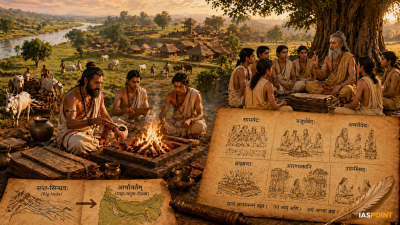
The Later Vedic Period (c. 1000 – 600 BCE) represents a significant shift in Indian civilization as the focus moved from the Sapta-Sindhu region to the Gangetic Doab (Aryavarta). This era witnessed the transition from a pastoral-tribal society to a sedentary-territorial one. While the Rig-Veda focused on hymns of praise, the Later Vedic literature—comprising the Sama, Yajur, and Atharva Vedas along with their Brahmanas, Aranyakas, and Upanishads—reflects complex rituals, social stratification, and the birth of profound philosophical inquiry.
The Three Later Vedas: Samhita Collections
The three Vedas composed after the Rig-Veda provided the liturgical and magical framework for the evolving Vedic society.
Sama-Veda (The Veda of Chants)
The Sama-Veda is primarily a collection of melodies (Saman). It is the earliest treatise on Indian music.
- Content: It contains 1,549 verses, most of which are taken directly from the Rig-Veda (specifically the 8th and 9th Mandalas) but rearranged for chanting.
- Purpose: These verses were sung by the Udgatri priests during the Soma sacrifice.
- Significance: It serves as the root of the Gandharva Veda (the Upaveda of Music).
Yajur-Veda (The Veda of Rituals)
The Yajur-Veda is a ritual manual containing the formulas (Yajus) recited by the Adhvaryu priests.
- Shukla Yajur-Veda (White): Contains only the mantras (verses) and is also known as the Vajasaneyi Samhita.
- Krishna Yajur-Veda (Black): Contains both the mantras and the prose explanations or commentaries.
- Key Sacrifices: It details the Rajasuya (consecration), Vajapeya (chariot race), and Ashvamedha (horse sacrifice) rituals used to bolster royal authority.
Atharva-Veda (The Veda of Magical Formulas)
Long excluded from the “Trayi” (the holy triad of Vedas), the Atharva-Veda was later incorporated into the Vedic fold. It reflects the popular beliefs and superstitions of the masses.
- Content: Composed of 20 books and 711 hymns, it deals with charms and spells to ward off diseases and evil spirits.
- Unique Role: It is the primary source for early Indian medicine (Ayurveda is its Upaveda).
- The Brahman: The priest associated with this Veda supervised the entire sacrifice and corrected mistakes in the rituals.
Structural Classification of Later Vedic Literature
The Later Vedic corpus is categorized into four distinct layers, moving from ritualistic action (Karma-kanda) to spiritual knowledge (Jnana-kanda).
| Category | Characterization | Focus Area |
| Samhitas | Collections | Hymns, prayers, and sacrificial formulas. |
| Brahmanas | Commentaries | Prose explanations of rituals and social duties. |
| Aranyakas | Forest Books | Symbolic and mystical interpretations of rituals. |
| Upanishads | Philosophical Texts | Inquiry into the Soul (Atman) and Brahman. |
Major Brahmanas and Their Historical Value
Brahmanas provide insights into the social hierarchy and the rise of the priestly class.
- Shatapatha Brahmana: The largest and most important Brahmana, attached to the White Yajur-Veda. It mentions the legend of Videgha Mathava, describing the expansion of Aryan culture into the eastern plains (Videha).
- Aitareya Brahmana: Defines the duties of the four Varnas and mentions the theory of the divine origin of kingship.
- Panchavimsha Brahmana: Also known as Tandya Maha Brahmana, it contains the Vratyastoma ritual to admit non-Aryans into the fold.
The Upanishads: The Peak of Indian Philosophy
There are 108 Upanishads, often referred to as Vedanta (the end of the Vedas). They reject literal ritualism in favor of self-realization.
- Mundaka Upanishad: The source of India’s national motto, “Satyameva Jayate” (Truth alone triumphs).
- Brihadaranyaka Upanishad: One of the oldest; it contains the famous dialogue between Sage Yajnavalkya and Gargi.
- Chandogya Upanishad: Provides the first reference to the three Ashramas (stages of life) and the concept of Tat Tvam Asi (That thou art).
- Katha Upanishad: Features the dialogue between Nachiketa and Yama (God of Death) regarding the nature of the soul.
Emergence of the Vedangas and Upavedas
To ensure the correct pronunciation and application of Vedic texts, six auxiliary disciplines known as Vedangas were developed.
The Six Vedangas
- Shiksha (Phonetics): Concerned with correct pronunciation.
- Kalpa (Ritual Canon): Includes Shrauta Sutras (public rituals), Grihya Sutras (domestic rituals), and Shulba Sutras (the oldest texts on geometry used for altar construction).
- Vyakarana (Grammar): Includes Panini’s Ashtadhyayi.
- Nirukta (Etymology): Explanation of difficult Vedic words (Yaska’s Nirukta).
- Chhanda (Metrics): Regulations for poetic meters.
- Jyotisha (Astronomy): Calculation of auspicious times for rituals.
The Four Upavedas (Applied Knowledge)
- Ayurveda: Medicine (linked to Atharva-Veda).
- Gandharva Veda: Music and Dance (linked to Sama-Veda).
- Dhanur Veda: Archery/Warfare (linked to Yajur-Veda).
- Shilpa Veda: Architecture/Arts (linked to Atharva-Veda).
Socio-Cultural Trivia for UPSC Prelims
- The Gotra System: The concept of Gotra (lineage) appeared first in the Later Vedic period, originally meaning “cow-pen” and later signifying descendants of a common ancestor.
- Iron (Shyama Ayas): Literature of this period refers to iron as Shyama Ayas or Krishna Ayas, indicating the technological shift that allowed for the clearing of dense forests.
- Status of Women: Unlike the Rig-Vedic period, women’s status declined; they were no longer allowed to attend the Sabha or Samiti, and the Aitareya Brahmana refers to a daughter as a source of misery.
- Types of Marriage: Later texts describe eight types of marriages, ranging from Brahma (superior) to Paishacha (inferior).