
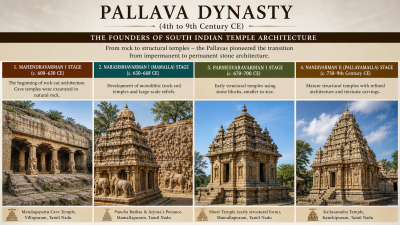
The Pallava dynasty (4th to 9th century CE) laid the foundational stone for South Indian temple architecture. Based in Kanchi (Kanchipuram) and the port city of Mamallapuram, the Pallavas transitioned Hindu architecture from ephemeral materials like wood and clay to permanent stone. This evolution is traditionally categorized into four distinct stages named after the reigning monarchs.
Four Stages of Pallava Architectural Evolution
Mahendra Style (600–630 CE)
Initiated by Mahendravarman I, this stage marks the beginning of rock-cut architecture in the Tamil region.
- Mandapas: These were rock-cut pillared halls without a separate sanctum.
- Pillar Design: Massive and square at the top and bottom, with an octagonal shaft in the middle.
- Examples: Mandagapattu (the first rock-cut temple), Mahendravadi, and Trichy rock-cut temples.
- Trivia: The Mandagapattu inscription describes the king as Vichitrachitta (the curious-minded) for building a temple without bricks, timber, or mortar.
Mamalla Style (630–668 CE)
Under Narasimhavarman I (Mamalla), rock-cut architecture reached its aesthetic peak at Mamallapuram (Mahabalipuram).
- Ratha Temples: Monolithic shrines carved out of a single boulder, resembling chariots.
- Panchapandava Rathas: A group of five monolithic temples. The Dharmaraja Ratha is the largest and provides the prototype for later Dravidian vimanas. The Draupadi Ratha is the smallest and resembles a simple thatched hut.
- Bas-Reliefs: The period is famous for “Descent of the Ganges” (or Arjuna’s Penance), one of the world’s largest open-air rock reliefs.
- Cave Temples: Notable examples include Varaha Cave and Mahishasuramardini Cave.
Rajasimha Style (670–700 CE)
Narasimhavarman II (Rajasimha) introduced structural temples built with stone blocks, moving away from rock-cutting.
- Shore Temple, Mamallapuram: One of the oldest structural stone temples in South India. It sits on the edge of the Bay of Bengal and features three shrines (two dedicated to Shiva, one to Vishnu).
- Kailasanathar Temple, Kanchipuram: Considered the masterpiece of this style. It features a pyramidal tower (shikara) and a series of small shrines attached to the inner enclosure wall.
- Architectural Shifts: Pillars became more slender and featured the Leogriff (Yali) motif at the base.
Nandivarman Style (800–900 CE)
The final phase under the later Pallavas saw a reduction in the size of the temples, tending toward the more standardized Dravidian forms that the Cholas would later perfect.
- Features: These were smaller structural temples, often incorporating features from previous stages but on a more modest scale.
- Examples: Vaikuntha Perumal Temple (Kanchipuram) and Mukteshwar Temple.
- Vaikuntha Perumal: Unique for its three-tiered sanctum and the extensive historical relief sculptures on its inner walls depicting the history of the Pallava dynasty.
Comparative Overview of Key Pallava Temples
| Temple Name | Location | Builder | Unique Feature |
| Shore Temple | Mamallapuram | Rajasimha | Early use of granite blocks; faces the ocean. |
| Dharmaraja Ratha | Mamallapuram | Mamalla | Multi-storied monolithic structure; prototype for Dravidian Vimana. |
| Kailasanathar | Kanchipuram | Rajasimha | Largest Pallava temple; sanctuary of sandstone. |
| Vaikuntha Perumal | Kanchipuram | Nandivarman II | Multistory sanctum; historical narrative friezes. |
| Mandagapattu | Villupuram | Mahendravarman I | Known as the “Lakshita-yatna” (the sought-after effort). |
Technical Features of Pallava Art
- The Yali Pillar: A signature motif where the base of the pillar is carved into a mythical lion-like creature (Yali) standing on its hind legs or sitting.
- Gopurams: Early precursors to the massive gateways of later centuries appeared as small entry porches.
- Vimana: The pyramidal tower over the sanctum sanctorum became a standardized feature during the Rajasimha phase.
- Dvarapalas: Massive, muscular door guardians (Dvarapalas) became a prominent feature flanking the entrance to the garbhagriha.
Heritage and Global Recognition
- UNESCO World Heritage Site: The Group of Monuments at Mahabalipuram (Mamallapuram) was inscribed in 1984.
- Maritime Influence: Pallava architecture influenced the temple styles of Southeast Asia, particularly the Khmer architecture of Cambodia (Angkor Wat) and the Champa architecture of Vietnam.
- Artistic Transition: The Pallavas successfully blended the Buddhist Chaitya and Vihara concepts into Hindu temple forms, specifically visible in the design of the Rathas.