
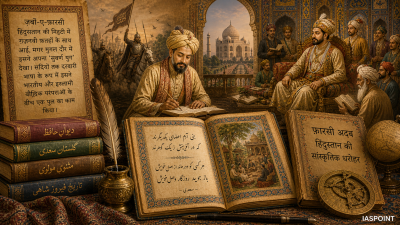
Persian literature’s journey in India began with the Ghaznavid conquests but found its “Golden Age” during the Mughal era. It served as the official court language for centuries, acting as a bridge between Indian and Islamic intellectual traditions.
Early Phase and the Delhi Sultanate
During the Delhi Sultanate, Persian became the language of the administration and the elite. This period saw the synthesis of Indian themes with Persian poetic forms.
- Amir Khusrau (1253–1325): Known as Tuti-e-Hind (Parrot of India), he pioneered the Sabaq-i-Hindi (Indian style) of Persian poetry. His works like Kiranu-s-Sa’dain and Khaza’in-ul-Futuh are vital historical sources.
- Ziauddin Barani: Author of Tarikh-i-Firoz Shahi, providing a detailed account of the Tughlaq dynasty.
- Minhaj-us-Siraj: Wrote Tabaqat-i-Nasiri, a universal history of the Islamic world.
The Mughal Renaissance and Official Historiography
The Mughals elevated Persian to unprecedented heights, making it the vehicle for sophisticated historiography and translations of Sanskrit epics.
- Akbar’s Reign: The Maktab Khana (Translation Bureau) was established. Notable translations included the Razmnama (Mahabharata) and Ramayana into Persian.
- Abul Fazl: His monumental works, Akbarnama and Ain-i-Akbari, set new standards for administrative and biographical writing.
- Dara Shikoh: The scholar-prince translated 52 Upanishads into Persian under the title Sirr-i-Akbar (The Great Secret), asserting that the Upanishads were the “hidden books” mentioned in the Quran.
Key Persian Literary Works and Authors
| Author | Work | Significance |
| Gulbadan Begum | Humayun-nama | Only major historical account by a woman in the Mughal era. |
| Faizi | Nal-Daman | Persian poetic adaptation of the Sanskrit story of Nala and Damayanti. |
| Badauni | Muntakhab-ut-Tawarikh | A critical contemporary history of Akbar’s reign. |
| Jahangir | Tuzuk-i-Jahangiri | An autobiography noted for its observations on flora, fauna, and art. |
Emergence and Growth of Urdu Literature
Urdu originated as a “camp language” (Zaban-e-Urdu-e-Mu’alla) through the interaction of Persian-speaking soldiers and local Prakrit speakers (Khari Boli) around Delhi.
The Dakhani School (Southern Tradition)
Before gaining prominence in the North, Urdu (as Dakhani) flourished in the Deccan kingdoms of Bijapur and Golconda.
- Muhammad Quli Qutb Shah: The first Sahib-e-Diwan (author of a collected volume of poetry) in Urdu.
- Wali Deccani: Known as the “Father of the Urdu Ghazal,” his arrival in Delhi in 1700 marks the shift of Urdu literature from the South to the North.
The Golden Age of Urdu in Northern India
The 18th and 19th centuries saw the refinement of Urdu under the patronage of the later Mughals and the Nawabs of Awadh.
- Mir Taqi Mir: Known as Khuda-e-Sukhan (God of Poetry), famous for his emotional depth in Ghazals.
- Mirza Ghalib: The most iconic figure of Urdu literature. His letters (Urdu-e-Mu’alla) revolutionized Urdu prose, while his Diwan-e-Ghalib remains a masterpiece of philosophical poetry.
- Zauq: The court poet of Bahadur Shah Zafar and a rival to Ghalib.
Modern Urdu Literature and the Aligarh Movement
The aftermath of 1857 led to a shift toward realism and social reform.
- Sir Syed Ahmed Khan: Promoted Urdu prose through the journal Tehzib-ul-Akhlaq.
- Altaf Hussain Hali: His Musaddas-e-Hali lamented the decline of Islamic glory and urged for modern education.
- Munshi Premchand: Though famous in Hindi, he began his career in Urdu (Soz-e-Watan), bringing the lives of the rural peasantry into mainstream literature.
Technical Forms in Persian and Urdu Literature
Both languages share several poetic structures that define their literary output:
- Ghazal: A collection of independent couplets (Sher) following a specific meter and rhyme, usually exploring themes of love and philosophy.
- Qasida: A panegyric or ode, often written in praise of a king or benefactor.
- Masnavi: Narrative poems in rhyming distichs, typically used for long epic or romantic stories.
- Marsiya: Elegies written to commemorate the martyrdom of Imam Hussain at Karbala, popularized heavily in Lucknow.
Comparative Influence and Trivia
- Linguistic Synthesis: Persian provided the vocabulary and script (Nastaliq), while Urdu adopted the grammar of Shauraseni Prakrit.
- Sufi Influence: Both literatures were heavily influenced by Sufism (Tasawwuf), emphasizing universal love and the mystical union with the divine.
- Official Status: Persian remained the official language of British India until 1835, when it was replaced by English and local vernaculars (including Urdu in certain regions).
- The Progressivists: In 1936, the Progressive Writers’ Movement (PWM) led by Sajjad Zaheer and Mulk Raj Anand gave Urdu literature a socialist and anti-imperialist direction.