
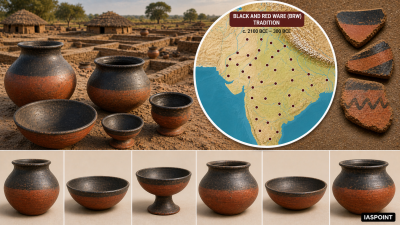
The Black and Red Ware (BRW) tradition is one of the most geographically widespread and chronologically persistent ceramic styles in Indian history. Spanning from the Neolithic-Chalcolithic era (c. 2100 BCE) through the Early Iron Age and up to the Early Historic period (c. 300 BCE), it serves as a crucial link between the decline of the Harappan civilization and the rise of the Mahajanapadas. Unlike the Ochre Coloured Pottery (OCP) or Painted Grey Ware (PGW), which are restricted to specific regions, BRW is found across the entire Indian subcontinent, from the Himalayas to the tip of the peninsula.
Technical Manufacturing: The Inverted Firing Technique
The defining characteristic of BRW is its distinctive dual-color appearance—black on the interior and around the rim, and red on the exterior. This was not achieved through painting, but through a specialized pyrotechnic process.
- Inverted Firing: The pots were placed upside down in the kiln. The interior and the rim were covered with organic matter (like husk or dung), creating a reducing atmosphere (oxygen-deprived) that turned the clay black.
- Oxidizing Atmosphere: The exposed exterior of the pot was subjected to an oxidizing atmosphere, where the iron in the clay turned red.
- Fabric Quality: BRW ranges from coarse, handmade varieties in the early Chalcolithic phases to fine, thin-walled, wheel-turned polished ware in the later Iron Age phases.
Chronological and Geographical Distribution
Archaeologists divide the BRW culture into two primary phases based on the associated metal technology and regional characteristics.
| Phase | Time Period | Key Regions | Associated Metal |
| Chalcolithic BRW | 2100 – 1000 BCE | Ahar (Rajasthan), Malwa (MP), Chirand (Bihar) | Copper |
| Iron Age BRW | 1000 – 300 BCE | Upper & Middle Ganga Valley, South India (Megalithic) | Iron |
Major Regional Variations
- Western India (Ahar-Banas Culture): The earliest significant concentration. At Ahar (Rajasthan), BRW is often decorated with white painted geometric designs.
- Middle Ganga Valley: Sites like Chirand (Bihar) and Pandu Rajar Dhibi (West Bengal) show BRW in a purely Chalcolithic context, predating the Iron Age.
- South India (Megalithic Burial Ware): In the Deccan and South India, BRW is the primary ceramic found in Megalithic burials (Adichanallur, Brahmagiri), often possessing a very high polish and metallic ring.
Typology and Decorative Patterns
While the color scheme remained consistent, the shapes evolved to meet the needs of settled agricultural and increasingly urban societies.
- Common Shapes: Deep bowls, basins, dishes-on-stand (in early phases), channeled spouts, and globular jars.
- White Painted BRW: A hallmark of the Ahar Culture, featuring dots, lines, and spirals painted in white over the black portion of the vessel.
- Graffiti Marks: Particularly in South Indian Megalithic BRW, pots often feature post-firing incised marks (symbols of stars, ladders, or arrows) that some scholars suggest are precursors to later scripts or clan identifications.
Socio-Economic and Cultural Context
The presence of BRW provides deep insights into the diet, social structure, and funerary practices of ancient Indians.
- Agricultural Base: BRW users were proficient in the cultivation of rice, wheat, barley, and lentils. In the South, it is associated with the cultivation of ragi.
- Ritualistic Use: In the Ganga Valley, BRW is often found alongside PGW (Painted Grey Ware), where BRW served as the common household ware while PGW was likely the “deluxe” or elite ware.
- Funerary Significance: In the Megalithic culture of South India, BRW was the standard funerary offering. Fine-quality bowls and dishes were placed in graves, suggesting a belief in the afterlife and the provision of food for the deceased.
Key Facts and Trivia for UPSC Prelims
- Earliest Occurrence: The earliest evidence of BRW in a Neolithic-Chalcolithic context comes from Lothal (Gujarat), indicating that the technique originated during the Harappan era but flourished later.
- The “Ahar” Connection: The Ahar-Banas culture is sometimes called the “Tambavati” (Place of Copper) culture, where BRW was the dominant ceramic.
- Stratigraphic Marker: In the Ganga Valley sequence (e.g., at Atranjikhera), BRW occupies the layer between the Ochre Coloured Pottery (OCP) and the Painted Grey Ware (PGW).
- Universal Tradition: BRW is the only pottery tradition in ancient India that bridges the gap between the Neolithic, Chalcolithic, Iron Age, and Early Historic periods across both North and South India.
- Technical Precision: The ability to maintain two distinct colors on a single vessel without the colors bleeding into each other demonstrates a very high level of control over kiln temperatures and atmospheric conditions.