
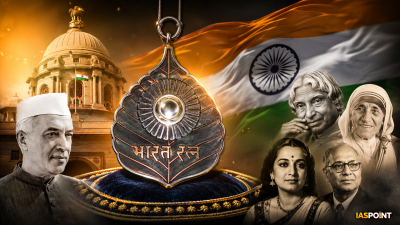
The Bharat Ratna (Jewel of India) is the highest civilian award of the Republic of India. Instituted on January 2, 1954, by the first President of India, Dr. Rajendra Prasad, it recognizes “exceptional service/performance of the highest order” without distinction of race, occupation, position, or gender. While initially limited to arts, literature, science, and public services, the criteria were expanded in December 2011 to encompass “any field of human endeavor.”
Constitutional Provisions and Validity
The Bharat Ratna and other national honors are subject to specific constitutional interpretations under Article 18(1) of the Indian Constitution, which prohibits the state from conferring titles.
- Balaji Raghavan v. Union of India (1996): The Supreme Court upheld the validity of these awards, ruling that they are not “titles” but “merit-based decorations.”
- Prohibition of Use: Recipients cannot use “Bharat Ratna” as a prefix or suffix to their names. Misuse can lead to the forfeiture of the award.
- Order of Precedence: Bharat Ratna recipients occupy the 7A position in the Indian Order of Precedence, placing them below Cabinet Ministers and above State Chief Ministers (when outside their respective states).
Statutory and Selection Framework
The process for conferring the Bharat Ratna is unique and lacks a formal nomination system like the Padma Awards.
- Recommendation: The Prime Minister recommends names directly to the President of India. No formal committee or public nomination process is mandated.
- Annual Limit: A maximum of three individuals can be awarded the Bharat Ratna in a single year (though 2024 saw an exceptional five awardees).
- Posthumous Awards: Originally, the 1954 statutes did not allow posthumous honors. This was amended in 1966. Lal Bahadur Shastri became the first posthumous recipient.
- Citizenship: While primarily given to Indian citizens, there is no written rule restricting it to nationals. Non-Indian recipients include:
- Khan Abdul Ghaffar Khan (1987) – Pakistani citizen.
- Nelson Mandela (1990) – South African citizen.
- Mother Teresa (1980) – Naturalized Indian citizen.
Design and Symbolism
The award does not include any monetary grant. Recipients receive a Sanad (certificate) signed by the President and a medallion.
| Feature | Description |
| Shape | Peepal leaf (Bronze) |
| Obverse | A sunburst with the words “Bharat Ratna” in Devanagari script |
| Reverse | State Emblem of India (Sarnath Lion Capital) with “Satyameva Jayate” |
| Wearable | Worn around the neck with a white ribbon |
Entitlements and Privileges
Beyond the prestige, the award brings specific state-sponsored benefits to the recipient:
- Tax Benefits: Indirect financial relief; any associated monetary gifts or prizes are exempt from income tax.
- Travel: Lifetime complimentary Executive Class travel on Air India and First Class travel on Indian Railways.
- State Protocol: Treated as “State Guests” during domestic travel within India.
- Passport: Eligible for a Diplomatic Passport (Maroon cover), providing VIP immigration clearance.
- Security: If required, the government provides Z-category security.
Notable Historical Facts and Trivia
- First Recipients (1954): C. Rajagopalachari, Dr. Sarvepalli Radhakrishnan, and Dr. C.V. Raman.
- Youngest Recipient: Sachin Tendulkar (at age 40), also the first sportsperson to receive the honor.
- Oldest Recipient: Dhondo Keshav Karve, who received it on his 100th birthday in 1958.
- Suspensions: The award was suspended twice:
- 1977–1980: By the Morarji Desai-led Janata Party government.
- 1992–1995: Due to PILs challenging the constitutional validity.
- Withdrawn Award: In 1992, the award for Subhash Chandra Bose was announced posthumously but was later withdrawn because the government could not provide legal proof of his death to the family’s satisfaction.
Bharat Ratna Awardees (2024)
In a historic move, five personalities were conferred the honor in 2024 for their transformative impact on Indian society and politics:
- Karpoori Thakur (Posthumous): Former Bihar CM, known for championing the cause of backward classes.
- Lal Krishna Advani: Veteran statesman and former Deputy Prime Minister.
- Chaudhary Charan Singh (Posthumous): Former Prime Minister and a towering leader of the farming community.
- P. V. Narasimha Rao (Posthumous): Former Prime Minister, architect of India’s 1991 economic reforms.
- M. S. Swaminathan (Posthumous): Father of India’s Green Revolution.