
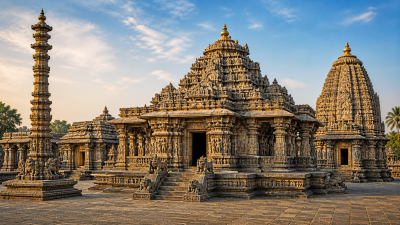
The Vesara style, often referred to as the “Hybrid” or “Deccan” style of Indian temple architecture, emerged between the 7th and 14th centuries CE. It represents a sophisticated synthesis of the Nagara (North Indian) and Dravida (South Indian) architectural traditions. Geographically, it flourished in the region between the Vindhyas and the River Krishna, primarily under the patronage of the Western Chalukyas, Rashtrakutas, and Hoysalas.
Origin and Evolutionary Phases
The evolution of Vesara architecture is marked by the experimentation of different dynasties attempting to harmonize various structural elements.
- The Early Phase (Badami Chalukyas): The style originated in the 6th century at sites like Aihole, Badami, and Pattadakal. Aihole is frequently described as the “Cradle of Indian Temple Architecture” due to the variety of experimental designs found there.
- The Mature Phase (Rashtrakutas and Later Chalukyas): The Rashtrakutas introduced monumental rock-cut versions of this hybridity, while the Western Chalukyas of Kalyani refined the structural details and ornamentation.
- The Zenith (Hoysalas): The Hoysala dynasty brought the style to its artistic peak, characterized by extreme ornamentation, the use of soapstone, and unique stellar (star-shaped) ground plans.
Architectural Characteristics of the Vesara Style
Vesara architecture is defined by the selective adoption of features from its parent styles, creating a unique aesthetic identity.
- The Shikhara (Spire): The tower typically adopts the tiered, horizontal layers of the Dravida style, but the overall profile is often curvilinear, mimicking the Nagara Shikhara.
- The Vimana: The height of the Vimana is generally reduced compared to pure Dravidian temples, giving it a more compact appearance.
- Ground Plan: While early temples followed square or rectangular plans, the later Vesara style (specifically Hoysala) adopted a Stellate (Star-shaped) plan. This was achieved by rotating a square around its center.
- Ornamentation: Vesara temples are famous for their “Jewelry-like” precision. This was facilitated by the use of Chloritic Schist (Soapstone), which is soft when quarried but hardens upon exposure to air.
- The Mandapa: Unlike the detached Mandapas of some Nagara temples, Vesara Mandapas are often integrated into the main structure, featuring highly polished, lathe-turned pillars.
Key Elements Borrowed from Parent Styles
| Feature Borrowed from Nagara | Feature Borrowed from Dravida |
| Curvilinear profile of the Shikhara. | Tiered or stepped arrangement of the tower levels. |
| Absence of prominent boundary walls in early phases. | Use of the Antarala (vestibule) connecting the sanctum to the hall. |
| The Amalaka and Kalasha at the top of the tower. | Presence of detailed carvings of Dvarapalas (Guardians). |
| Decorative motifs like the Gavaksha (horseshoe arches). | Emphasis on the horizontal division of the wall surface. |
Major Dynastic Contributions and Sites
The Badami Chalukyas (Early Vesara)
- Aihole: Home to the Lad Khan Temple (an early flat-roofed experiment) and the Durga Temple (known for its unique apsidal or semi-circular plan).
- Pattadakal: A UNESCO World Heritage site where both Nagara and Dravida styles coexist. The Papanatha Temple is a classic early Vesara example, while the Virupaksha Temple is purely Dravidian.
- Badami: Known for its four rock-cut caves that bridge the gap between Northern and Southern iconographies.
The Rashtrakutas
- Kailasa Temple (Ellora): Although predominantly Dravidian in its monolithic execution, it incorporates Nagara elements in its decorative friezes and interior layouts.
- Navalinga Temples (Kukkanur): A cluster of nine shrines exhibiting the transition toward more complex Vesara designs.
The Hoysalas (The Pinnacle)
- Chennakesava Temple (Belur): Commissioned by King Vishnuvardhana; famous for its intricate bracket figures known as Madannikas or Shalabhanjikas.
- Hoysaleswara Temple (Halebidu): A double-shrine temple (Dvikuta) featuring a massive Nandi pavilion and thousands of friezes depicting the Ramayana and Mahabharata.
- Kesava Temple (Somanathapura): A perfect example of a Trikuta (three-shrine) temple built on a high platform (Jagati) in a star shape.
Factful Trivia for UPSC Prelims
- Lathe-Turned Pillars: A unique feature of the later Vesara style where pillars were literally turned on a lathe to create deep, circular grooves and a metallic polish.
- Jagati (Platform): Most Vesara temples are built on a high platform that follows the star-shaped contour of the temple, providing a wide path for circumambulation (Pradakshina Patha).
- The Dvikuta/Trikuta System: Unlike the single sanctum of many North Indian temples, Vesara temples often feature two (Dvikuta), three (Trikuta), or even five (Panchakuta) shrines sharing a common central hall.
- Soapstone Utility: The transition from sandstone to soapstone in the 12th century allowed craftsmen to carve stone as if it were ivory or wood, leading to the dense ornamentation seen at Belur and Halebidu.
- Vimana-Shikhara Hybridity: In Vesara architecture, the terms Vimana and Shikhara are often used interchangeably because the structure consistently blends the horizontal tiers of the South with the vertical curvature of the North.
Comparative Summary of Indian Temple Styles
| Aspect | Nagara | Dravida | Vesara |
| Region | North India | South India | Deccan (Central India) |
| Tower | Curvilinear Shikhara | Pyramidal Vimana | Hybrid/Stepped Curvilinear |
| Plan | Square/Panchayatana | Square | Square/Stellar |
| Boundary | No boundary walls | High walls (Prakara) | Occasionally fenced |
| Gateways | Simple Toranas | Grand Gopurams | Modest entrances |
| Patrons | Guptas, Chandelas, Solankis | Pallavas, Cholas | Chalukyas, Hoysalas |