
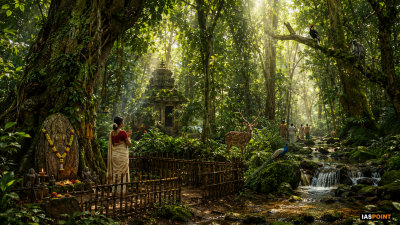
Sacred Groves, known as Pavitra Vana or Devrai, are patches of virgin forest or natural vegetation dedicated to local deities or ancestral spirits. In the framework of Indian Sacred Geography, these groves represent the “climax vegetation” of a region, preserved through traditional taboos and religious sanctions rather than formal legislation. They serve as a bridge between spiritual belief and ecological conservation, acting as “mini-biosphere reserves” that protect rare flora and fauna.
Regional Nomenclature and Distribution
Sacred groves are found across diverse bioclimatic zones in India, known by various local names that reflect the linguistic diversity of the subcontinent’s cultural landscape.
| Region/State | Local Name | Associated Deities/Community |
| Maharashtra | Devrai / Devraan | Often dedicated to Mother Goddesses like Waghjai or Kalkai. |
| Rajasthan | Oran / Kenkri | Dedicated to deities like Pabuji, Gogaji, or Mallinath. |
| Kerala | Kavu (Sarpakavu) | Associated with Serpent deities (Nagas) or Bhagavathy. |
| Karnataka | Devarakadu | Managed by the Kodava community in Coorg. |
| Tamil Nadu | Kovil Kadu | Dedicated to Aiyanar or Amman deities. |
| Meghalaya | Law Kyntang | Managed by Khasi and Jaintia tribes. |
| Madhya Pradesh | Sarna / Devkot | Central to the identity of Munda and Gond tribes. |
| Himachal Pradesh | Deo Bhumi / Deovan | Dedicated to village deities (Gram Devtas). |
Ecological and Environmental Significance
From a conservation perspective, sacred groves are vital repositories of biodiversity that provide essential ecosystem services.
- Gene Banks: They often harbor “Relict Flora”—species that have disappeared from the surrounding landscape due to deforestation.
- Water Conservation: Most groves are located near perennial water sources, ponds, or streams. The dense root systems help in groundwater recharge and soil moisture retention.
- Microclimate Regulation: These groves act as heat sinks, maintaining lower temperatures and higher humidity than their immediate surroundings.
- Nutrient Cycling: The undisturbed leaf litter promotes a rich soil profile and diverse fungal and microbial life.
Cultural and Ritual Dimensions
The preservation of these groves is governed by “Unwritten Laws” and social mores that have persisted for centuries.
- Religious Taboos: Removal of timber, hunting of animals, or even the plucking of leaves is strictly prohibited in most groves. It is believed that violating these rules incurs the wrath of the presiding deity.
- The Sarna Tradition: In Central India, the Sarna is a sacred cluster of Sal trees where the supreme deity Dharmesh is worshipped. It is the site for major festivals like Sarhul.
- Sacred Corridors: In the Western Ghats, a series of Devrais often form a contiguous corridor, allowing for the movement of wildlife and the maintenance of genetic diversity.
- Community Management: Unlike state-owned forests, sacred groves are managed by village councils or specific families, making them prime examples of Community Conserved Areas (CCAs).
Threats and Challenges
Despite their spiritual protection, sacred groves face modern pressures that threaten their integrity:
- Sanskritization: The transformation of aniconic forest shrines into concrete temples leads to the clearing of vegetation and the “urbanization” of the grove.
- Fragmentation: Infrastructure projects, such as roads and power lines, often bisect these groves, leading to the loss of edge-sensitive species.
- Invasive Species: The introduction of weeds like Lantana camara often chokes the native undergrowth.
- Commercialization: Erosion of traditional beliefs among the younger generation sometimes leads to the illegal felling of valuable timber.
Legal Status and Conservation Framework
While sacred groves were traditionally outside the purview of the Forest Department, recent legal frameworks have attempted to provide formal protection:
- Wildlife Protection (Amendment) Act, 2002: Introduced the category of “Community Reserves”, providing a legal mechanism for the government to recognize and protect sacred groves.
- Biological Diversity Act, 2002: Recognizes the role of local communities in conserving biological resources and allows for the declaration of Biodiversity Heritage Sites.
- Scheduled Tribes and Other Traditional Forest Dwellers (Recognition of Forest Rights) Act, 2006: Empowers Gram Sabhas to protect and manage their “Community Forest Resources,” which include sacred groves.
Fact File for UPSC Aspirants
- The Largest Grove: The Mawphlang Sacred Grove in Meghalaya is one of the most famous and well-preserved, strictly prohibiting the removal of even a single twig.
- Orans of Rajasthan: These are crucial for the survival of the Great Indian Bustard, as they provide undisturbed nesting grounds in the desert landscape.
- Endemic Species: The Kunstleria keralensis, a rare climbing legume, was discovered only within the sacred groves of Kerala.
- Cultural Landscape: In the Eastern Ghats, the Kondh tribes preserve groves dedicated to the Earth Goddess (Dharani Penu), linking agricultural fertility to forest health.
Trivia: The ‘Living Fossils’
Many sacred groves in the Western Ghats contain species of trees that date back to the Gondwana era. Botanists often refer to these groves as “Living Museums” of botanical history because the species inside them have remained unchanged for millions of years, protected by the “Sacred Geography” of the local inhabitants.
Last Modified: May 7, 2026