
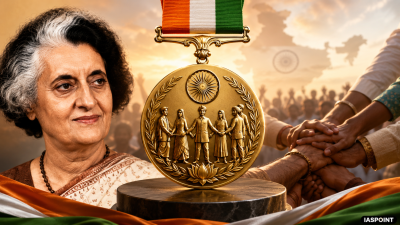
The Indira Gandhi Award for National Integration is a prestigious recognition instituted by the Indian National Congress in 1985 to mark its centenary year. Named after the former Prime Minister Indira Gandhi, the award honors individuals and institutions for their “exceptional contribution to promoting national integration and understanding and fellowship amongst religious groups, communities, ethnic groups, cultures, languages, and traditions of India.” It seeks to strengthen the nation’s unity through both thought and action.
Institutional Framework and Selection
The award is distinct from the Indira Gandhi Prize for Peace, Disarmament and Development, as it specifically focuses on the internal social fabric and domestic unity of India.
- Granting Authority: Indian National Congress (INC).
- Administration: Overseen by an Advisory Committee of eminent personalities from diverse fields such as art, science, culture, education, literature, social work, journalism, law, and public life.
- Eligibility: Open to Indian citizens and institutions. It covers services rendered during the year of the award and the two preceding years.
- Presentation Ceremony: Traditionally presented on October 31st, which marks the death anniversary (Martyr’s Day) of Indira Gandhi.
Award Components
The honor includes a monetary grant and a formal commendation for the recipient’s life-long or specific recent contributions.
- Cash Prize: ₹10 Lakh (originally ₹5 Lakh, later revised).
- Citation: A detailed scroll of honor describing the recipient’s impact on national unity.
Distinguished Recipients
The award has been conferred upon a wide spectrum of pioneers, ranging from classical musicians and filmmakers to social activists and spiritual leaders.
| Year | Recipient | Field / Contribution |
| 1985 | Aruna Asaf Ali | Freedom fighter and social activist; the first recipient. |
| 1990 | M. S. Subbulakshmi | Carnatic music legend; used music as a tool for national harmony. |
| 1991 | Rajiv Gandhi | Posthumously awarded for his vision of a modern, united India. |
| 1993 | Acharya Tulsi | Jain religious leader and pioneer of the Anuvrat movement. |
| 2003 | Shyam Benegal | Filmmaker; recognized for his cinema reflecting India’s pluralistic culture. |
| 2005 | Javed Akhtar | Noted lyricist and poet; vocal advocate for secularism. |
| 2010 | A. R. Rahman | Global music composer; shared with the Ramakrishna Mission. |
| 2012 | Gulzar | Renowned poet and filmmaker for promoting linguistic and cultural harmony. |
| 2013 | M. S. Swaminathan | Agricultural scientist; for ensuring food security as a pillar of stability. |
| 2015-16 | T. M. Krishna | Carnatic vocalist; for breaking caste barriers in classical music. |
| 2017-19 | Chandi Prasad Bhatt | Environmentalist and Chipko Movement pioneer; for social upliftment. |
Specific Objectives and Criteria
The award selection is guided by the recipient’s ability to navigate and mitigate the “narrow domestic walls” of society. Key criteria include:
- Communal Harmony: Active work in reducing friction between different religious and ethnic groups.
- Cultural Fellowship: Efforts to bridge the gap between diverse Indian languages and traditions.
- Strengthening Unity: Academic or field-based work that reinforces the concept of “Ek Bharat Shreshtha Bharat.”
- Upliftment of the Down-trodden: Dedicated service to the poor and marginalized across all communities.
Comparison with the Indira Gandhi Peace Prize
For UPSC aspirants, it is critical to distinguish between these two similarly named honors to avoid errors in Prelims.
| Feature | Award for National Integration | Prize for Peace, Disarmament & Development |
| Authority | Indian National Congress | Indira Gandhi Memorial Trust |
| Focus | Domestic Unity and Harmony | International Peace and Development |
| Monetary | ₹10 Lakh | ₹1 Crore |
| Scope | National | International |
| Latest (2026) | Periodic Selection | Graça Machel (Mozambican humanitarian) |