
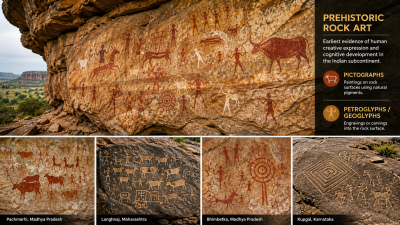
Prehistoric rock art serves as the earliest evidence of human creative expression and cognitive development in the Indian subcontinent. Indian rock art is broadly categorized into two types: Pictographs (paintings on rock surfaces) and Petroglyphs/Geoglyphs (engravings or carvings into the rock surface).
Distinction Between Petroglyphs and Geoglyphs
Petroglyphs
Petroglyphs are created by removing part of a rock surface through incising, picking, carving, or abrading. In India, these are primarily found on vertical cave walls or boulders.
Geoglyphs
Geoglyphs are large-scale designs or motifs produced on the ground. These are often formed by arranging stones (additive) or by removing the top layer of soil/patina to reveal the contrasting rock underneath (substractive). The Konkan region of Maharashtra is the primary hub for these in India.
Key Geographical Clusters of Indian Petroglyphs
| Region | Key Sites | Distinctive Features |
| Ladakh | Leh, Kargil, Zanskar (e.g., Saspol, Domkhar) | Depictions of Ibex, snow leopards, and hunters; strong influence of Central Asian styles. |
| Konkan (Maharashtra) | Ratnagiri, Rajapur, Lanja (e.g., Kasheli, Barsu) | Predominantly geoglyphs of massive scale; includes aquatic life (whales, turtles) and land animals (elephants, tigers). |
| Karnataka | Kupgal, Sanganakallu, Maski | Known for “musical stones” or lithophones; depictions of cattle, humped bulls, and anthropomorphic figures. |
| Andhra Pradesh | Ketavaram, Kurnool | Rich in Neolithic and Mesolithic petroglyphs showing hunting scenes and deer. |
| Kashmir | Burzahom | A famous Neolithic slab depicting a hunting scene with two suns (potentially a supernova observation). |
The Konkan Geoglyphs: A Recent Discovery
The Konkan region of Maharashtra and Goa has revealed over 1,000 geoglyphs across 50 sites, which are currently on the UNESCO World Heritage tentative list. These sites are carved into laterite plateaus known locally as Sada.
Chronology and Cultural Significance
- Time Period: Estimated to date from the Mesolithic era (approx. 10,000–30,000 years ago).
- Ecological Insight: The presence of hippopotamus and rhinoceros carvings suggests that the Konkan climate was once vastly different, likely characterized by wetlands and perennial rivers.
- Scale: Some figures are life-sized, while others, like the “Master of Animals” at Barsu, span several meters, depicting a human figure flanked by two large animals.
The Ladakh Petroglyphs: The “Art of the Silk Road”
Ladakh is one of the world’s richest petroglyph zones, acting as a crossroads for different ancient cultures.
Thematic Elements
- Hunting and Fauna: Deeply incised images of the Himalayan Ibex, which was considered a symbol of fertility and prosperity.
- Early Religious Symbols: Early “Swastikas,” Sun motifs, and “Chortens” (Stupas) carved during the transition to the Buddhist era.
- Weaponry: Detailed depictions of bows, arrows, and shields used by early nomadic tribes.
South Indian Rock Engravings: The Neolithic Phase
In the Deccan plateau, petroglyphs are often associated with the Neolithic-Megalithic transition.
The Kupgal “Cinder Mounds”
Kupgal in Karnataka is famous for petroglyphs that are bruised into the rock rather than deeply carved. A unique feature of this site is the “musical rocks”—boulders with natural resonance that were struck as part of ritualistic performances, evidenced by the percussion marks on the rock art itself.
Analytical Comparison: Rock Paintings vs. Petroglyphs
| Feature | Rock Paintings (Pictographs) | Petroglyphs/Geoglyphs |
| Medium | Natural pigments like hematite (Geru), lime, and charcoal. | Physical abrasion, carving, or chiseling of the rock crust. |
| Prominent Site | Bhimbetka (Madhya Pradesh). | Ratnagiri (Maharashtra), Ladakh. |
| Durability | Vulnerable to rain and light; often found in deep shelters. | More durable against weather; often found on open plateaus (Geoglyphs). |
| Primary Themes | Social dancing, communal feasts, pregnancy. | Zoomorphic figures, geometric patterns, and large-scale animals. |
Key Facts for UPSC Prelims
- UNESCO Status: The Petroglyphs of the Konkan region were added to the UNESCO World Heritage Tentative List in 2022.
- Scientific Dating: Methods like Cosmogenic Radionuclide Dating and Optically Stimulated Luminescence (OSL) are being increasingly used to date these engravings, as traditional Carbon-14 dating is difficult on inorganic rock.
- The Burzahom Slab: This Neolithic site in Kashmir features a petroglyph showing two suns and a hunting scene; many astronomers believe this represents the HB9 supernova witnessed around 3600 BCE.
- Petroglyph vs. Inscription: Unlike later Ashokan inscriptions which are linguistic and political, prehistoric petroglyphs are purely symbolic and ritualistic, representing a pre-literate society.
Conservation Challenges
The prehistoric rock art of India faces significant threats from industrialization and natural weathering. In the Konkan region, laterite mining and the proposed Ratnagiri Refinery and Petrochemicals project have sparked debates regarding the conservation of the geoglyphs. Furthermore, the lack of a dedicated national legislation specifically for “non-monumental” rock art sites makes them vulnerable to encroachment and destruction.
Last Modified: May 4, 2026