

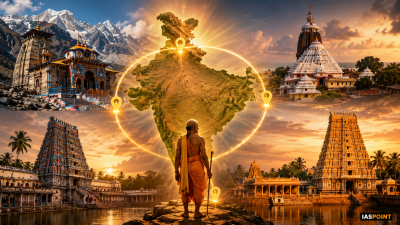
The Char Dham (meaning “Four Abodes”) represents a grand pilgrimage circuit defined by the four cardinal directions of the Indian subcontinent. Unlike the “Chota Char Dham” of Uttarakhand, this circuit encompasses the entire geographical extent of India. Established by the 8th-century philosopher-saint Adi Shankaracharya, the circuit was designed to integrate the diverse cultural and linguistic regions of India into a single cohesive spiritual landscape, fostering a sense of national unity (Ek Bharat Shreshtha Bharat).
The Four Cardinal Points and Their Significance
Each site in the Char Dham is dedicated to a specific form of Lord Vishnu (or his avatars) and is associated with a specific temporal age (Yuga).
| Direction | Site | State | Primary Deity | Associated Yuga |
| North | Badrinath | Uttarakhand | Badrinarayan (Vishnu) | Satya Yuga |
| East | Jagannath Puri | Odisha | Lord Jagannath (Krishna) | Kali Yuga |
| South | Rameshwaram | Tamil Nadu | Ramanathaswamy (Shiva/Vishnu) | Treta Yuga |
| West | Dwarka | Gujarat | Dwarkadhish (Krishna) | Dwapara Yuga |
Badrinath: The Northern Abode
Situated in the Garhwal Himalayas at an elevation of 3,133 meters, Badrinath is the only site that is part of both the original Char Dham and the Himalayan Chota Char Dham.
- Architecture: The temple features a bright, colorful facade reminiscent of Buddhist vihara architecture. It is built in the Nagara style with a conical top (shikhara).
- Key Features: The presiding deity is a 1-meter tall black stone (Shaligram) statue of Vishnu in a meditative pose (Padmasana).
- Sacred Geography: Located on the banks of the Alaknanda River. It includes the Tapt Kund, a natural thermal spring believed to have medicinal properties.
- The Adi Shankara Connection: Shankara discovered the idol in the Alaknanda River and enshrined it in a cave near the Tapt Kund.
Jagannath Puri: The Eastern Abode
Located on the coast of the Bay of Bengal, Puri is the site of the 12th-century Jagannath Temple, a masterpiece of Kalinga Architecture.
- Deities: A unique trinity consisting of Lord Jagannath, his brother Balabhadra, and sister Subhadra. The idols are made of wood (Darubrahma) and are replaced every 12 or 19 years (Nabakalebara).
- Ratha Yatra: The world-renowned Chariot Festival where the deities travel to the Gundicha Temple.
- Architectural Marvels: The temple is famous for its “non-shadow” property (the main shikhara’s shadow is said not to fall on the ground at any time of day) and the Nilachakra (an eight-spoked wheel atop the temple).
Rameshwaram: The Southern Abode
Situated on Pamban Island in Tamil Nadu, this site bridges the traditions of Shaivism and Vaishnavism.
- Mythology: Believed to be the place where Lord Rama built the Ram Setu (Adam’s Bridge) to Lanka and later established a Shiva Lingam to seek atonement.
- Architecture: A classic example of Dravidian Architecture. It is world-famous for its outer corridor, which is the longest temple corridor in the world, featuring nearly 1,212 carved pillars.
- Sacred Wells: The temple complex contains 22 Theerthams (sacred water bodies); bathing in these is considered an essential part of the pilgrimage.
Dwarka: The Western Abode
Located at the tip of the Saurashtra peninsula where the Gomti River meets the Arabian Sea, Dwarka is the legendary kingdom of Lord Krishna.
- Jatadwara (Dwarkadhish Temple): The main temple, also known as Jagat Mandir, is a five-storied limestone structure supported by 72 pillars.
- The Flag (Dhvaj): The temple flag, featuring the sun and moon, is changed five times a day and is visible from several kilometers away.
- Archaeological Significance: Marine archaeology has uncovered submerged structures off the coast of Dwarka, providing a historical basis for the descriptions found in the Mahabharata.
The Adi Shankara Institutional Framework: The Four Mathas
To preserve the Char Dham tradition and the Advaita Vedanta philosophy, Adi Shankara established four monastic institutions (Mathas) corresponding to the cardinal points.
| Matha | Location | Veda Associated | Mahavakya (Great Saying) |
| Jyotirmath | Joshimath (near Badrinath) | Atharva Veda | Ayam Atma Brahma |
| Govardhana Matha | Puri | Rig Veda | Prajnanam Brahma |
| Sringeri Sharada Peetham | Sringeri (near Rameshwaram) | Yajur Veda | Aham Brahmasmi |
| Kalika Matha | Dwarka | Sama Veda | Tat Tvam Asi |
Cultural Landscape and Pilgrimage Economy
- Traditional Routes: Historically, the Char Dham encouraged “Parikrama” (circumambulation) of the entire Indian landmass, facilitating the exchange of art, silk, spices, and philosophical ideas.
- Sanskritization: The circuit helped integrate local folk deities into the “Great Tradition” of Puranic Hinduism.
- Socio-Economic Hubs: These sites evolved into centers of excellence for classical music, dance (e.g., Odissi in Puri), and traditional crafts (e.g., Pattachitra paintings).
Fact File for UPSC Aspirants
- Badrinath Opening: The temple remains closed for six months during winter; the deity is moved to Joshimath for worship.
- Rameshwaram’s dual status: It is the only site that is both a Char Dham and a Jyotirlinga.
- The “Chota” Distinction: The Chota Char Dham (Yamunotri, Gangotri, Kedarnath, Badrinath) is located entirely within Uttarakhand and is a regional circuit, unlike the pan-Indian Char Dham.
- Nirmalya: The Mahaprasad of Jagannath Puri is the only offering in India that can be shared by people of all castes together, symbolizing social equality in the eyes of the divine.
Trivia: The Divine Daily Routine
A popular cultural belief suggests that Lord Vishnu performs his daily chores across the four abodes:
- Bathes at Badrinath (North).
- Changes Clothes at Dwarka (West).
- Eats at Puri (East).
- Rests at Rameshwaram (South).