
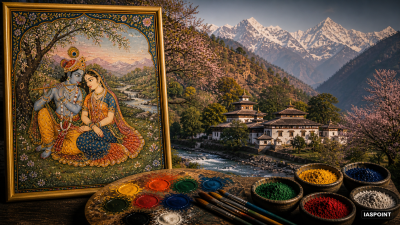
The Pahari School of Painting refers to the artistic traditions that flourished in the Himalayan foothills (Punjab Hills) between the 17th and 19th centuries. Spanning the regions of modern-day Himachal Pradesh, Jammu & Kashmir, and Uttarakhand, this school is renowned for its lyrical grace, rhythmic lines, and deep emotional resonance, primarily rooted in the Bhakti movement.
Historical Genesis and Evolution
The Pahari style emerged from a synthesis of the indigenous folk art of the hills, the refined Mughal technique brought by fleeing artists during Aurangzeb’s reign, and the influence of the Rajasthani Basohli style.
- Early Phase (17th Century): Dominated by the Basohli school, characterized by bold colors, unconventional geometry, and intense emotional expression.
- Refinement Phase (18th Century): The migration of the Pandit Seu family (and his sons Manaku and Nainsukh) led to the development of the Guler and Kangra styles, introducing naturalism and delicate linework.
- Late Phase (19th Century): A gradual decline in patronage led to more repetitive styles, though the Sikh school in Punjab emerged as a late offshoot.
Core Stylistic Characteristics
Pahari paintings are distinguished by their “miniature” scale and specific aesthetic standards that separate them from their Rajasthani counterparts.
- Color Palette: Use of soft, cool colors like blues, greens, and pinks (especially in Kangra), contrasting with the fiery reds and yellows of the earlier Basohli phase.
- Landscape: Unlike the flat backgrounds of Mewar, Pahari art features realistic Himalayan topography, including flowering trees, undulating hills, and winding streams.
- Human Form: Women are depicted with porcelain-like skin, long tapering fingers, and almond-shaped eyes. The faces are usually shown in profile with a high forehead and a straight nose.
- Symbolism: Use of “Barahmasa” (twelve months) and “Nayaka-Nayika Bheda” (classification of heroes and heroines) to symbolize the soul’s yearning for the divine.
Major Sub-Schools of Pahari Painting
The Pahari tradition is a cluster of distinct regional styles, each with unique technical identifiers.
| Sub-School | Key Features | Notable Patrons/Artists |
| Basohli | Oldest school; bold primary colors; use of beetle wings for jewelry effects. | Raja Kirpal Pal; Artist Devidasa. |
| Guler | The “Birthplace” of the Kangra style; introduces naturalism and soft shading. | Raja Govardhan Chand; Pandit Seu. |
| Kangra | The zenith of Pahari art; lyrical, feminine grace; focus on Radha-Krishna. | Raja Sansar Chand; Artist Manaku. |
| Kullu-Mandi | Known for a “folk” or “primitive” style with bold lines and dark colors. | Local chieftains. |
| Chamba | Similar to Guler/Kangra; famous for “Chamba Rumal” (embroidery mimicking paintings). | Raja Umed Singh. |
| Garhwal | Developed in Uttarakhand; focuses on romantic themes and hilly landscapes. | Mola Ram (Famous Artist-Poet). |
| Jammu | Influenced by the Guler style; notable for large-format portraits. | Raja Balwant Singh; Artist Nainsukh. |
Master Artists of the Pahari Tradition
The evolution of Pahari art is inextricably linked to the lineage of Pandit Seu.
- Pandit Seu: The patriarch who transitioned the style from the bold Basohli idiom to the refined Guler naturalism.
- Nainsukh: The most celebrated Pahari artist. His work for Raja Balwant Singh of Jammu is famous for its “candid” quality, depicting the king in informal, everyday activities.
- Manaku: Nainsukh’s elder brother, known for his masterful illustrations of the Gita Govinda and Bhagavata Purana.
- Mola Ram: A versatile artist and poet of the Garhwal school who provided a distinct identity to the paintings of the Srinagar (Garhwal) region.
Thematic Diversity and Literary Influence
Pahari art is deeply literary, serving as a visual commentary on Sanskrit and Braj Bhasha poetry.
- Jayadeva’s Gita Govinda: The most illustrated text, capturing the stages of love between Radha and Krishna.
- Bhanudatta’s Rasamanjari: Focused on the “Rasa” (emotion) and classification of lovers, particularly popular in the Basohli school.
- Keshav Das’s Rasikapriya: A sophisticated exploration of the Nayaka-Nayika Bheda.
- The Bhagavata Purana: Extensive series depicting the childhood and pastoral life of Krishna (Gopas and Gopis).
- Sikh Influence: Portraits of Gurus and scenes from the Janamsakhis (biographies) emerged in the late 18th century under Sikh patronage in the hills.
360° Fact Sheet for UPSC Prelims
- Beetle Wing Decoration: This technique is exclusive to the Basohli school, where tiny pieces of shiny green beetle wings were pasted on the paper to represent emeralds in jewelry.
- Raja Sansar Chand: His reign in Kangra is considered the “Golden Age.” He established a massive atelier that produced thousands of paintings.
- Pahari vs. Rajasthani: While both are Rajput styles, Pahari art is more “feminine” and delicate, whereas Rajasthani art is often “masculine” and bold.
- Nainsukh’s Family Tree: Modern art historians (like B.N. Goswamy) reconstructed the history of Pahari art primarily through the genealogy and signed works of the Seu-Nainsukh family.
- Materials: Paintings were made on Sialkoti paper or layered Vasli. Brushes were crafted from the hair of squirrels or goats.
- Chamba Rumal: A unique offshoot where the fine Kangra-style drawings were embroidered onto silk or muslin cloth using a double-satin stitch (Do-rukha), making the pattern visible on both sides.
Trivia: The “Unseen” King
Nainsukh is famous for a unique painting of Raja Balwant Singh of Jammu where the king is seen getting his beard trimmed. This level of realism and informality was revolutionary for 18th-century Indian court art, which usually favored stiff, idealized portraits.
Last Modified: May 5, 2026