
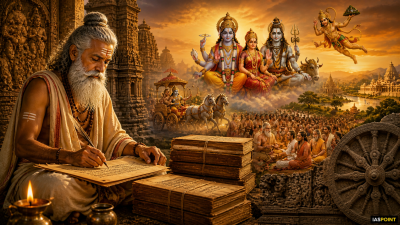
The word Purana literally translates to “ancient” or “old.” While the seeds of Puranic stories are found in the Vedas, the Puranas as a distinct literary genre were compiled primarily during the Gupta Period (4th–6th Century CE). They transition Indian religious thought from the abstract philosophy of the Upanishads to a more accessible, devotional (Bhakti) form of Hinduism. They serve as an encyclopedic record of Indian history, mythology, law, and sectarian beliefs.
The Five Characteristics: Panchalakshana
According to the classical definition provided in the texts themselves (notably the Matsya Purana), a true Purana must cover five specific topics, known as Panchalakshana:
- Sarga: The original creation of the universe.
- Pratisarga: Secondary creation or the periodic destruction and renewal of the worlds.
- Vamsha: Genealogies of gods, sages, and patriarchs.
- Manvantara: The reigns of the various Manus (time periods of human history).
- Vamshanucharita: The history of various dynasties, particularly the Solar (Suryavanshi) and Lunar (Chandravanshi) lineages.
Classification of the Mahapuranas
There are 18 Mahapuranas (Great Puranas) and an equal number of Upapuranas (Subsidiary Puranas). Traditionally, the Mahapuranas are classified into three groups based on the Gunas (qualities) and the primary deity they extol:
| Category | Associated Guna | Primary Deity | Examples |
| Sattva | Purity/Goodness | Vishnu | Vishnu Purana, Bhagavata Purana, Garuda Purana, Narada Purana. |
| Rajas | Passion/Activity | Brahma | Brahma Purana, Brahmanda Purana, Markandeya Purana, Bhavishya Purana. |
| Tamas | Inertia/Darkness | Shiva | Shiva Purana, Linga Purana, Matsya Purana, Kurma Purana, Agni Purana. |
Historical and Geographical Value
For UPSC aspirants, the Puranas are vital not just as religious texts but as primary sources for ancient Indian history.
- Dynastic Lists: The Vayu, Vishnu, Matsya, and Brahmanda Puranas contain detailed lists of the Haryanka, Shishunaga, Nanda, Maurya, Shunga, and Andhra (Satavahana) dynasties.
- Bhuvanakosa: Many Puranas contain a section called Bhuvanakosa, which provides a detailed geographical account of India (Bharatavarsha), mentioning its mountains (like the Kulaparvatas), rivers, and various tribes (Janapadas).
- The Concept of Time: The Puranas introduce the cyclical concept of time, divided into four Yugas: Krita (Satya), Treta, Dvapara, and Kali.
Significant Mahapuranas and Their Highlights
- Matsya Purana: Considered the oldest of the Mahapuranas. It provides a detailed account of the Satavahana dynasty and the Matsya (Fish) Avatar of Vishnu.
- Bhagavata Purana: Perhaps the most popular Purana today, it focuses on the life of Krishna and the philosophy of Bhakti. It is a central text for the Vaishnavite tradition.
- Agni Purana: Described as an “Encyclopaedia of Hinduism,” it covers diverse subjects such as law, medicine, martial arts, grammar, and even architecture (Vastu Shastra).
- Markandeya Purana: Contains the Devi Mahatmya (or Chandi Path), which is the foundational text for Shaktism and the worship of Goddess Durga.
- Garuda Purana: Primarily deals with funeral rites, the journey of the soul after death, and the concepts of heaven and hell.
- Bhavishya Purana: Notable for containing “prophecies” regarding future rulers, including mentions of the Mughals and the British, likely added through later interpolations.
Distinctive Puranic Concepts
- Dashavatara: The Puranas systematized the concept of the ten incarnations of Lord Vishnu, showing a proto-evolutionary sequence (Fish → Tortoise → Boar → Lion-man → Dwarf → Warrior → Prince → Cowherd → Buddha → Future Warrior).
- Tirtha Mahatmya: Most Puranas dedicate chapters to the sanctity of specific pilgrimage sites (Tirthas), which played a crucial role in the cultural integration of India.
- Sectarian Integration: While specific Puranas favor certain deities, they often practice “syncretism,” where Shiva and Vishnu are described as manifestations of the same ultimate reality.
Trivia and Factoids for UPSC Prelims
- Compilation: The Puranas are traditionally attributed to Sage Vyasa, the same compiler as the Vedas and the Mahabharata.
- Language and Style: Unlike the complex Vedic Sanskrit, Puranas are written in simple, flowing Epic Sanskrit (shloka meter), making them accessible to the general public.
- Upapuranas: These are 18 secondary texts that often focus on local deities or specific philosophical traditions (e.g., Samba Purana focuses on Sun worship).
- The Puranic Vamshanucharita: It is the only indigenous source that attempts to provide a continuous chronological record of Indian kings from the Mahabharata war down to the Gupta period.
- Lalitopakhyana: Found within the Brahmanda Purana, it is the primary source for the worship of Goddess Lalita Tripurasundari.