
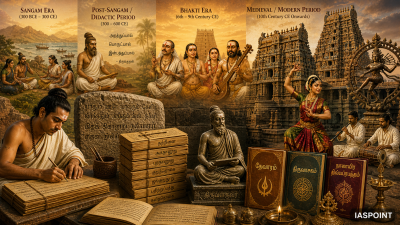
Tamil literature holds the distinction of being one of the oldest living classical traditions in the world, with a recorded history spanning over 2,000 years. It is unique for its independent origin, largely distinct from the Sanskrit tradition in its earliest phase. The evolution of Tamil literature is broadly classified into the Sangam Era, the Post-Sangam (Didactic) Period, the Bhakti Era, and the Medieval/Modern periods.
The Sangam Era (3rd Century BC – 3rd Century AD)
The Sangam Age represents the “Golden Age” of Tamil literature. According to tradition, three literary academies (Sangams) were held in Madurai under the patronage of the Pandya kings. While the first two Sangams are considered legendary, the works of the Third Sangam form the bedrock of ancient Tamil heritage.
Core Classification: Akam and Puram
The Sangam corpus is divided into two broad thematic categories:
- Akam (Interior): Deals with the nuances of love, emotions, and private life. It uses metaphorical landscapes (Thinai) to represent different stages of a relationship.
- Puram (Exterior): Focuses on public life, heroism, war, ethics, and the exploits of kings and philanthropists.
Major Works of the Sangam Corpus
The surviving literature of the Third Sangam is organized into three major groups:
| Category | Description | Key Features |
| Pathinenmelkanakku | The “Eighteen Major Works.” | Divided into Ettutogai (Eight Anthologies) and Pattupattu (Ten Idylls). |
| Tolkappiyam | Authored by Tolkappiyar. | The oldest surviving Tamil grammar work; it also provides insights into social and political conditions. |
| Ettutogai | Eight Anthologies. | Includes Aingurunuru, Narrinai, Agananuru, Purananuru, and Kuruntogai. |
The Post-Sangam Period: Pathinenkilkanakku
Following the Sangam era, the focus shifted from love and war to ethics and moral conduct, heavily influenced by Jain and Buddhist philosophies. This group is known as the “Eighteen Lesser Works.”
- Tirukkural: Authored by Thiruvalluvar, it is the most celebrated work in Tamil literature. It is divided into three sections: Aram (Virtue), Porul (Wealth/Politics), and Inbam (Love). It is often called the “Universal Veda.”
- Naladiyar: A collection of 400 quatrains composed by Jain monks, emphasizing the transient nature of life and the importance of virtue.
- Pazhamozhi Nanuru: Uses proverbs to teach moral lessons.
The Five Great Epics (Aimperumkappiyangal)
The development of narrative poetry led to the creation of the five major Tamil epics, which provide a rich tapestry of the religious and social life of the period.
- Silappatikaram (The Jewelled Anklet): Written by Ilango Adigal (a Jain prince). It tells the story of Kannagi, Kovalan, and Madhavi, centering on the theme of justice and chastity.
- Manimekalai: Written by Sattanar. It is a sequel to Silappatikaram, focusing on the daughter of Kovalan and Madhavi and her journey toward Buddhism.
- Civaka Cintamani: Authored by Tirutakkatevar, it is a Jain epic known for its poetic excellence and focus on the life of Prince Civaka.
- Valayapathi: A Jain work of which only fragments remain today.
- Kundalakesi: A Buddhist epic written as a polemic against Jainism; only fragments survive.
The Bhakti Movement and Shaiva/Vaishnava Literature
Between the 6th and 12th centuries, Tamil literature was dominated by the intense devotional hymns of the Alvars (Vaishnava) and Nayanars (Shaiva).
Shaivite Literature (The Tirumurai)
The hymns of the 63 Nayanars were compiled into 12 volumes called the Tirumurai.
- Tevaram: The first seven volumes, containing the hymns of Sambandar, Appar, and Sundarar.
- Thiruvasagam: The eighth volume, composed by Manikkavasagar, known for its emotional depth.
- Periya Puranam: The twelfth volume, written by Sekkizhar, providing biographies of the 63 Nayanars.
Vaishnavite Literature (The Divya Prabandham)
- Nalayira Divya Prabandham: A compilation of 4,000 hymns by the 12 Alvars. It was compiled by Nathamuni.
- Tiruppavai: Composed by Andal, a female saint, it remains a central part of Tamil religious life during the month of Margazhi.
Medieval Tamil Literature and the Chola Influence
The Imperial Chola period (9th–13th century) saw the flourishing of courtly literature and the refinement of Tamil grammar.
- Kamba Ramayanam: Authored by Kambar, this is an adaptation of the Valmiki Ramayana. It is considered one of the greatest literary masterpieces in Tamil due to its linguistic beauty.
- Kalingathu Parani: A war poem by Jayankondar celebrating the victory of Kulottunga Chola I over Kalinga.
- Nannul: A 13th-century grammar work by Pavanandi Munivar, which became the standard grammar for modern Tamil.
Essential Facts for UPSC Prelims
- Classical Language Status: Tamil was the first language in India to be accorded the status of a “Classical Language” by the Government of India in 2004.
- The Concept of Five Landscapes (Ainthinai): Sangam poetry classifies the earth into Kurinji (Mountains), Mullai (Forest), Marutham (Agricultural land), Neithal (Coastal), and Paalai (Desert).
- Foreign Influence: Early Tamil literature contains references to “Yavanas” (Greeks and Romans) and the flourishing maritime trade in ports like Puhar (Kaveripoompattinam) and Musiri.
- Subramania Bharati: A pivotal figure in the modern era, known as the “Mahakavi,” who transitioned Tamil literature from classical styles to nationalist and social-reform themes in the early 20th century.
- U.V. Swaminatha Iyer: Known as Tamil Thatha, he was instrumental in recovering and publishing forgotten Sangam classics in the late 19th century.