
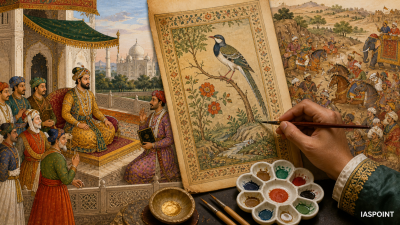
The Mughal School of Painting (16th–19th century) represents a sophisticated synthesis of indigenous Indian traditions, Safavid Persian techniques, and European naturalism. Unlike the earlier Pala or Western Indian schools that were primarily religious, Mughal painting was essentially a secular, courtly art focused on documenting history, royal life, and the natural world. It transformed from the flat, two-dimensional Persian style into a three-dimensional, realistic tradition that eventually influenced regional Rajput and Deccani schools.
Technical Characteristics and Methodology
Mughal miniatures are celebrated for their meticulous detail and technical brilliance, achieved through a collaborative workshop system known as the Tasvir Khana.
- Collaborative Production: A single painting often involved multiple specialists: the Tarrah (sketcher), the Amal (painter), and the Cheharagush (portrait specialist).
- Pigments and Medium: Artists used “Gouache” (opaque watercolor). Pigments were derived from minerals (Lapis Lazuli for blue, Orpiment for yellow), vegetables (Indigo), and precious metals (Gold and Silver leaf).
- Siyahi Qalam: A technique of fine brushwork using a single-hair brush, often made from squirrel tail hair, to achieve microscopic detail.
- Burnishing: After painting, the work was placed face down on a smooth marble slab and rubbed with an agate stone to provide a characteristic sheen and bond the pigments.
The Imperial Progression: Reign-wise Development
The school evolved through the personal tastes of the Mughal Emperors, each adding a distinct layer to the tradition.
| Emperor | Key Contribution | Signature Style/Works |
| Babur | Introduction of Persian aesthetics. | Minimal surviving works; focus on flora and fauna in Baburnama. |
| Humayun | Foundations of the Mughal Atelier. | Brought Persian masters Mir Sayyid Ali and Abd-us-Samad from Kabul. |
| Akbar | Synthesis and Mass Production. | Birth of the “Indo-Persian” style; focus on epic narratives (Hamzanama). |
| Jahangir | Naturalism and Individualism. | Peak of refined portraiture and scientific study of nature; Muraqqas (albums). |
| Shah Jahan | Decorative Grandeur. | Formalism, excessive use of gold, and focus on courtly architectural pomp. |
| Aurangzeb | Decline of Imperial Patronage. | Shift toward sober, less vibrant works; led to the migration of artists to regional courts. |
Key Artistic Features and Innovations
The Mughal style introduced several elements that were revolutionary for the Indian subcontinent:
- Foreshortening and Perspective: Under European influence (via Jesuit missionaries), Mughal artists began using linear perspective and foreshortening to create a sense of depth and distance.
- Grisaille (Nim-Qalam): A technique of painting entirely in shades of grey or neutral tints, often used to mimic European engravings.
- The Royal Halo: Introduced during Jahangir’s reign, the “Halo” or Aura was used to signify the divine right of the Emperor, a motif borrowed from Christian iconography.
- Ornate Borders (Hashiyas): In the later phases, the borders became as important as the central painting, featuring intricate floral patterns, birds, and even small human figures.
Major Illustrated Manuscripts and Themes
Mughal art functioned as a visual record of the empire’s literary and political achievements.
- Hamzanama: The first major project under Akbar, consisting of 1,400 large illustrations on cloth (canvas), depicting the adventures of Amir Hamza.
- Razmnama: The Persian translation of the Mahabharata, showcasing the integration of Hindu themes into the Mughal atelier.
- Akbarnama and Padshahnama: Official histories of Akbar and Shah Jahan, respectively, focusing on battles, sieges, and court ceremonies.
- Anwar-i-Suhayli: A Persian version of the Panchatantra, emphasizing animal fables.
- Jahangirnama: Notable for its accurate depictions of rare animals (like the Dodo and Cheetah) and exotic flowers.
Celebrated Masters of the Mughal Atelier
Identifying specific artists became common during the Mughal era, marking a shift from anonymous craftsmanship to individual recognition.
- Basawan: Known for his mastery of distance and the “Western” style of modeling figures.
- Daswant: An artist from a humble background (palanquin-bearer) who became a lead painter for the Razmnama.
- Mansur (Ustad Mansur): Jahangir’s favorite nature artist, titled Nadir-al-Asr (Wonder of the Age), famous for his “Siberian Crane” and “Bengal Florican.”
- Abul Hasan: A master of portraits and allegorical paintings, titled Nadir-uz-Zaman (Wonder of the Time).
- Bichitr: Renowned for his crisp, formal style and his inclusion of European symbols in portraits of Shah Jahan.
Fact-File and Trivia for UPSC Prelims
- First Appearance of European Art: European paintings and engravings first reached the Mughal court in 1580 through the first Jesuit Mission to Akbar’s court.
- The Muraqqa: Unlike manuscripts (books), Muraqqas were albums of individual paintings and calligraphic specimens bound together, a format that became popular under Jahangir.
- Tulip of Kashmir: Mansur’s painting of the Western Asiatic Tulip is considered one of the earliest botanical studies in India.
- Calligraphy: In Mughal art, calligraphy (Khat) was considered a higher art form than painting. Masters like Muhammad Husayn al-Kashmiri (Zarin Qalam) were highly revered.
- Shift in Subject: While Akbar’s art was “Action-Oriented” (wars, hunts), Jahangir’s art was “Contemplative” (portraits, birds), and Shah Jahan’s was “Architectural/Formal.”
Decline and the “Afterglow”
The decline of Mughal painting began under Aurangzeb, who viewed the arts as contrary to Islamic orthodoxy. The subsequent dispersal of artists from the imperial workshop led to the enrichment of:
- Provincial Mughal Schools: Developed at Awadh, Murshidabad, and Patna.
- Company School: A hybrid style developed during the early British era where Mughal techniques were used to satisfy the colonial demand for “exotic” Indian documentation.
- Pahari and Rajput Schools: These schools gained technical refinement by absorbing displaced Mughal masters, leading to the birth of the Kangra and Kishangarh styles.