
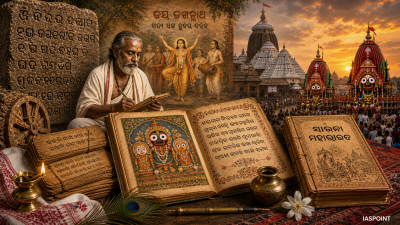
Odia is one of the six Classical Languages of India, a status granted due to its ancient roots, independent tradition, and extensive body of recorded literature spanning over 1,500 years. The language evolved from the Odra Magadhi Apabhramsa and has been significantly influenced by the socio-religious movements of the region, particularly the Jagannath cult.
Ancient and Early Medieval Foundations
The origins of Odia literature are traced back to the Charyapada (8th to 12th century), which are mystical Buddhist poems composed in an early form of the language. These tantric verses represent the common literary heritage of Odia, Bengali, and Assamese.
- Inscriptional Evidence: The earliest evidence of written Odia is found in the Urujayy inscription and the Hathigumpha inscription (though the latter is Prakrit, it shows the linguistic lineage). The 10th-century Kalasa Chautisa by Bachha Das is considered one of the earliest structured poems in Odia.
- The Sarala Age (15th Century): Often called the “Father of Odia Literature,” Sarala Das composed the Mahabharata in Odia. Unlike a mere translation, his work was a complete reimagining rooted in the soil and culture of Odisha. He also authored the Bilanka Ramayana and Chandi Purana.
The Panchasakha Era (The Five Friends)
The 16th century marked a spiritual and literary revolution led by five saint-poets who were contemporaries of Chaitanya Mahaprabhu. They made Sanskrit scriptures accessible to the masses by translating them into simple, lyrical Odia.
| Poet | Major Contribution | Significance |
| Balarama Das | Jagamohana Ramayana | Also known as the Dandi Ramayana; the first complete Odia Ramayana. |
| Jagannath Das | Odia Bhagabata | The most influential book in Odisha; every village historically had a “Bhagabata Tungi” (community hall) to read it. |
| Achyutananda Das | Sunya Samhita | Explored the concept of “Sunya” (the void) and authored the prophetic Malika literature. |
| Ananta Das | Hetu Udaya Bhagabata | Focused on the philosophy of the soul and the body. |
| Yashovanta Das | Govinda Chandra | Famous for his devotional songs and the “Chaurasi Yantra” philosophy. |
The Riti Yuga: Era of Ornate Poetry
Following the Panchasakha era, Odia literature entered a period of stylistic sophistication known as Riti Yuga (17th to 19th century). This era focused on linguistic acrobatics, eroticism (Shringara), and complex metaphors.
- Upendra Bhanja: Known as Kabi Samrata (The Emperor of Poets), his works like Baidehisa Bilasa, Labanyabati, and Kotibrahmanda Sundari are masterpieces of verbal craftsmanship where every line might start with the same letter or carry multiple meanings.
- Dinakrushna Das: Author of Rasakallola, famous for its devotion to Lord Krishna and the fact that every line begins with the consonant ‘Ka’.
- Abhimanyu Samanta Simhara: Noted for Bidagdha Chintamani, which explores the divine love of Radha and Krishna through complex poetic meters.
- Kabi Surjya Baladeba Rath: He composed the Kishore Chandrananda Champu, a unique blend of prose and poetry that remains a cornerstone of Odishas’ musical and literary heritage.
Modern Odia Literature: The Renaissance
The late 19th century saw a transition from traditional verse to modern prose, driven by the introduction of the printing press and the need for linguistic identity during the “Odia Bhasa Andolan.”
The Trinity of Modern Odia Literature
- Fakir Mohan Senapati: Known as the “Vyasa Kabi,” he is the father of modern Odia fiction. His masterpiece, Chha Mana Atha Guntha (Six Acres and a Third), was the first Indian novel to deal with the exploitation of peasants by a zamindar using a realistic, satirical tone.
- Radhanath Ray: Known as “Kabibar,” he introduced Western literary styles and wrote long narrative poems like Chilika and Mahajatra. He shifted the focus from mythology to the natural beauty and history of Odisha.
- Madhusudan Rao: Known as “Bhaktakabi,” he pioneered modern Odia poetry and wrote Barnabodha, the primary primer used for teaching the Odia alphabet for over a century.
The Satyabadi Era
In the early 20th century, the Satyabadi Bana Bidyalaya (Forest School) became the hub of nationalistic literature.
- Gopabandhu Das: Known as “Utkal Mani,” his works like Bandira Atmakatha (Prisoner’s Autobiography) and Dharmapada infused Odia literature with intense patriotism and social reform.
- Nilakantha Das & Godabarisha Mishra: They expanded the literary horizons by incorporating historical themes and folk legends into modern verse and drama.
Post-Independence and Contemporary Trends
Post-1947, Odia literature embraced diverse movements such as Sabuja (Green), Pragati (Progressive), and Prayogabadi (Experimental).
- Gopinath Mohanty: The first Odia to win the Jnanpith Award. His novels like Paraja and Amrutara Santana provide a deep sociological and psychological look into the lives of the tribal communities of Odisha.
- Sachidananda Routray: The “Poet of the People,” he introduced Marxist and modernistic elements. His poem Baji Rout is a tribute to the youngest martyr of the Indian freedom struggle.
- Sitakant Mahapatra & Pratibha Ray: Pratibha Ray’s Yajnaseni (reinterpreting Draupadi) and Sitakant Mahapatra’s anthropological poetry have earned them Jnanpith honors, highlighting the global relevance of modern Odia writing.
Notable Literary Facts for Competitive Exams
- Classical Language Status: Odia was declared a Classical Language in 2014, making it the first Indo-Aryan language to receive this distinction.
- Jnanpith Awardees: Odisha has produced four Jnanpith winners: Gopinath Mohanty, Sachidananda Routray, Sitakant Mahapatra, and Pratibha Ray.
- The Palm Leaf Tradition: Odisha has one of the largest collections of palm-leaf (Tala Patra) manuscripts in India, covering diverse subjects from medicine (Ayurveda) to art (Chitra Kavya).
- Utkal Sahitya Samaj: Established in 1903, it is one of the oldest literary organizations in India dedicated to the promotion of a regional language.
- Major Literary Forms:
- Chautisa: A poem consisting of 34 stanzas, each beginning with a consonant of the Odia alphabet in sequence.
- Koili: A lyrical form where the poet addresses a cuckoo (Koili) to express grief or devotion (e.g., Kesaba Koili).
- Champu: A composition featuring a mix of prose and poetry.