

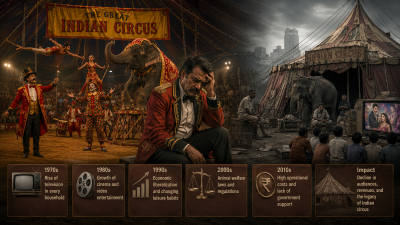
The Indian circus, once a premier form of mass entertainment and a symbol of national pride, began to witness a steady decline toward the late 20th century. This downturn was not triggered by a single event but was the result of a cumulative shift in legislative, socio-economic, and technological landscapes.
- Loss of Princely Patronage: Post-independence, the abolition of the Privy Purses led to the withdrawal of financial support from royal families who had historically funded large troupes.
- Technological Disruptions: The advent of color television in the 1980s, followed by the proliferation of satellite channels and digital streaming, offered cheaper and more accessible home entertainment.
- Urbanization and Land Scarcity: The expansion of cities led to the disappearance of open grounds (maidans), which were essential for pitching the Big Top. Increased municipal taxes and ground rents made touring financially unviable.
Legislative Interventions and Impact
The most significant blow to the traditional circus format came from animal welfare and child labor regulations. While these laws were ethically necessary, they dismantled the core attractions of the traditional circus without providing a transitional framework for the artists.
Animal Protection Laws
- 1991 Ministry Notification: The Ministry of Environment and Forests banned the training and exhibition of five specific animals: bears, monkeys, tigers, panthers, and lions.
- Central Zoo Authority (CZA) 2013: A landmark decision by the CZA derecognized circuses as “captive animal facilities,” effectively banning the use of elephants, which were the primary crowd-pullers.
- Species Ban Impact: The removal of exotic animals led to a 50-70% drop in ticket sales, as the “menagerie” was historically the central USP of the Indian circus.
Child Labor and Human Rights
- Supreme Court Ruling (2011): The court banned the employment of children in circuses to prevent exploitation and physical risk.
- Right to Education (RTE): Implementation of RTE made the traditional apprenticeship model—where children of performers trained from a young age—legally impossible. This led to a “talent vacuum,” as many complex acrobatic skills are best acquired during early childhood.
Comparative Table: Traditional vs. Modern Challenges
| Factor | Traditional Era (1880–1990) | Modern Crisis (1991–Present) |
| Main Attraction | Wild animals and exotic species. | Purely human-centric acrobatics. |
| Recruitment | Family-based apprenticeship/Children. | Professional adults/Shortage of trained talent. |
| Competition | Folk theatre and local fairs. | Gaming, OTT platforms, and Multiplexes. |
| Logistics | Large scale, 300+ staff, long stays. | Smaller troupes, high mobility, high costs. |
Efforts Toward Revival and Modernization
Despite the decline, the Indian circus is undergoing a “New Circus” (Cirque-style) transformation, focusing on theatricality and human skill over animal exhibition.
Global Influences and Adaptation
- Cirque du Soleil Model: Indian troupes like Rambo Circus and Gemini Circus have started adopting the “Global New Circus” format, utilizing advanced sound systems, synchronized LED lighting, and narrative storylines.
- Indo-International Collaborations: Many Indian circuses now hire performers from Ethiopia, Russia, and Uzbekistan to bring in high-energy acts that compensate for the absence of animal shows.
Institutional Support and Recognition
- Thalassery Circus Academy: Re-established by the Kerala Government, this academy aims to provide professional training to youngsters using modern safety equipment and scientific coaching methods.
- Sangeet Natak Akademi (SNA) Recognition: There is a growing demand to include “Circus Arts” under the umbrella of the Ministry of Culture to grant performers the status of “Artists,” making them eligible for pensions and government quotas.
Key Facts and Trivia for UPSC Aspirants
- The First Modern Circus: The Great Indian Circus, founded by Vishnupant Chatre in 1880, was the first indigenous response to the Western circus.
- Mera Naam Joker Effect: The 1970 film Mera Naam Joker remains the most significant cultural documentation of the Indian circus, filmed largely at the Gemini Circus.
- UNESCO Intangible Heritage: While the Indian circus is not yet on the UNESCO list, several European circus traditions have received this status, prompting Indian advocates to push for similar recognition for the Thalassery lineage.
- The “Circus Capital”: Thalassery in Kerala remains the spiritual home of the Indian circus, having produced almost all major circus owners and trainers in the country.
Current Trends and the Path Forward
The survival of the Indian circus now depends on “Theatricalization.” This includes moving away from the dusty outdoor tents to air-conditioned auditoriums and integrating traditional Indian arts like Mallakhamba and Kalaripayattu into the circus ring. Digital marketing and “Circus Festivals” in metropolitan cities are also being used to re-brand the circus as a “Heritage Experience” rather than just a child’s outing.
Last Modified: May 7, 2026