
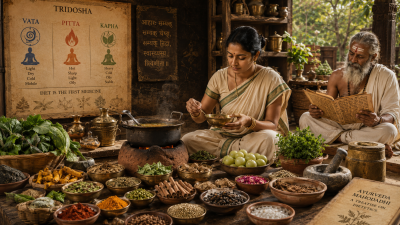
Ayurvedic culinary science is founded on the principle that “when diet is wrong, medicine is of no use; when diet is correct, medicine is of no need.” It classifies food not just by nutritional value, but by its energetic impact on the Tridosha (Vata, Pitta, and Kapha). In the Indian heritage context, this is codified in the Ayurveda Mahodadhi, a 16th-century treatise dedicated entirely to dietetics.
The Six Tastes: Shad-Rasa Theory
Ayurveda identifies six distinct tastes, each composed of two of the five elements (Mahabhutas). A balanced meal must ideally incorporate all six to ensure physiological equilibrium.
| Rasa (Taste) | Elements | Biological Effect | Examples |
| Madhura (Sweet) | Earth + Water | Builds tissues, calms nerves | Grains, milk, honey, ghee |
| Amla (Sour) | Earth + Fire | Improves digestion, sharpens senses | Lemon, curd, tamarind, fermented food |
| Lavana (Salty) | Water + Fire | Lubricates tissues, stimulates appetite | Rock salt (Saindhava), sea salt |
| Katu (Pungent) | Fire + Air | Clears sinuses, stimulates metabolism | Chillies, ginger, garlic, black pepper |
| Tikta (Bitter) | Air + Space | Detoxifies, thins blood, anti-inflammatory | Neem, turmeric, bitter gourd |
| Kashaya (Astringent) | Air + Earth | Heals wounds, absorbs moisture | Beans, lentils, pomegranate, tea |
Concept of Agni and Digestion
Central to Ayurvedic cooking is the maintenance of Jatharagni (the digestive fire). If Agni is weak, food turns into Ama (metabolic toxins), which is considered the root cause of all diseases in Indian traditional medicine.
- Deepana and Pachana: The use of appetizers and digestive stimulants. Ginger and lime are classic Deepana (kindling) agents used before a meal.
- Order of Consumption: Ayurveda prescribes eating sweet foods (Madhura) first because they are heavy and require the strongest Agni, followed by sour and salty, and ending with bitter and astringent tastes to suppress the appetite.
Viruddhara: The Concept of Incompatible Foods
A unique aspect of Indian culinary heritage is the strict avoidance of Viruddhara—combinations that are “antagonistic” to the body’s tissues or disrupt the Doshas.
- Milk Combinations: Milk should not be consumed with fish, melons, or sour fruits (e.g., bananas).
- Honey and Heat: Honey must never be cooked or heated, as it is believed to become toxic (Amavisha) when its molecular structure is altered by high temperatures.
- Ghee and Honey: Mixing equal proportions by weight is considered incompatible; they must always be consumed in unequal ratios.
Ritucharya: Seasonal Dietary Regimen
Ayurvedic cooking adapts to the solar and lunar cycles, emphasizing that the human body is a microcosm of the environment.
- Adana Kala (Northern Solstice): During the hot summer, cooling foods (Sheeta) like melons and cooling spices like fennel and coriander are emphasized.
- Visarga Kala (Southern Solstice): In winter, the Agni is strongest; hence, heavy, oily (Snigdha), and warming foods are recommended to sustain the body.
Classification of Food Quality (Guna)
Ayurveda categorizes food based on its physical properties and post-digestive effect (Vipaka).
- Guru (Heavy) vs. Laghu (Light): Meat and dairy are Guru; parched rice and moong dal are Laghu.
- Snigdha (Oily) vs. Ruksha (Dry): Ghee provides Snigdha Guna, essential for lubricating joints and brain function.
- Ushna (Hot) vs. Sheeta (Cold): Refers to the potency (Virya) of the food, not just its temperature.
Rituals and Ethics of Ayurvedic Cooking
The preparation of food is considered a meditative act, influencing the subtle energy of the meal.
- Prana in Food: Freshly cooked food consumed within three hours of preparation is considered highest in Prana (life force). Stale or reheated food is categorized as Tamasic.
- Vessel Selection: Specific benefits are attributed to cooking in different metals. Gold was for royalty, Silver for cooling Pitta, Copper for purifying water and reducing Kapha, and Iron for treating anemia (Pandu).
- Bhojana Vidhi: Rules for eating include sitting on the floor (Sukhasana), eating in silence, and focusing entirely on the food to ensure the brain signals the stomach for optimal enzyme secretion.
Essential Ayurvedic Spices (The Healing Cabinet)
- Turmeric (Haridra): A natural antibiotic and blood purifier.
- Cumin (Jeera): Enhances nutrient absorption.
- Asafoetida (Hing): Used specifically with lentils to prevent flatulence (balancing Vata).
- Cardamom (Elaichi): Neutralizes the mucus-forming properties of milk.
- Fenugreek (Methi): Regulates blood sugar and benefits the nervous system.
Trivia for UPSC Prelims
- Sattvic Diet: Consists of foods that are Prana-varchas (life-enhancing).
- Anupana: The liquid vehicle (water, milk, or honey) taken along with or after medicine/food to enhance its action.
- Sushruta Samhita: Contains extensive chapters on the dietary properties of various meats, vegetables, and waters from different regions.
- Pathya-Apathya: The logic of what is “wholesome” vs “unwholesome” for a specific individual’s constitution (Prakriti).