
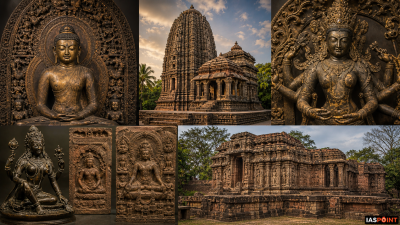
The Pala and Sena dynasties (8th to 12th century CE) represent the final flourish of classical artistic traditions in Eastern India, primarily covering the regions of modern-day Bihar and West Bengal. While the Palas were staunch patrons of Mahayana and Vajrayana Buddhism, the Senas, who succeeded them, were predominantly Hindu. This period is often referred to as the “Pala School of Art” or the “Bihar-Bengal School,” characterized by a unique synthesis of post-Gupta elegance and tantric influence.
The Pala School of Sculpture (8th–11th Century CE)
Pala sculpture is distinguished by its high degree of finish and the use of specific regional materials. It played a pivotal role in spreading Buddhist iconography to Southeast Asian countries like Tibet, Myanmar, and Indonesia.
- Material and Technique:
- Black Basalt: Most stone sculptures were carved from fine-grained black basalt (Chlorite) stone, sourced from the Rajmahal Hills. This stone allowed for extremely detailed carving and a metallic-like polish.
- Bronze Casting: The Palas excelled in the “lost-wax” process. Major centers for metal casting included Nalanda and Kurkihar.
- Stylistic Features:
- The figures are characterized by “S” shaped curves, slender bodies, and elongated eyes.
- The sculptures are usually “stele” (relief slabs) where the main deity is carved in high relief against a back-slab decorated with various motifs.
- Over time, the art moved from the simplicity of the early Pala period to heavy ornamentation and crowded compositions in the later stages.
Iconic Themes and Iconography
Pala art is synonymous with the evolution of the Vajrayana Buddhist pantheon, featuring complex multi-armed deities and tantric symbols.
- Buddhist Deities: Prolific representations of Gautama Buddha (specifically the “Earth Touching Gesture” or Bhumisparsha Mudra), Avalokiteshvara, Manjushri, Maitreya, and female deities like Tara and Prajnaparamita.
- Hindu Influence: Despite being Buddhist, the Palas commissioned several Brahmanical icons, including Vishnu, Surya, and Umamaheshvara, reflecting the religious syncretism of the era.
- The Nalanda Bronzes: These are world-renowned for their graceful proportions. They often feature a distinctive “flame” motif around the halo.
The Sena Transition (11th–12th Century CE)
The Sena period saw a shift in religious focus from Buddhism to Hinduism (Vaishnavism and Shaivism), which influenced the sculptural output.
- Artistic Evolution: Sena sculpture continued the Pala tradition of using black basalt but introduced even more lavish ornamentation. The figures became more rigid and formal compared to the fluid Pala style.
- Key Icons: The Senas are credited with popularizing the image of Dhakaeshwari and various forms of Vishnu (Vasudeva). The representation of the “Ganga and Yamuna” goddesses on temple doorframes reached its peak during this time.
Comparison of Pala and Sena Sculptural Traits
| Feature | Pala Sculpture | Sena Sculpture |
|---|---|---|
| Primary Religion | Mahayana & Vajrayana Buddhism | Brahmanical Hinduism |
| Aesthetics | Fluid, slender, and graceful | Stiff, formal, and heavily ornate |
| Back-slab (Stele) | Rounded or simple pointed tops | Highly intricate, often featuring ‘Kirtimukha’ |
| Focus | Spiritual serenity and internal calm | Royal grandeur and external decoration |
| Major Centers | Nalanda, Vikramshila, Bodh Gaya | Vijaynagar, Vikrampur, Somapura |
Significant Archaeological Sites and Findings
- Nalanda: A major center for bronze casting; hundreds of small portable bronzes have been excavated here, which were carried by monks to Tibet and China.
- Vikramshila: Known for its terracotta plaques that decorated the basement of the Great Stupa, depicting secular life, animals, and Buddhist themes.
- Kurkihar (Gaya): Famous for a hoard of nearly 150 bronze images representing the high point of Pala metallurgical skill.
- Antichak: Site of the Vikramshila university ruins, providing a vast array of stone and terracotta sculptures.
Technical Facts for UPSC Prelims
- Dhiman and Vitapala: According to Taranatha (a Tibetan historian), these two legendary artists from the 9th century were the founders of the Pala school of stone carving and metal casting.
- Tantric Influence: The 10th-century Pala art is heavily influenced by Tantricism, leading to the creation of fierce deities like Mahakala, Heruka, and Yamantaka.
- Terracotta Tradition: While stone and bronze were for the elite, the common people used terracotta. The plaques at Paharpur (Somapura Mahavihara) are the most extensive examples of this folk-influenced Pala art.
- International Reach: The Pala style was the direct ancestor of the art of Nepal and Tibet and significantly influenced the Shailendra dynasty’s art in Java (Borobudur).
Trivia and Key Takeaways
- The Black Stone Effect: The black basalt used by Pala sculptors is so dense and polished that early European travelers often mistook the stone statues for metal or cast iron.
- Evolution of the Buddha Image: The Pala period is where the Buddha started being depicted as a “Sovereign Ruler” (crowned Buddha), reflecting the intersection of kingship and divinity.
- Manuscript Illustration: The Pala period also saw the birth of the “Pala Miniature Paintings” on palm leaves, which often mirrored the sculptural styles of the era in a two-dimensional format.