
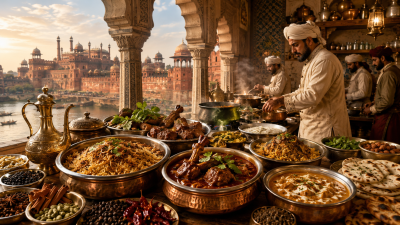
The advent of Islamic rule in India, beginning with the Delhi Sultanate (1206–1526) and reaching its zenith during the Mughal Empire (1526–1857), fundamentally transformed the Indian kitchen. This period introduced a “Persianized” food culture that merged Central Asian, Persian, and Turkish techniques with indigenous Indian ingredients and spices. This synthesis gave birth to Hindustani Cuisine, characterized by the use of aromatics, complex slow-cooking methods, and a sophisticated meat-and-dairy culture.
Key Architectural and Technical Innovations
The Islamic influence introduced specific kitchen technologies and spatial arrangements that were previously unknown or less common in the subcontinent.
- The Degchi and Handi: Introduction of heavy-bottomed copper and brass vessels allowed for uniform heat distribution, essential for slow-cooking meat and rice.
- The Tandoor: While proto-tandoors existed in the Harappan era, the Islamic period popularized the clay oven for baking leavened breads (Naan) and roasting meats (Kebabs) at high temperatures.
- The Hamam-Dasta: The Persian mortar and pestle became essential for creating the fine spice pastes (Masalas) that form the base of Mughlai gravies.
- The Rakhabdar (Chef): A specialized class of royal chefs emerged, responsible for the Toshakhana (royal pantry), elevating cooking from a domestic chore to a high art form.
Distinctive Culinary Techniques (The “Dum” and “Bhunao”)
The Islamic period institutionalized specific cooking styles that defined the texture and flavor profiles of North Indian cuisine.
- Dum Pukht (Slow Steaming): A Persian technique where a pot is sealed with dough (Atta) and cooked over a slow fire. This allows the food to cook in its own juices, preserving the aroma.
- Bhunao (Sautéing): The process of frying spices and meat in fat (ghee/oil) until the oil separates, ensuring the “raw” smell of spices is eliminated.
- Yakhni (Stock): The use of meat stock instead of water to cook grains and gravies, adding depth and richness to the dish.
- Dhungar (Smoking): A technique of infusing a smoky flavor into a dish using a piece of burning charcoal placed in a small cup inside the cooking vessel, often drizzled with ghee and spices.
Evolution of Staples: Rice and Bread
The Islamic influence significantly expanded the variety of cereal preparations, moving beyond simple boiled rice and flatbreads.
| Category | Item Name | Characteristics |
| Rice | Biryani | A layered dish of spiced rice and meat, believed to have evolved from the Persian Pilaf. |
| Rice | Tehri | A vegetarian version of Biryani, popularised in the Awadh region. |
| Bread | Naan | Leavened bread made with refined flour (Maida) and baked in a tandoor. |
| Bread | Sheermal | A saffron-flavored, slightly sweet traditional flatbread made with milk and ghee. |
| Bread | Bakarkhani | A thick, spiced flatbread, often associated with the culinary heritage of Old Delhi and Dhaka. |
Introduction of New Ingredients and Aromatics
Islamic rulers and traders brought several new crops and flavorings to India through the Silk Road and maritime trade.
- Dry Fruits and Nuts: Almonds, pistachios, raisins, and cashew nuts were integrated into gravies and desserts to provide texture and “Shahi” (royal) richness.
- Aromatics: The use of Saffron (Zaffran), Rose water (Gulab-jal), and Kewra (screwpine essence) became hallmarks of festive cooking.
- Fruits: The Mughals, especially Babur, had a deep nostalgia for Central Asian fruits, leading to the large-scale cultivation of grapes, melons, and improved varieties of mangoes via grafting.
- Spices: While India was the land of spices, the Islamic influence refined the use of “Garam Masala”—a specific blend of warming spices like cardamom, cinnamon, cloves, and black pepper.
Regional Variations of Islamic Culinary Influence
The synthesis of Islamic and local cultures led to the development of distinct regional cuisines across the subcontinent.
- Mughlai (Delhi/Agra): Characterized by rich, creamy gravies using cream, butter, and nuts. Signature dishes include Nihari and Shahi Paneer.
- Awadhi (Lucknow): Famous for the Dum Pukht style and “Galauti” (melt-in-the-mouth) kebabs, designed for the aging Nawabs who could not chew tough meat.
- Hyderabadi (Deccan): A blend of Mughlai and local Telugu influences, utilizing tamarind, coconut, and peanuts. Kutchi Biryani and Haleem are iconic examples.
- Mappila (Kerala): Developed through Arab trade, featuring dishes like Thalassery Biryani and Pathiri (rice pancakes).
Confectionery and Beverages
The concept of the “dessert course” was significantly refined during this era.
- Halwa: Derived from the Arabic word ‘Hulw’ (sweet). Varieties like Sooji ka Halwa and Gajar ka Halwa became Indian staples.
- Gulab Jamun: An evolution of the Persian Luqmat-al-Qadi, adapted to use Indian milk solids (Khoya).
- Jalebi: Introduced as Zulabiya by Persian traders, it evolved into the quintessential Indian celebratory sweet.
- Sharbat: The tradition of chilled fruit and herb-based syrups (like Khus or Gulab) was brought from the cooling traditions of Persia.
Fact Sheet and Trivia for UPSC Prelims
- Ain-i-Akbari: Written by Abu’l-Fazl, this text contains a detailed section on the imperial kitchen of Akbar, categorizing dishes into three types: those without meat (Sufiyana), those with meat and rice, and those with meat and spices.
- Nihari: Derived from the Arabic word Nahar (morning). It was originally a breakfast stew for laborers and later became a delicacy for the royalty.
- The Chili Paradox: While many associate Islamic cuisine with red chilies, the Portuguese introduced chilies to India in the 16th century. Early Islamic dishes relied on black pepper and long pepper for heat.
- Kulfi: Often cited as the first “Indian ice cream,” it was created in the 16th century by freezing a dense mixture of sweetened milk in metal cones using saltpeter for refrigeration.