
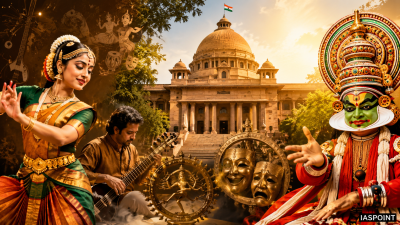
The Sangeet Natak Akademi (SNA) is India’s national-level academy for music, dance, and drama. It functions as the apex body for the performing arts in the country, tasked with the preservation and promotion of India’s vast intangible heritage. Established as an autonomous body under the Ministry of Culture, it plays a pivotal role in defining the standards of excellence in the performing arts and ensuring the continuity of the Guru-Shishya parampara.
Historical Evolution and Governance
- Establishment: It was the first of the three national academies to be established, inaugurated on January 28, 1953, by the first President of India, Dr. Rajendra Prasad.
- Registration: It was registered as a society in 1961 under the Societies Registration Act, 1860.
- Headquarters: Located at Rabindra Bhavan, Ferozeshah Road, New Delhi.
- Management: The Akademi is managed by a General Council. The Chairman is appointed by the President of India for a term of five years.
- First Chairman: Dr. P.V. Rajamannar.
Objectives and Functions
The Akademi acts as a safeguard for traditional art forms while fostering contemporary expression.
- Documentation: Maintaining a vast archive of audio/video recordings, photographs, and films on the performing arts.
- Standardization: Establishing uniform standards for education and training in music, dance, and drama.
- Promotion of Classical Status: It provides the formal recognition of “Classical” status to Indian dance forms. Currently, the Akademi recognizes eight dance forms as classical: Bharatnatyam, Kathak, Kathakali, Kuchipudi, Odissi, Sattriya, Manipuri, and Mohiniyattam.
- Preservation of Intangible Heritage: Acting as the nodal agency for UNESCO’s Intangible Cultural Heritage (ICH) nominations from India.
Prestigious Awards and Fellowships
The awards conferred by the Sangeet Natak Akademi are considered the highest national recognition provided to practicing artists.
| Award Category | Significance and Details |
| Sangeet Natak Akademi Ratna (Fellowship) | The highest honor. Restricted to 40 living individuals at any given time. |
| Sangeet Natak Akademi Puraskar (Award) | Awarded annually since 1952. Includes a purse of ₹1,00,000, a citation, an Angavastram, and a Tamrapatra. |
| Ustad Bismillah Khan Yuva Puraskar | Introduced in 2006 to encourage outstanding young artists below the age of 40. |
| Tagore Ratna and Tagore Puraskar | Instituted to commemorate the 150th birth anniversary of Rabindranath Tagore for contribution to the arts. |
Constituent Units and Special Centers
The Akademi manages several specialized institutions that focus on specific regional or thematic art forms.
- Kathak Kendra (National Institute of Kathak Dance): Located in New Delhi, it is dedicated to the promotion of the Kathak dance form.
- Jawaharlal Nehru Manipur Dance Academy (JNMDA): Situated in Imphal, it focuses on Manipuri dance and music.
- Sattriya Centre: Established to promote the Sattriya dance of Assam, originated by Srimanta Sankardev.
- Kutiyattam Kendra: Located in Thiruvananthapuram, dedicated to preserving Kutiyattam, the Sanskrit theatre of Kerala (recognized by UNESCO).
- National Projects: The Akademi runs specific projects for the promotion of Chhau (Purulia, Seriakella, and Mayurbhanj styles) and the specialized North-East Centre in Guwahati.
Cultural Schemes and Initiatives
- Intangible Cultural Heritage (ICH) Scheme: Provides financial assistance for the preservation and propagation of endangered traditional performing art forms.
- Digital India Integration: The “Sangeet Natak Akademi Digital Archive” is one of the world’s largest collections of its kind, preserving thousands of hours of rare performances.
- Asavari and Deshi: Periodic festivals organized to showcase classical and folk/tribal performing arts respectively.
- Kala Deeksha: A specialized initiative focused on training and scholarship for budding artists under the Guru-Shishya model.
Trivia and Facts for UPSC Prelims
- UNESCO Connection: Sangeet Natak Akademi was instrumental in the inclusion of Kutiyattam, Vedic Chanting, Ramlila, and Chhau Dance in the UNESCO Representative List of the Intangible Cultural Heritage of Humanity.
- The Museum: The Akademi maintains a museum of musical instruments called Asavari, which houses over 600 instruments, including rare and folk varieties.
- National Anthem: The Akademi has provided the official standardized version of the National Anthem (timing and notation).
- First Woman Fellow: The legendary Carnatic singer M.S. Subbulakshmi was among the early recipients of the Akademi Fellowship (1954).
- Ustad Bismillah Khan: While the Yuva Puraskar is named after him, it is worth noting that he was a recipient of the Sangeet Natak Akademi Award long before he received the Bharat Ratna.