
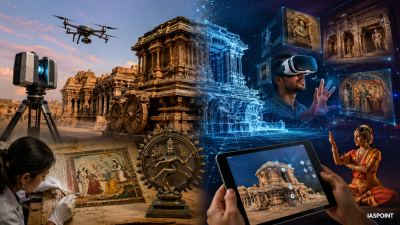
Digitization in the context of Indian heritage refers to the conversion of physical cultural assets—including monuments, manuscripts, artifacts, and intangible traditions—into high-resolution digital formats. Virtual Heritage (VH) leverages these digital assets using technologies like 3D Laser Scanning, Photogrammetry, Augmented Reality (AR), and Virtual Reality (VR) to provide immersive access and ensure the “digital longevity” of sites prone to climate change, vandalism, or natural decay.
Institutional Framework and National Missions
The Government of India has established specialized bodies to oversee the transition from physical to digital archives, ensuring a standardized approach across various states and departments.
- National Mission on Monuments and Antiquities (NMMA): Launched in 2007, its primary goal is to create a national-level database of all built heritage and antiquities, facilitating easy retrieval for research and security.
- National Mission on Manuscripts (NAMAMI): Established in 2003 by the Ministry of Culture, it aims to digitize the estimated five million Indian manuscripts. It creates “Kritisampada,” the National Database of Manuscripts.
- Indira Gandhi National Centre for the Arts (IGNCA): Acts as the nodal agency for the “National Cultural Audiovisual Archives” (NCAA), which is the world’s first IAF-certified digital media archive for cultural heritage.
Key Technologies in Virtual Heritage
The application of Industry 4.0 technologies ensures that heritage conservation moves beyond mere photography into scientific reconstruction.
| Technology | Application in Heritage | Indian Example |
| Terrestrial Laser Scanning (LiDAR) | Captures precise 3D coordinates of large structures to create “Digital Twins.” | 3D mapping of Hampi and Rani ki Vav. |
| Photogrammetry | Creating 3D models from 2D photographs for high-textured visualization. | Digitization of sculptures in the National Museum. |
| JATAN Virtual Museum Builder | A digital collection management system for Indian museums. | Implemented in Salar Jung Museum and Allahabad Museum. |
| Bhuvan Portal (ISRO) | Satellite-based mapping of protected limits and heritage sites. | Monitoring encroachments around ASI monuments. |
Major Projects and Initiatives
Several flagship projects demonstrate India’s commitment to virtualizing its cultural landscape for global audiences.
- Indian Heritage in Digital Space (IHDS): A research initiative by the Department of Science and Technology (DST) that created a digital 3D reconstruction of Hampi. It includes “ViRaasat,” a platform for digital heritage crafts.
- Project Jatan: A Ministry of Culture initiative to create a unified digital portal for all 10 museums under its direct control. It allows users to view 360-degree high-definition images of rare artifacts.
- National Virtual Library of India (NVLI): Part of the National Mission on Libraries, this portal aggregates digital resources from libraries, archives, and museums into a single platform for researchers.
- E-Tiketing and SMARAC: Integration of digital gateways for monument entry and the “Smart Monitoring of Monument Regulated Areas” (SMARAC) portal for regulatory clearances.
Significance of Digitization for Conservation
Digital heritage serves as more than just a public viewing gallery; it is a critical tool for structural engineering and law enforcement.
- Disaster Recovery: If a monument is damaged (e.g., the fire at the National Museum of Natural History), 3D data enables accurate physical reconstruction.
- Combatting Illicit Trade: A digital register with high-resolution “fingerprints” of antiquities makes it difficult for stolen artifacts to be sold in the international market.
- Scientific Analysis: High-resolution scans allow experts to study micro-cracks, weathering patterns, and chemical degradation of stone without physical contact.
- Global Accessibility: Virtual tours allow people with disabilities or those in remote locations to experience the “Universal Value” of World Heritage Sites.
Challenges in the Digital Transition
Despite significant progress, several hurdles remain in the 360-degree digitization of Indian art and culture.
- Technological Obsolescence: Digital formats change rapidly; ensuring that files created today remain readable in 50 years (Digital Preservation) is a major cost factor.
- Huge Volume of Data: With over 3,697 centrally protected monuments and millions of unprotected local sites, the scale of documentation is unparalleled globally.
- IPR and Copyright: Determining the Intellectual Property Rights of digitized cultural content, especially when used for commercial VR experiences, remains a legal gray area.
- Standardization: Different states and museums often use non-interoperable software, making the creation of a “Single Source of Truth” difficult.
Factful Trivia for UPSC Prelims
- The 3D Hampi Project: It is the first of its kind in India where an entire UNESCO site was reconstructed digitally using laser scanning.
- SynthID and Watermarking: The Ministry is exploring AI-based watermarking to protect digital heritage images from unauthorized AI-generation or deepfakes.
- NCAA Certification: The National Cultural Audiovisual Archives (IGNCA) is the first archive in the world to receive the ISO 16363 certification for Trusted Digital Repositories.
- Google Arts & Culture: India has a major partnership with this platform to showcase “Incredible India” heritage through Street View and high-resolution gigapixel images.
- Virtual Experiential Museum (VEM): The first VEM was established at Man Mahal, Varanasi, providing a VR journey through the cultural history of the Ganges.