
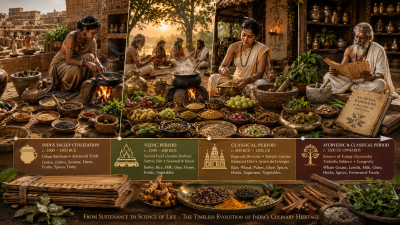
The culinary heritage of ancient India is a synthesis of indigenous agricultural practices, religious philosophies, and the science of longevity. It spans from the proto-historic urbanism of the Indus Valley to the refined dietetics of the Vedic and Classical periods. This evolution is characterized by a transition from nomadic pastoralism to a sophisticated “science of eating” (Ayurveda), which continues to define the Indian palate today.
The Harappan Foundation: Proto-Historic Sophistication
Archaeological excavations at sites such as Mohenjo-daro, Harappa, and Kalibangan provide the earliest evidence of a structured culinary system in the Indian subcontinent.
- Agricultural Base: The Harappans followed a multi-cropping system. Winter (Rabi) crops included wheat and barley, while summer (Kharif) crops included millets and rice (evidenced at Lothal and Rangpur).
- The World’s First Curry: Analysis of starch granules from ceramic pots reveals the use of turmeric, ginger, and garlic. This “triad” suggests the origin of the spice-based cooking now synonymous with India.
- Technological Advancement: The presence of underground and overground ovens (Tandoors) at Kalibangan indicates advanced pyrotechnology. Saddle querns were used for grinding grain and spices.
- Dietary Diversity: They consumed a mix of plant-based foods and animal protein, including cattle, sheep, and aquatic resources like fish and mollusks. Lipid residue analysis confirms the early processing of dairy into curd and ghee.
Vedic Culinary Philosophy: Food as a Cosmic Principle
The Vedic period (c. 1500–500 BCE) shifted the focus from mere sustenance to the spiritual and physiological impact of food.
- Annam Brahma: The Upanishads treat food as a manifestation of the divine. The Bhagavad Gita later codified food into three categories: Sattvic (pure), Rajasic (stimulating), and Tamasic (heavy/stale).
- The Ghee Economy: Clarified butter (Ghrita) became the “liquid gold” of the Vedic diet, used in both daily meals and ritualistic offerings (Yagyas).
- Dairy Dominance: The Cow was termed Aghanya (not to be killed), leading to a diet rich in milk (Kshira), curd (Dadhi), and fresh butter (Navanita).
- Staple Transitions: While the Rig Veda emphasizes Yava (barley), the Later Vedic texts see the rise of Vrihi (rice) and Godhuma (wheat).
Ayurveda and the Science of Dietetics
Ayurveda transformed Indian cooking into a preventive healthcare system by categorizing ingredients based on their “energetic” properties.
- The Shad-Rasa (Six Tastes) Framework: A balanced meal must ideally incorporate all six tastes to maintain the equilibrium of the Tridoshas (Vata, Pitta, and Kapha).
| Rasa (Taste) | Element Association | Function in Body | Examples |
| Madhura (Sweet) | Earth + Water | Tissue building | Grains, Milk, Honey |
| Amla (Sour) | Earth + Fire | Digestion stimulation | Lemon, Curd |
| Lavana (Salty) | Water + Fire | Lubrication | Rock Salt |
| Katu (Pungent) | Fire + Air | Metabolism boost | Ginger, Pepper |
| Tikta (Bitter) | Air + Space | Detoxification | Neem, Turmeric |
| Kashaya (Astringent) | Air + Earth | Moisture absorption | Beans, Pomegranate |
- Concept of Agni: Cooking focused on “kindling” the digestive fire (Jatharagni) using spices like Cumin, Asafoetida (Hing), and Black Pepper.
- Viruddhara (Incompatible Foods): Ayurvedic texts warned against toxic combinations, such as milk with fish or heating honey, which were believed to create metabolic toxins (Ama).
Culinary Practices in the Mauryan and Gupta Eras
During the Classical period, culinary arts became a matter of statecraft and refined urban living.
- Arthashastra Records: Kautilya’s treatise provides detailed regulations on the Superintendent of Granaries (Panyadhyaksha) and prescribes rations for different classes of society.
- Introduction of New Crops: Increased trade with the Roman Empire and Southeast Asia led to the popularization of exotic spices and fruits.
- Sophisticated Sweets: The Gupta period is often called the “Golden Age” of Indian sweets. Documents mention Apupa (honey-soaked cakes) and Samyava (a precursor to Halwa made of wheat flour, ghee, and milk).
Key Ancient Indian Food Terms for UPSC Prelims
- Karambha: A Rig Vedic dish made of parched barley meal mixed with curd or butter.
- Purodasha: A sacrificial cake made of ground rice or barley, used in Vedic rituals.
- Odana: Boiled rice, often mixed with pulses (Mudgoda) or meat (Mamsodana).
- Saktu: Flour made from parched grains; a common portable food for ancient travelers.
- Madhu-Parka: A ceremonial offering made of honey, curd, ghee, sugar, and water.
- Kshir-Prakara: An early version of modern Kheer, mentioned in various ancient Sanskrit texts.
Regional Diversification and Evolution
As the civilization expanded, regional variations emerged based on the local ecology:
- Magadha (East): Predominance of rice and freshwater fish.
- Avanti (Central): Known for wheat-based preparations.
- Dravidian South: Extensive use of coconut, tamarind, and fermented rice-based batters, as noted in early Sangam literature.
Summary Table: Evolution of Key Ingredients
| Period | Key Staple | Primary Sweetener | Cooking Medium |
| Indus Valley | Barley, Wheat, Millets | Dates, Honey | Sesame/Mustard Oil |
| Early Vedic | Barley (Yava) | Wild Honey | Ghee (Ghrita) |
| Later Vedic | Rice (Vrihi), Wheat | Jaggery (Guda) | Ghee, Sesame Oil |
| Classical Age | Rice, Wheat, Pulses | Sugarcane, Honey | Ghee, Various Oils |